The debate over Flock license plate readers in Murfreesboro reached the city council chamber on Thursday night, when roughly a dozen residents lined up to tell elected officials they want the cameras gone. What followed was a compact version of a fight now playing out in towns across America: how much surveillance is a community willing to accept in exchange for a safer street?
What Residents Told the Council
The tone from the podium was direct rather than technical. Speakers were not debating the finer points of data architecture. They were making a values argument.
Sidney Ware framed it plainly, telling council members she does not accept the idea that public safety should be purchased with residents’ privacy. It was a sentiment several others echoed in different words over the course of the evening.
Jay Hill, who launched a petition opposing the city’s use of the cameras, went further and challenged the council’s mandate outright. In his view, the officials backing the technology are out of step with the people they represent, and residents simply do not want the system in place.
That claim — that the council is in the minority — is the crux of the local dispute. Supporters see a tool with measurable results. Opponents see a decision made without genuine community buy-in.
The Case for Keeping the Cameras
Not everyone in the room was opposed. One speaker, identified as Maxwell, offered a defence built on outcomes rather than ideology.
His argument had three parts:
- The technology has produced real assistance for police work
- Guardrails and constraints already govern how it is used
- Public input is a feature, not a threat, and can make the system stronger over time
That last point matters. It reframes nights like Thursday as part of the oversight process instead of an attack on it — a position that allows supporters to acknowledge criticism without conceding the underlying policy.
How License Plate Readers Actually Work
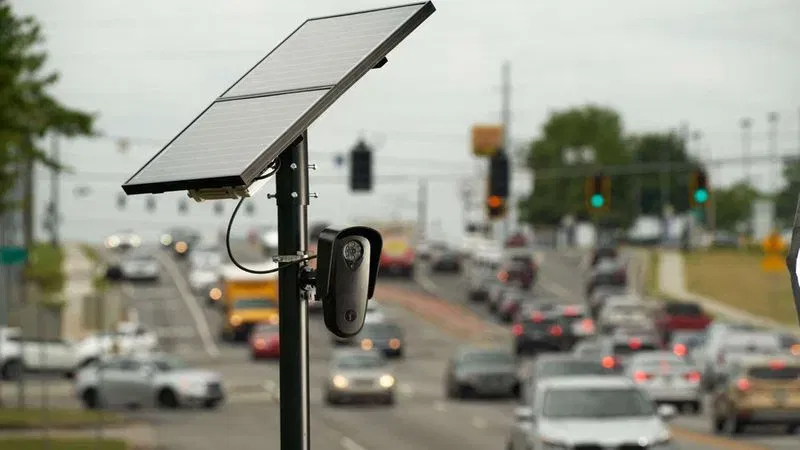
Automated license plate recognition cameras photograph passing vehicles, convert the plate into readable text, and log the result with a timestamp and location. The record is stored in a searchable database that participating agencies can query.
The technology is unremarkable on its own. What generates controversy is the accumulation. A single photograph of a car at an intersection tells you almost nothing. Thousands of such records, gathered across a city over weeks, can sketch a detailed picture of where someone goes, when, and how often — including trips to a doctor, a place of worship, a lawyer’s office or a political meeting.
That gap between individual data points and aggregate insight is where most privacy objections live.
Flock Announces Nationwide Changes
The company at the centre of the debate has signalled it is adjusting course. Flock CEO Garrett Langly recently announced a set of product changes scheduled to take effect on January 1, 2027.
The three headline measures are:
- A mandatory audit tool designed to flag unusual or abnormal search activity
- A reduced data retention period, dropping from 30 days down to seven
- A requirement that every search be linked to a specific case through an entered code
Each addresses a distinct criticism. The audit tool responds to worries about officers running searches for personal reasons. The shorter retention window shrinks how much historical movement data exists to be misused in the first place. The case-code requirement creates a paper trail, making every query attributable.
Whether that satisfies critics is another question. Some will read the changes as meaningful accountability. Others will note that the company is still the one setting the rules, and that policies adopted voluntarily can be revised just as easily.
Why This Argument Keeps Repeating
Murfreesboro is not unusual. Similar confrontations have unfolded in cities of every size, and they tend to follow a familiar shape.
Police departments adopt the cameras quickly, often citing stolen vehicle recoveries and assistance with active investigations. The systems are relatively cheap and require little training. Results arrive fast.
Residents typically learn about the deployment after the fact. By the time a public meeting happens, the cameras are already installed and generating data, which shifts the burden onto opponents to argue for removal rather than onto officials to justify installation.
The result is a mismatch in momentum. One side is defending something operational; the other is asking to undo it.
The Questions Still Unanswered
Thursday’s meeting surfaced concerns but did not resolve them. Several practical issues remain on the table for Murfreesboro and cities like it:
- Who exactly can access the database, and under what authority
- Whether outside agencies, including federal ones, can query local data
- What happens to a resident who is wrongly flagged
- How the public can verify that stated policies are being followed
- Whether any of it requires council approval to change
Answers to those questions matter more than the general principle. Two cities can run identical hardware and end up with very different levels of accountability depending on how they handle access, sharing and review.
Where Things Go From Here
For now, the cameras stay and the petition circulates. Residents have made their position public, at least one speaker has defended the program on the record, and the vendor has promised tighter controls arriving in 2027.
The council’s next move will determine whether Murfreesboro treats this as a settled matter or an open one. Either way, Thursday demonstrated something worth noting: the people showing up to these meetings are not asking to be less safe. They are asking who gets to watch them, for how long, and with what oversight — and those are questions a city can answer well or badly, but cannot avoid.
Author
-
Lucienne Albrecht is Luxe Chronicle’s wealth and lifestyle editor, celebrated for her elegant perspective on finance, legacy, and global luxury culture. With a flair for blending sophistication with insight, she brings a distinctly feminine voice to the world of high society and wealth.