Putin’s visit to the Kuril Islands has triggered a sharp diplomatic protest from Japan, with Prime Minister Sanae Takaichi calling the trip absolutely unacceptable and restating Tokyo’s claim that the territory belongs to Japan.
It was the Russian president’s first ever visit to the disputed archipelago — a detail that gives the trip its weight.
Tokyo’s Response
Writing on X on Thursday, Takaichi said Japan had repeatedly asked Moscow to ensure the president did not travel to what Tokyo calls the Northern Territories, its designation for the disputed southern Kurils.
Those requests were ignored. Her language in response was unusually direct for Japanese diplomatic communication, describing the islands as inherently Japanese territory.
Foreign Minister Toshimitsu Motegi added his own protest via Facebook, stating that Japan strongly objects to the visit.
What Putin Actually Did There
The Russian president travelled to Iturup, where Russia maintains a military base of considerable strategic value.
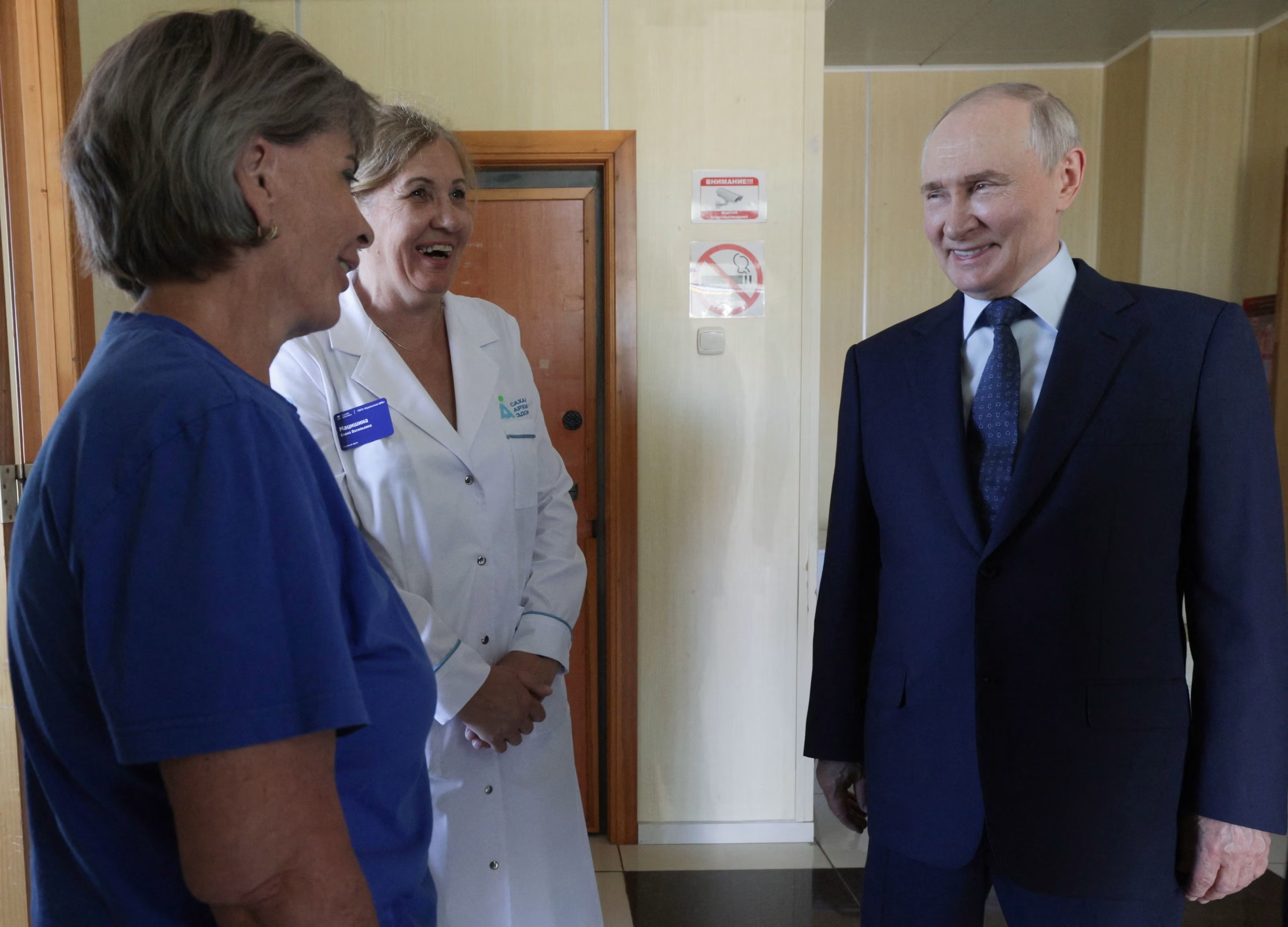
His itinerary was deliberately civilian in emphasis. He toured a fish-processing complex, a hospital and a school, then met Valery Limarenko, the regional governor of Sakhalin.
That programme choice is worth noting. Visiting schools and hospitals frames the islands as ordinary Russian communities requiring ordinary Russian governance — a subtler assertion of sovereignty than any military display would have made.
The Geography of the Dispute
The Kuril chain runs between the southern end of Russia’s Kamchatka Peninsula and the north-eastern corner of Hokkaido. Sparsely populated and volcanic, the archipelago forms the boundary separating the Sea of Okhotsk from the Pacific Ocean.
That position is the reason the islands matter militarily. Control of the chain shapes access between the Sea of Okhotsk and open ocean — significant for naval movement and for the security of what Russia treats as protected waters.
The four southernmost islands are the contested ones. The Soviet Union annexed them during its invasion of Japanese territory in the closing phase of the Second World War.
A Legal Knot Eighty Years Old
The dispute persists because the postwar settlement left it unresolved rather than settled.
Under the 1951 Treaty of San Francisco, Japan renounced all right, title and claim to the Kuril Islands. But the treaty did not recognise Soviet sovereignty over them, and Japan has never accepted that its renunciation covered the four southern islands it continues to claim.
That gap has blocked a formal peace treaty between Tokyo and Moscow ever since. The two countries did end their state of war through a joint declaration in 1956, but the territorial question was deferred rather than answered — and it has stayed deferred for seven decades.
The Defence White Paper Connection
Analysts at the Institute for the Study of War, a Washington-based think tank, read the visit as a calculated response rather than a routine regional trip.
Their assessment is that the Kremlin timed the visit to answer Japan’s newly published defence white paper and to undermine Takaichi’s efforts to strengthen Japanese defence capability.
Japan released the document earlier this month. It drew objections from Putin and from Russia’s ally North Korea, with the Russian president particularly critical of its identification of Moscow as one of the significant threats facing Japan.
The paper’s own language on the islands was pointed. It stated that Russia continues active military operations in the Northern Territories — described as inherent Japanese territory under illegal occupation.
Read alongside each other, the sequence is legible. Japan formally names Russia a threat and calls the islands occupied. Weeks later, Putin lands on one of them, tours a school, and meets the governor.
Why the Timing Signals More Than the Trip
A first-ever presidential visit carries symbolic freight that repeat visits do not. Previous Russian leaders have visited the Kurils, but Putin had not.
Choosing this moment converts a routine act of regional administration into a message. It says the islands are not merely held but governed, not merely governed but visited at the highest level, and that Japanese objection changes nothing.
For Takaichi, the difficulty is that Japan’s options are limited to protest. There is no mechanism through which Tokyo can prevent a Russian president from travelling to territory Russia controls.
What Comes Next
The immediate consequence is a further chill in a relationship that was already cold. Any prospect of movement on a peace treaty, always remote, moves further away.
The longer-term question concerns Japan’s defence trajectory. If the visit was intended to discourage Takaichi’s build-up, it may achieve the opposite — hardening domestic support for exactly the capabilities the white paper proposed.
Eighty years after the war that created it, the dispute remains where it has always been: unresolved on paper, settled on the ground, and periodically reactivated when one side decides to make a point.
Author
-
Lucienne Albrecht is Luxe Chronicle’s wealth and lifestyle editor, celebrated for her elegant perspective on finance, legacy, and global luxury culture. With a flair for blending sophistication with insight, she brings a distinctly feminine voice to the world of high society and wealth.