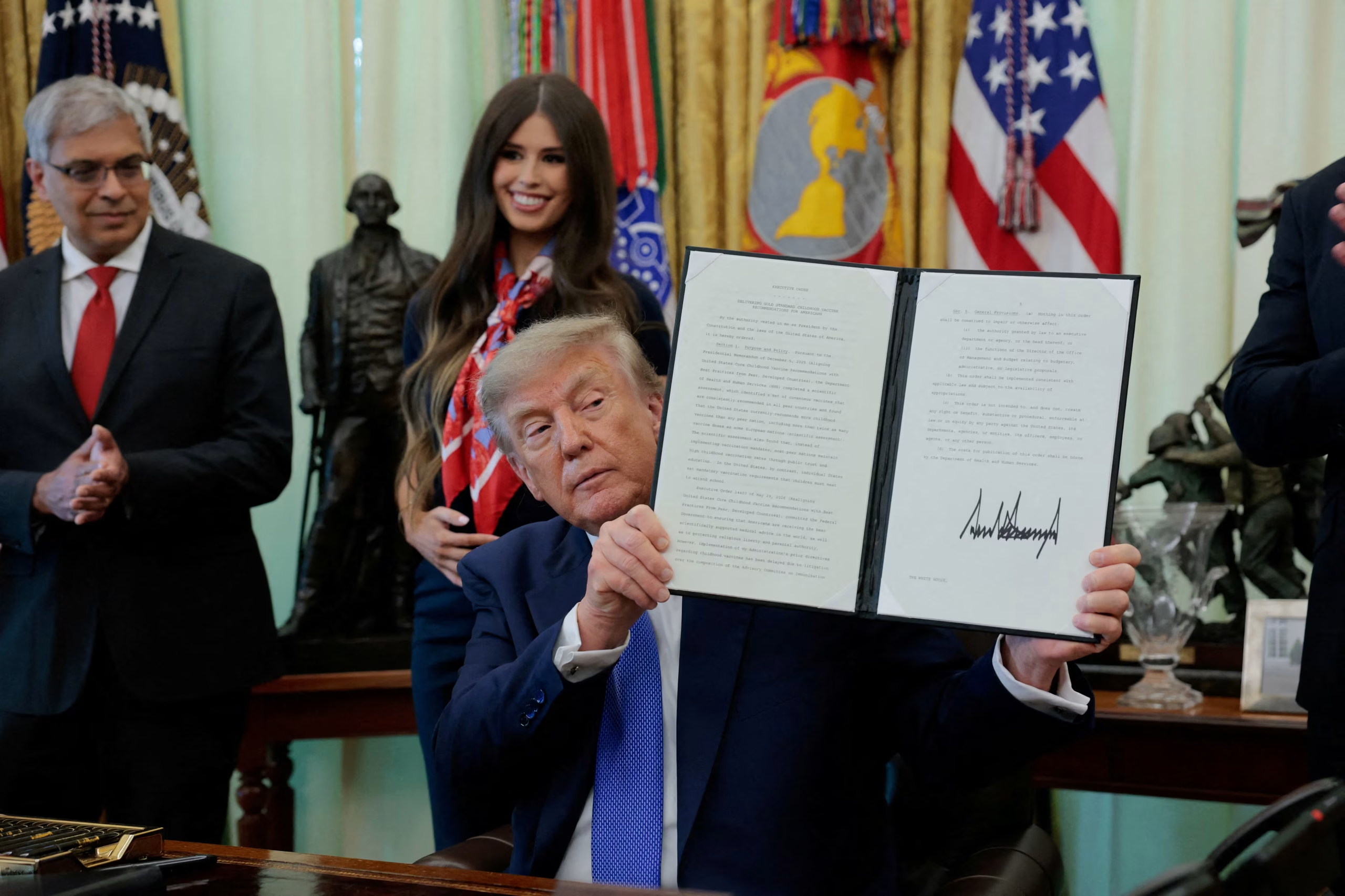
The MMR vaccine executive order signed by President Donald Trump this week has drawn immediate criticism from public health specialists, but the sharpest objections have less to do with ideology than with arithmetic. Splitting combination vaccines apart would require rebuilding a supply chain that has not existed in the United States for roughly fifty years — and asking parents to absorb the difference.
What the Order Actually Says
The directive, announced Monday, instructs federal officials to develop plans within 90 days for breaking the measles, mumps and rubella shot into three separate injections. It also calls for spreading out other childhood vaccinations across a longer timeline wherever that is feasible.
The White House frames this as expanding choice. Spokesman Kush Desai said the administration’s approach would give parents more control over timing and frequency for their children, and argued that this would ultimately lift vaccination rates against all three diseases.
The Manufacturing Problem
Here is the immediate obstacle: the individual vaccines the order envisions do not currently exist on the American market.
Every measles, mumps and rubella vaccine licensed by the Food and Drug Administration is a combination product. The three-in-one formulation has been the U.S. standard since the 1970s. Standalone versions are mainly used in lower-income countries that cannot afford the combined shot.
Merck, GSK and the small group of other firms supplying American childhood vaccines produce only the combination product.
Reviving separate versions would require:
- New clinical studies demonstrating that individual shots generate immune responses comparable to current products
- Construction of manufacturing plants capable of producing millions of additional doses
- Federal review and separate licensing of each unbundled vaccine
- Validation of new production facilities and procedures
Dr. Jesse Goodman, who previously led vaccine oversight at the FDA and now teaches at Georgetown University, noted that companies might be able to lean partly on data from the original standalone products — but that depends on the quality of that older evidence and how regulators view it decades later.
Industry estimates put the timeline for designing, building and securing approval of a new vaccine plant at around five years. The studies alone could run into tens of millions of dollars.
Goodman put the situation starkly, saying he knows of no comparable instance of dismantling a highly effective public health measure protecting infants without any documented scientific reason for doing so.
What It Would Mean at the Doctor’s Office
The current schedule is straightforward. The MMR shot is given in two doses — one around age 1, the second after age 4.
Separating it into three components turns two appointments into six. Spacing out other vaccines, including those for pertussis, would multiply visits further.
Dr. Anna Durbin of the Johns Hopkins Bloomberg School of Public Health described this as the core practical danger. As the number of required appointments climbs, more parents miss them or stop scheduling altogether. The result, she said, would be less convenience, higher cost and fewer children fully vaccinated.
She acknowledged that inconvenience is sometimes worth accepting. What she rejected was the premise here, saying there is no good justification for the change and calling it bad public health policy.
Providers would feel it too. Pediatric practices would need more appointment slots, more syringes and more staff time for the same number of protected children.
What the Evidence Shows
Research conducted in the United States and elsewhere has consistently found that combination vaccines improve the likelihood that children are fully protected against infectious disease before they enter school. Fewer visits means fewer opportunities for a family to fall off the schedule.
Merck addressed the question directly in a statement, saying no published scientific evidence demonstrates any benefit from separating the MMR combination into three individual shots. Both Merck and GSK defended the safety and effectiveness of their existing products, and neither indicated any intention to unbundle them.
The Political Background
Trump has argued for well over a decade — contrary to guidance from major medical organizations — that American children receive too many vaccines and that doses should be spread across a longer period. Last year he asked Health Secretary Robert F. Kennedy Jr. to examine reducing the number.
Officials have pointed to countries such as Denmark, which recommend marginally fewer vaccinations than the U.S. schedule.
Durbin raised an inconsistency in that comparison. Breaking apart combination shots would leave American children receiving considerably more individual injections than children in the countries being cited as models — the opposite of the stated goal.
The Order Cannot Force Anything
Perhaps the most important limitation is legal.
Neither the White House nor the FDA can compel a pharmaceutical company to develop a product or seek approval for one. Commercially, the incentive runs the other way.
Dr. Paul Offit, a vaccine researcher at Children’s Hospital of Philadelphia and a former government adviser, put the business logic plainly: manufacturers would be competing against their own existing products, with no reason to do so.
The order also cannot change school requirements. Authority to mandate vaccination for schoolchildren rests with state governments. The directive only suggests that states consider revising their laws to align with the administration’s position.
Offit predicted that states would simply disregard it, adding that Americans should not be turning to the president for medical guidance.
Where This Leaves Things
The order sets a 90-day clock for federal planning, but planning is not production. Without manufacturer participation, FDA licensure and state adoption, the practical effect may be limited to signaling.
The risk experts describe is subtler than a formal policy change: that public messaging encouraging delayed or divided vaccination erodes confidence in the existing schedule, and that coverage rates slip even if no shot is ever unbundled.
Author
-
Lucienne Albrecht is Luxe Chronicle’s wealth and lifestyle editor, celebrated for her elegant perspective on finance, legacy, and global luxury culture. With a flair for blending sophistication with insight, she brings a distinctly feminine voice to the world of high society and wealth.