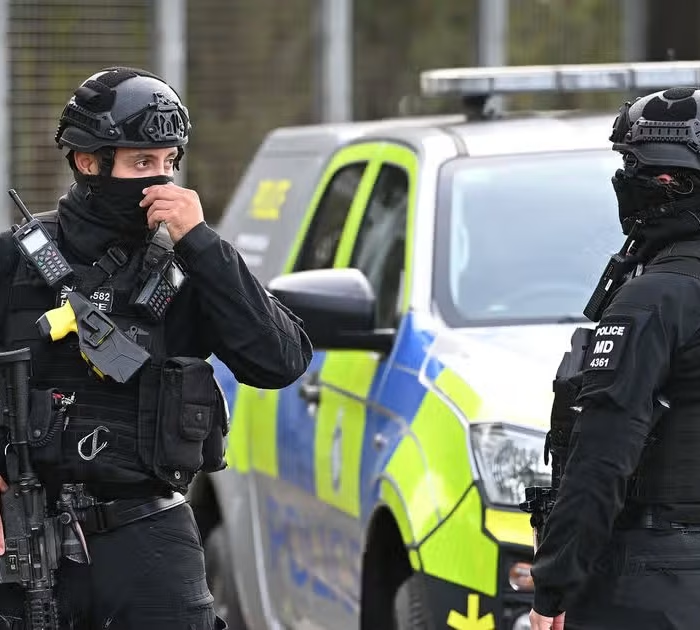
Ukrainian drone attack on Russia reached a scale not previously recorded in the conflict overnight, with Russian officials reporting at least six deaths, a massive warehouse fire outside Moscow, and interception figures running well into the hundreds.
The assault marks a turning point in a war that has increasingly become a contest of long-range strike capacity rather than territorial advance.
The Numbers Russia Reported
Moscow’s defence ministry said it destroyed 822 drones during the attack. Over the preceding 24-hour period, the ministry claimed to have brought down nine Ukrainian cruise missiles and 1,478 drones in total, figures that cannot be independently verified.
Mayor Sergei Sobyanin said roughly 600 drones were directed toward the capital region, with 201 destroyed. He described it to Tass as the largest air raid on Moscow in two years, though given how rapidly Ukraine’s capabilities have grown, it may well be the biggest single wave since the war began in 2022.
Andrey Vorobyov, governor of the Moscow region, characterised the operation as among the most massive drone attacks in recent memory.
The Warehouse That Burned
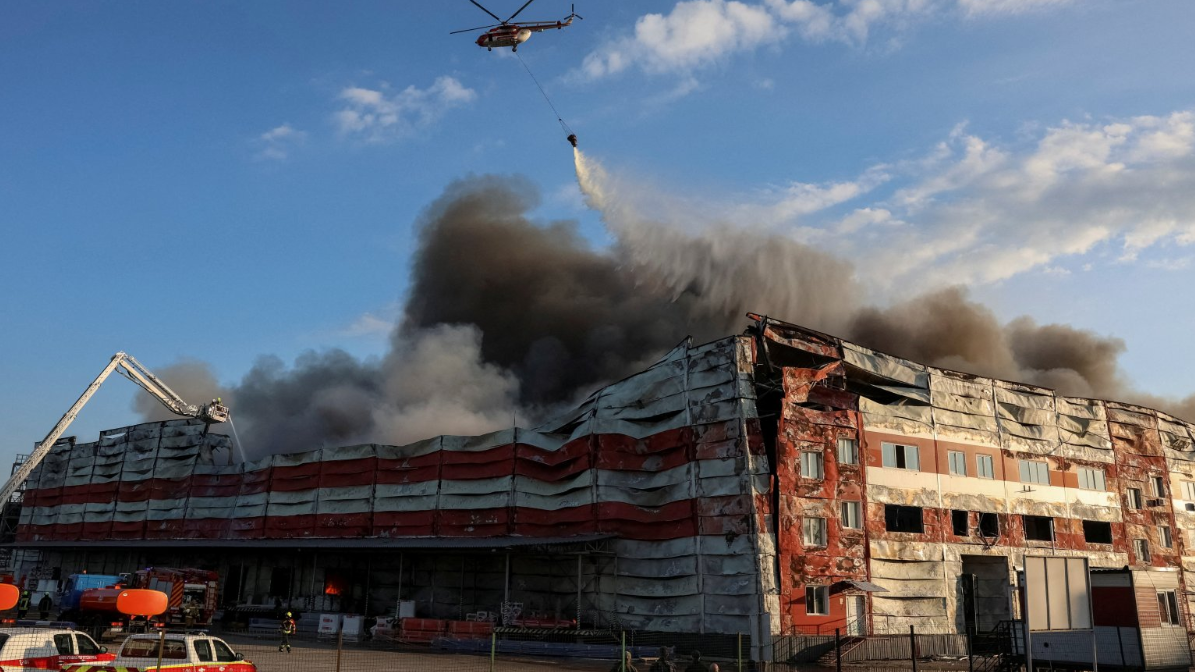
The most visually dramatic consequence unfolded in Podolsk, south of Moscow, where a distribution facility belonging to the Russian retail company Wildberries caught fire.
Photographs showed flames spreading across a structure covering roughly 200,000 square metres, with heavy black smoke rising above the site.
That target was not incidental. Over the past month, Kyiv has deliberately concentrated on Wildberries infrastructure, striking approximately 20 warehouses and associated buildings. The company underpins a substantial share of Russian online retail, and the strategy appears aimed at damaging the domestic economy while making the war’s costs tangible for ordinary Russian consumers.
It is economic warfare with a civilian-facing edge, and it raises the same uncomfortable questions that Russia’s own strikes on Ukrainian infrastructure have provoked.
Casualties on Both Sides
Five deaths were reported in Russia’s southern Rostov region, which borders Ukraine. The regional governor said an additional 150 incoming drones were destroyed there. One further death was reported in the Moscow area.
Russian strikes on Ukraine killed seven people during the same period, including two in the central city of Kryvyi Rih, two in the Sumy border region and three elsewhere.
A ballistic missile attack on Kyiv shortly before 3 a.m. injured six people and triggered multiple fires across the capital.
A Book Market Reduced to Ash
Among the destroyed sites in Kyiv was a substantial portion of the Petrovka book market in the Obolonskyi district.
Several booksellers reported losing their entire inventory in the blaze. It is a small loss measured against the war’s overall toll, but a resonant one, representing the erasure of a cultural fixture and the livelihoods of the traders who depended on it.
President Volodymyr Zelenskyy praised emergency crews and accused Russia of targeting civilians deliberately, stating that wherever Russian ballistic missiles can reach, civilian infrastructure is what gets hit.
The Weekly Tally
Zelenskyy said that over the past week alone, Russia had launched more than 1,550 attack drones, close to 1,560 guided aerial bombs and 62 missiles at Ukrainian cities and communities. The majority of the missiles were ballistic types.
That volume illustrates the intensity now defining the air war on both sides.
The Defensive Gap Ukraine Cannot Close
Buried in those figures is Ukraine’s most serious vulnerability.
Ukrainian forces have become highly effective at intercepting slower-moving drones, using a mix of mobile fire teams, electronic warfare and conventional air defence. Ballistic missiles are a different problem entirely.
These weapons travel at speeds that leave almost no reaction window. The only systems capable of reliably intercepting them are US-made Patriot batteries, and Ukraine’s supply of Patriot interceptor missiles has been depleted.
The practical result is that Ukraine can blunt drone swarms while remaining largely exposed to the fastest and most destructive category of incoming fire.
NATO Territory Enters the Picture
The overnight activity spilled beyond the two combatants. A Spanish F-18 operating as part of a NATO patrol mission shot down a drone at around 5 a.m. after it crossed into Romanian airspace.
A NATO military spokesperson said the drone appeared to be Russian.
Incidents of this kind have grown more frequent as strike volumes rise, and each one carries escalation risk. A NATO member’s aircraft engaging a weapon over its own territory is legally straightforward but politically delicate.
The Strategic Shift
The broader story is Ukraine’s transformation during 2026 into a genuine deep-strike power.
Kyiv can now reach targets up to 1,500 miles, or roughly 2,400 kilometres, from its border, putting warehouses, oil refineries, ports and military installations across a vast area within range. That effectively closes a gap that existed from the war’s opening days, when only Russia possessed meaningful long-range reach.
The timing matters. Both sides are now operating with air defence networks stretched close to exhaustion, meaning larger shares of incoming weapons get through.
What that produces is a war where offensive capability is expanding on both sides while defensive capability erodes on both sides. It is a dynamic that tends to increase casualties rather than settle outcomes, and there is little indication either side sees an off-ramp in the near term.
Author
-
Lucienne Albrecht is Luxe Chronicle’s wealth and lifestyle editor, celebrated for her elegant perspective on finance, legacy, and global luxury culture. With a flair for blending sophistication with insight, she brings a distinctly feminine voice to the world of high society and wealth.