The FIFA Balogun red card controversy has erupted into one of the most talked-about scandals in recent World Cup history, and at its center sits an unlikely figure: the President of the United States. What began as a routine disciplinary matter on the football pitch has spiraled into a heated debate about political influence, ethical standards, and the very independence of the sport’s global governing body.
A Bizarre but Predictable Storm
To many observers, the chaos unfolding around the tournament feels genuinely unprecedented. Yet according to experts, it isn’t entirely surprising. Given Donald Trump’s well-documented tendency to insert himself into matters far outside the political arena, some analysts suggest this collision between sport and politics was always waiting to happen.
The drama reached a boiling point when FIFA rejected Belgium’s appeal against the reversal of Balogun’s suspension, labeling the challenge “inadmissible.” That ruling landed just hours before the USA and Belgium were set to face off in their knockout clash in Seattle, adding an extra layer of tension to an already charged encounter.
How It All Started
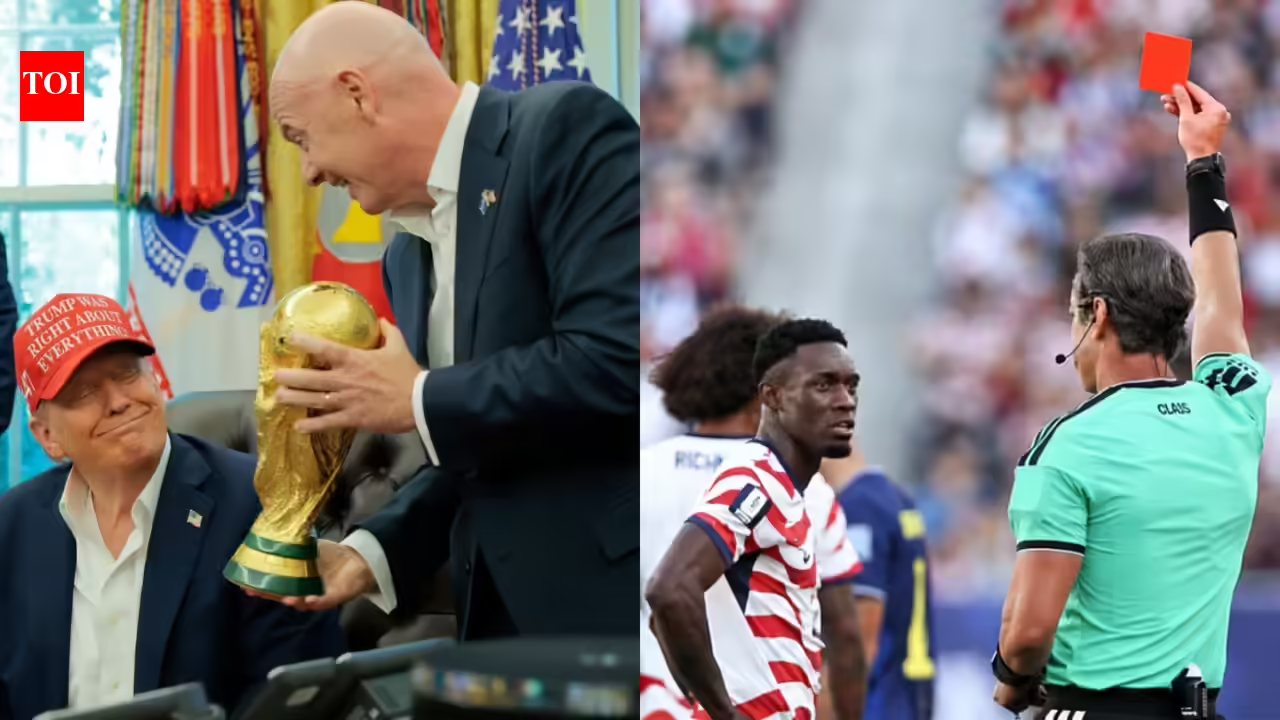
The saga traces back to a moment during the USA’s round-of-32 match against Bosnia and Herzegovina. American forward Folarin Balogun stepped awkwardly on the ankle of Bosnian player Tarik Muharemovic during his team’s 2-0 victory, an incident that earned him a red card and, with it, an automatic one-game suspension.
Under normal circumstances, that suspension would have sidelined Balogun for the crucial last-16 showdown against Belgium. But the situation took an extraordinary turn on Sunday when FIFA announced it had suspended the red card altogether.
The timing raised eyebrows immediately, because the reversal followed a direct appeal from Trump, who had personally urged FIFA chief Gianni Infantino to revisit the decision.
Trump’s Growing Grip on Global Football
The relationship between Trump and Infantino has never been a secret. However, this particular episode has spotlighted just how far the American president’s reach now extends into the world of football.
Simon Chadwick, a professor of Afro-Eurasian sport at the Emlyon Business School in Shanghai, didn’t hold back in his assessment. He argued that Trump’s “Make America Great Again” agenda is now fully visible on the international stage, running parallel to FIFA’s relentless pursuit of revenue.
Chadwick suggested that this clash had been brewing for a long time, describing it as an accident waiting to happen.
Interestingly, Trump had remained relatively quiet on football matters once the tournament kicked off. Before the World Cup began, he had been outspoken on several issues, including the Iranian team’s participation. Yet for roughly three weeks after the competition started, he refrained from commenting on any on-field incidents, until the Balogun controversy broke his silence.
According to Chadwick, this intervention felt almost inevitable. As the situation developed, he believed it was only a matter of time before Trump spoke up and Infantino ultimately gave in to his request.
Infantino Attempts Damage Control
Facing mounting criticism, Infantino moved quickly to defend FIFA’s integrity. In an official statement, the FIFA president insisted that the organization’s judicial committees operate independently and were solely responsible for reversing the suspension.
He emphasized that these bodies function autonomously, applying FIFA’s Disciplinary Code and deciding cases based on the relevant regulations and specific facts presented to them.
However, Infantino also openly acknowledged his conversation with Trump. He explained that he regularly discusses World Cup-related matters with the US president, framing it as part of his routine communication with heads of state, government officials, football stakeholders, and business leaders across the globe.
According to Infantino, during their exchange he informed Trump that a legal process involving FIFA’s independent judicial bodies was already underway, and that the case would be resolved in due course by the appropriate authorities. He stressed that this reflects how FIFA’s system operates, a principle he claimed he would always defend.
The FIFA chief further noted that he always reviews the decisions handed down by these bodies. Sometimes those rulings surprise him, sometimes he agrees with them, and sometimes he disagrees. Regardless, he maintained that he consistently respects both the decisions and the autonomy of those making them.
Critics Cry Foul
Not everyone was convinced by Infantino’s explanations. Chadwick, in particular, argued that FIFA’s own rules against third-party interference effectively collapsed the moment Trump got involved.
He described the handling of the Balogun case as highly irregular and a clear breach of established ethical standards. In his view, altering rules midway through a tournament, without proper consultation and under the influence of what he called an often-chaotic politician, sets a deeply troubling precedent.
The backlash has been swift and widespread. The decision sparked outrage directed at FIFA, generated sympathy for Belgium, and unleashed a wave of pointed jokes from national team coaches wondering whether they, too, might be able to appeal disciplinary actions against their own players.
Coaches and Legends Weigh In
The ripple effects reached other corners of the tournament almost immediately. After England defender Jarell Quansah was sent off during his team’s dramatic 3-2 victory over Mexico in the last 16, England manager Thomas Tuchel seized the opportunity to question the entire situation.
Speaking to reporters at Mexico City Stadium, Tuchel expressed genuine confusion. He wondered aloud who exactly overturns such decisions, when, and on what grounds. He questioned how far this new precedent might extend, calling the whole affair strange.
Perhaps even more striking was the intervention of Sepp Blatter, the former FIFA president who resigned in 2015 amid corruption allegations. Despite his own controversial history, Blatter joined the chorus of critics.
He argued firmly that red cards should be overturned by rules, evidence, and independent bodies, not by political phone calls. Blatter posed a pointed question about FIFA’s direction, warning that football must never become a playground for political power. His use of the Latin phrase “Quo vadis”, meaning “where are you going”, captured the sense of alarm surrounding the organization’s future.
A Dangerous Precedent
Chadwick shared Blatter’s concerns, raising a series of unsettling questions about what might come next. He wondered who else could benefit from such interventions, for what purposes, and to whose advantage.
In his estimation, FIFA appears to have overstepped its boundaries, allowing itself to become increasingly commercialized, geopoliticized, and, in his words, Americanized. The fear among critics is that this single decision could open the door to further political meddling in a sport that prides itself on fairness and independence.
Looking Ahead
As the dust settles on this remarkable episode, the questions it raises linger uncomfortably over the tournament. The FIFA Balogun red card controversy has become far more than a debate about one player’s suspension. It has evolved into a referendum on the integrity of football’s highest institution.
Whether FIFA can restore confidence in its independence remains to be seen. For now, the incident stands as a stark reminder of how easily the lines between sport and politics can blur, and how vulnerable even the world’s most popular game may be to outside influence. The football world will be watching closely to see whether this proves to be an isolated event or the beginning of a troubling new era.
Author