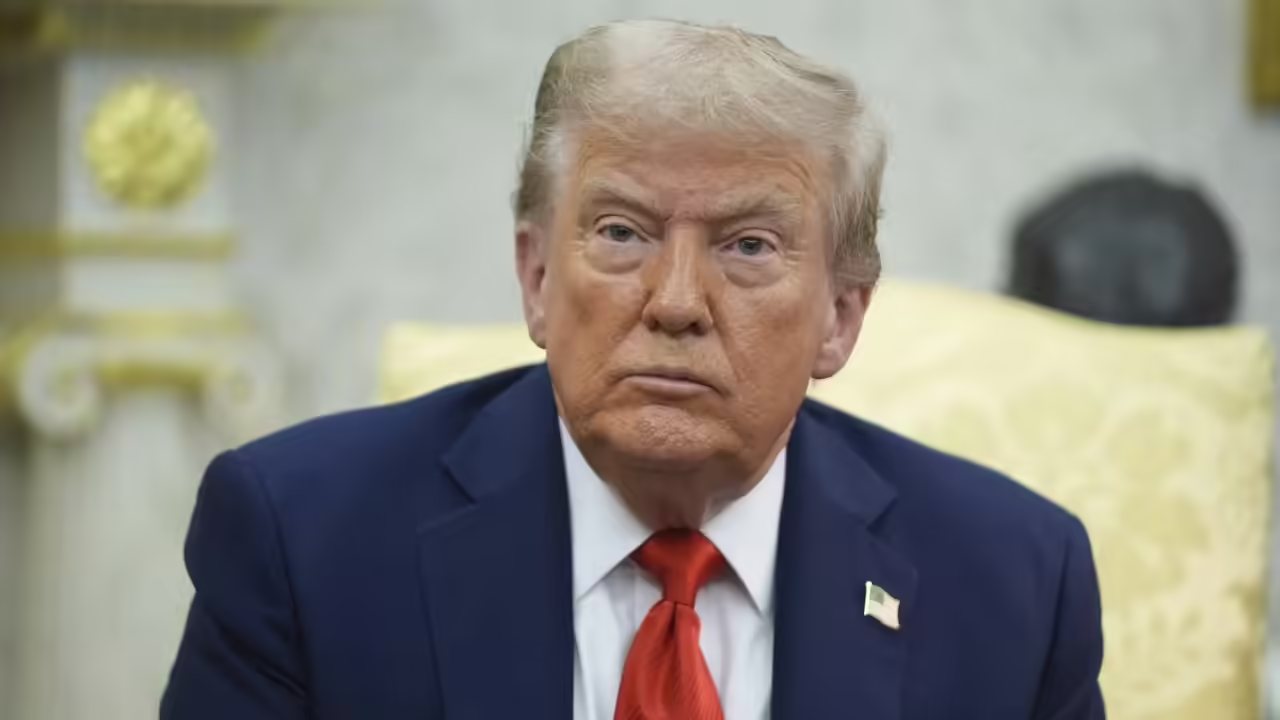
The Iran peace talks have rolled into a new month with little to show for it, and a visibly frustrated President Donald Trump is pushing back hard against those questioning his strategy. On Monday, he insisted that Tehran “really wants to make a deal,” even as fresh air strikes between the two nations reignited fears of a wider conflict.
His confident tone, however, stands in sharp contrast to events on the ground, where progress remains stubbornly out of reach.
Key Points at a Glance
- Trump claimed Iran is eager for an agreement, promising it will benefit the U.S. and its allies.
- His remarks came just after air strikes between the U.S. and Iran resumed over the weekend.
- Reports suggest Trump has requested several changes to the latest terms his envoys had negotiated with Iran.
Trump’s Defiant Message
Taking to Truth Social, Trump struck an optimistic note about the prospects of a deal, declaring that Iran genuinely wants an agreement and that any outcome would favor the United States and those aligned with it.
But much of his post was aimed squarely at his critics. He accused political opponents, whom he derisively labeled the “Dumocrats,” along with what he called unpatriotic Republicans, of making his job far harder. In his telling, the constant stream of commentary, demands to move faster or slower, to go to war or hold back, only complicates delicate negotiations.
His advice to the doubters was characteristically blunt: sit back, relax, and trust that everything will work out in the end, as he insists it always does.
Air Strikes Resume Near a Critical Chokepoint
Trump’s reassurances arrived against a tense backdrop. Over the weekend, air strikes between the U.S. and Iran flared up again, with both sides claiming to have struck military targets near the Strait of Hormuz.
That location matters enormously. The strait typically carries around 20% of the world’s oil traffic, making it one of the most strategically sensitive waterways on the planet.
According to U.S. Central Command, American forces carried out what it described as “self-defense strikes” on Iranian radar and drone command-and-control sites at Goruk and Qeshm Island. In response, Iran’s Islamic Revolutionary Guard Corps said it had targeted an air base used in the U.S. attack, framing the move as retaliation.
Sticking Points Behind the Scenes
While Trump projects confidence, the details suggest a more complicated picture. A report published over the weekend indicated that Trump had requested several amendments to the latest terms his negotiators had reached with Iranian officials.
Citing unnamed U.S. officials, the report said his concerns centered on several issues, most notably the question of Iran’s nuclear material. The accuracy of those claims could not be independently confirmed, but they hint at deeper disagreements that may be slowing the process.
Kuwait Caught in the Crossfire
The conflict’s reach extended further on Monday when Kuwait, sitting in the northwestern corner of the Persian Gulf, reported that its air defenses were intercepting missile and drone attacks.
The Kuwaiti army moved quickly to reassure the public, explaining that any explosions heard were the result of its defense systems intercepting hostile incoming fire rather than direct hits on the country. The episode underscored just how easily neighboring states can be pulled into the widening confrontation.
A Deal Promised, but Never Delivered
Trump has repeatedly suggested that Washington and Tehran have been on the verge of an agreement ever since a ceasefire took effect in early April. Yet in the weeks since, talks have shown little real movement.
That gap between rhetoric and results has not gone unnoticed by analysts watching the situation closely.
Markets May Be Too Hopeful
Guntram Wolff, a senior fellow at the Brussels-based think tank Bruegel, warned that market participants may be far too optimistic about the chances of a diplomatic breakthrough.
He pointed out that a good deal has been promised for a long time now, with more than 90 days having passed without one materializing. While he acknowledged that crafting a durable agreement takes time, he stressed that the underlying realities have not shifted.
In his assessment:
- Iran still holds significant capabilities to inflict serious damage.
- It retains the ability to disrupt the Strait of Hormuz.
- It continues to possess nuclear-enriched materials.
In short, the fundamentals that make this standoff so dangerous remain firmly in place.
Oil Prices Climb Amid the Uncertainty
The renewed tensions rippled quickly through energy markets. On Monday morning, oil prices pushed higher as traders reacted to the weekend’s escalation.
Brent crude futures for August delivery rose nearly 3% to around $93.74 per barrel, while U.S. West Texas Intermediate futures for July delivery climbed 3.3% to roughly $90.20 per barrel.
The gains followed a rough stretch for oil. The previous week, Brent and WTI had tumbled by 11.1% and 9.6% respectively, marking their worst weekly performance since mid-April. The sharp swings highlight just how sensitive markets remain to every twist in the U.S.-Iran standoff.
A Standoff With No Clear Exit
For now, the Iran peace talks remain locked in an uneasy limbo. Trump continues to insist a strong deal is within reach, urging patience and dismissing his critics as noise. Yet with air strikes resuming, neighboring countries coming under fire, and analysts cautioning that nothing fundamental has changed, the path to a genuine agreement looks as uncertain as ever.
Whether Trump’s confidence proves justified or premature will depend on what happens in the coming weeks, as a fragile ceasefire continues to fray and the stakes for the wider region grow ever higher.
Author