Israel Orders Evacuation of Ancient Tyre, Forcing Residents to Flee a 4,700-Year-Old City
The Tyre evacuation order issued by Israel has placed residents of one of the world’s oldest cities in an agonizing position: remain and risk death from airstrikes, or leave and become displaced within their own country. For the people of this ancient Lebanese coastal city, neither choice offers comfort, and many families are now scattered between those who fled north and those who stayed behind.
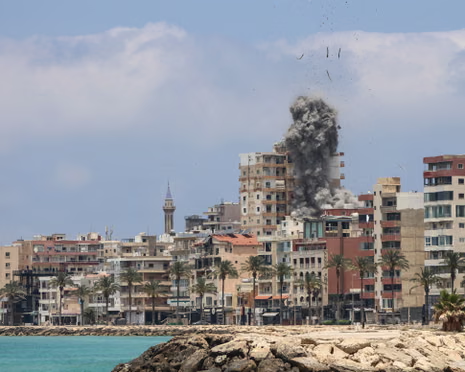
The latest order marks a significant escalation. For the first time since Israel launched its current offensive into southern Lebanon to dismantle Hezbollah, the evacuation now extends to Al Hara, the historic Christian quarter of a city that has stood for more than 4,700 years.
A Quarter That Believed Itself Safe
For residents of Al Hara, the order shattered a long-held sense of security. Janette Barbour, a married mother of three grown children, told NBC News she never imagined being forced to leave the neighborhood she considered safe, emphasizing that its residents are unarmed civilians.
When Israel first began striking Hezbollah positions in southern Lebanon earlier this year, most people in Al Hara chose to stay, even as the conflict crept closer to Tyre. Barbour explained that families managed the danger carefully. If some members left for medical reasons, others always remained behind, reinforcing the community’s conviction that their corner of the city would be spared.
That belief, however, collided with Israel’s military assessment. The Israelis contend that Hezbollah, the Shia Muslim militant group allied with Iran, is using Al Hara as cover to launch rocket and drone attacks across the border.
Families Split Between Staying and Fleeing
As the strikes on Tyre intensified, Barbour joined the exodus heading north toward Beirut. She described leaving in the morning with her daughter, intending to stay with her brother in the capital.
Yet her departure meant splitting her family apart. Her husband and son remained in Al Hara, unable to abandon the businesses that anchor their lives. Her son runs a café in Tyre, while her husband operates a restaurant at the Tyre port, which falls within Al Hara itself. For them, walking away from their livelihoods was not an option.
Barbour also noted that many of the city’s older residents refused to leave their homes. Despite her fear, particularly with part of her family still there, she clung to the hope that Al Hara’s status as a neutral area, free of political parties and weapons, might protect it from attack.
A City Shaped by Centuries of Siege
Tyre’s history is one of repeated conflict stretching back millennia. Founded by the ancient Phoenicians, the city has endured numerous sieges over the centuries, including by Alexander the Great and later the Crusaders. Since 1978, it has been bombarded repeatedly by Israeli forces.
In peacetime, though, Al Hara presents a very different face. The quarter, designated a UNESCO World Heritage site, has long drawn waves of tourists eager to admire its ancient beauty and enjoy some of the finest sandy beaches along the Mediterranean. That contrast, between a cherished cultural treasure and a repeated target of war, defines much of the city’s modern existence.
Those Who Choose to Remain
Not everyone has fled. A worker at an Al Hara hotel, who asked that neither he nor his workplace be identified out of fear of becoming a target, said most of his guests had already left. He described having around 10 people still in the hotel, some unwilling to leave Tyre and others simply unsure of where they could go.
The worker said he intended to stay as well, even as most of his neighbors departed. He acknowledged that fear was a natural human response, but noted something striking: for the first time, many families had actually left Al Hara, a sign of just how serious the current situation has become.
Damaged Homes and Scattered Loved Ones
For others, this is not the first time war has reached their doorstep. Lily Hawila, a 29-year-old English teacher, lives in a section of Tyre called Al Houch, a few miles from Al Hara. She has fled the city, but her connection to it remains fraught with loss.
Hawila recalled that her area was attacked during the 2024 war, leaving her apartment with shattered glass and broken doors. The family repaired the damage after a ceasefire took hold in November 2024. Now, she has no idea what condition her apartment is in, though she is certain that buildings throughout her street and others nearby have been reduced to rubble.
When the fighting resumed, Hawila arranged an apartment in the Chouf Mountains northeast of Tyre for her mother and her brother, who lives in Poland and had returned home for a visit. Her father, however, refused to leave, choosing to stay with his elderly mother in Al Bass, another part of Tyre that she described as far from safe.
A Cycle of Displacement and Return
For some families, evacuation has become a grim and repeated ritual. Sana Abou Zeid, a 50-year-old mother of three grown children, lives in a densely populated part of Tyre called Al-Masaken. She explained that each time an Israeli evacuation order comes, she takes her children outside the city to wait, returning home only once it is deemed safe.
Her ties to Tyre run deep. Her eldest son serves in the Lebanese army, while her youngest is still in high school, and none of them can picture life anywhere else. As Zeid put it, she cannot leave Tyre because her children refuse to.
But the danger is immediate and unrelenting. Even as Zeid spoke with a reporter, she received devastating news: her street had been bombed, and eight people had been killed. Shaken, she expressed a fragile hope that her family might be able to stay where they were rather than face yet another displacement, and that they could one day return home.
The Human Cost of a Strategic Battle
Behind the military objectives lies a profound human toll. Israel frames its campaign as a necessary effort to root out an Iran-backed militant group it accuses of embedding itself within civilian areas. For the residents of Tyre, however, that strategic logic translates into shattered homes, fractured families, and the painful choice between safety and belonging.
The inclusion of Al Hara in the evacuation order has stripped away one of the last places residents believed could remain untouched. As airstrikes continue and the death toll rises, the people of this ancient city are left holding onto hope, hope that their neighborhoods might be spared, that their loved ones might survive, and that they might someday come home to a city that has weathered conquest and siege for thousands of years.
Author