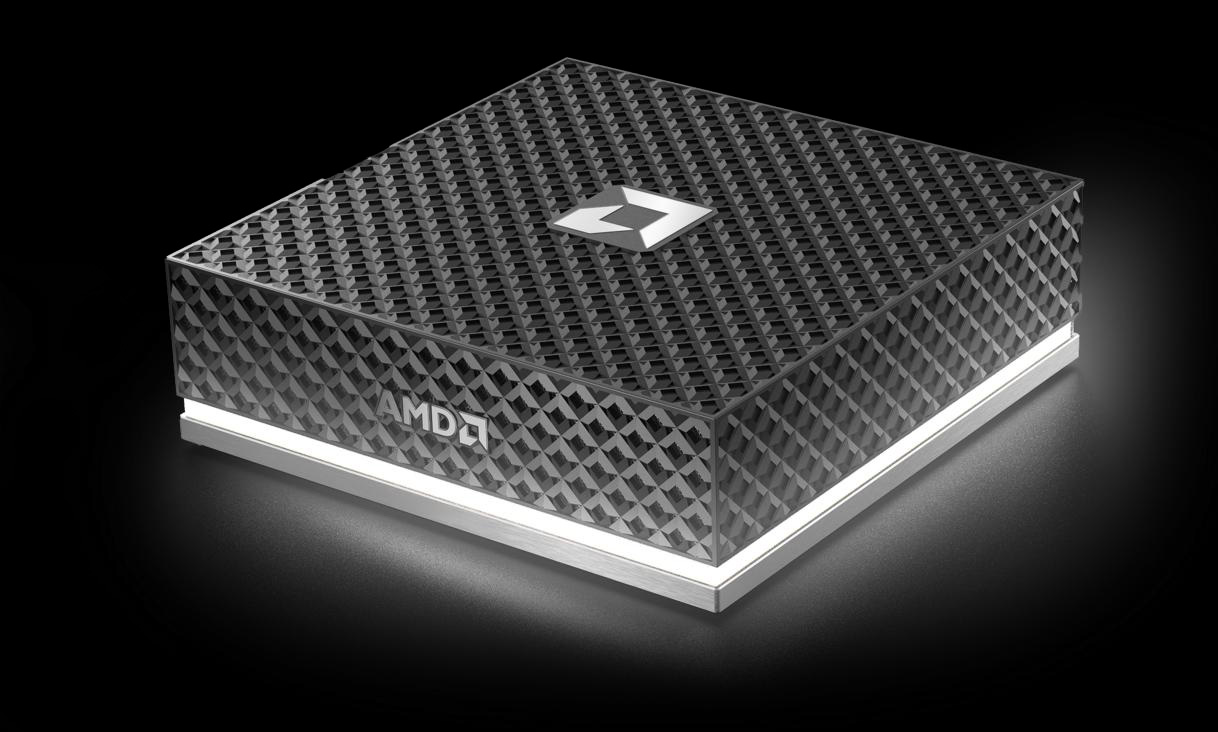
AMD Ryzen AI Halo PC Pricing Revealed Alongside Next-Generation Ryzen AI Max 400 Chips
The AMD Ryzen AI Halo PC has officially received its price tag, and the company is making a bold statement to anyone still relying heavily on cloud-based artificial intelligence services. AMD’s message for the year ahead seems straightforward: stop paying expensive monthly fees for AI processing power and bring that capability directly to your desk instead. The compact yet powerful machine is set to begin at three thousand nine hundred ninety-nine dollars, with preorders kicking off in June.
A Tiny System with Massive Ambitions
First introduced earlier this year at CES, the Ryzen AI Halo PC stands out for its impressively small footprint. It is roughly the size of a Mac Mini but packed with serious computational muscle aimed squarely at developers and AI professionals. The starting configuration comes equipped with Ryzen AI Max 300 series processors, while a future variant featuring the brand new Ryzen AI Max 400 chips has also been confirmed.
This release signals AMD’s commitment to carving out a meaningful place in the rapidly expanding personal AI hardware space. Rather than just announcing chips, the company is delivering an entire compact workstation ready to handle demanding workloads right out of the box.
Why the Price Tag Might Actually Make Sense
A four thousand dollar machine sounds steep on paper, especially for individual users. AMD, however, is framing the Halo PC as a long-term money saver rather than a luxury purchase. Many developers currently spend hundreds or even thousands of dollars every month on cloud-based AI tokens, and those costs can stack up quickly.
The company laid out a clear example. Someone spending around seven hundred seventy-three dollars per month to process six million daily AI tokens could theoretically break even on the Halo PC within just six months. For heavier workloads, AMD points to its Radeon R9700 Pro GPU, also priced near four thousand dollars, which it claims could pay for itself in just three months for users running eighteen million daily tokens at over two thousand dollars in monthly cloud charges.
In short, this is a calculated bet that local AI computing is more affordable in the long run than continuing to rent computational power from cloud providers.
Going Head to Head with NVIDIA
It is no secret who AMD is targeting with this release. The Ryzen AI Halo PC is built to compete directly against NVIDIA’s DGX Spark AI workstation, which originally launched at four thousand dollars and now sells for around four thousand six hundred ninety-nine. The two devices share some similarities but also differ in ways that could matter for developers making a choice.
One major advantage of the AMD machine is operating system flexibility. The Halo PC runs on an x64 chip, allowing it to operate either Windows or Linux depending on user preference. NVIDIA’s DGX Spark, by contrast, is limited strictly to Linux. For developers who prefer or require a Windows environment, this alone could be a deciding factor.
Hardware Strengths Worth Noting
The Halo also brings impressive specifications under the hood. It features a fifty TOPS neural processing unit alongside a Radeon GPU with forty compute units, splitting AI workloads across dedicated hardware components. NVIDIA’s DGX Spark relies more heavily on its Blackwell graphics processor for everything AI related.
Both systems include one hundred twenty-eight gigabytes of unified system memory, which is a critical specification for running large language models locally. That memory capacity actually exceeds what is available on either the Mac Mini or Mac Studio, both of which have become favorites among independent AI developers. For users running heavy models, that extra memory headroom is more than just a number on a spec sheet.
Meet the New Ryzen AI Max 400 Series
Looking ahead, AMD has even bigger plans with its upcoming Ryzen AI Max 400 chip lineup. Leading the charge is the Ryzen AI Max Plus Pro 495, a sixteen core processor that pushes boost clock speeds up to five point two gigahertz. The chip pairs that raw computing power with a fifty-five TOPS neural processing unit and integrated Radeon 8065S graphics.
Perhaps even more impressive is the memory support. The new chips can handle up to one hundred ninety-two gigabytes of unified memory, enabling as much as one hundred sixty gigabytes to be allocated to GPU VRAM. That kind of capacity opens doors for running larger and more complex models entirely on local hardware without compromise.
On paper, the performance jump over the existing Ryzen AI Max 395, which runs at a five gigahertz boost speed, looks modest. However, official benchmark comparisons have not yet been released, so the true gap between generations remains to be seen. AMD has confirmed that these new chips are scheduled to launch sometime in the third quarter of 2026.
Who Should Consider Buying This System
To be clear, the Ryzen AI Halo PC is not designed for everyday consumers. This is professional grade hardware aimed at developers, researchers, AI engineers, and businesses serious about handling artificial intelligence workloads on local machines. Gamers, students, and casual users will find much better value in standard consumer hardware.
For those who fit the target audience, however, the math could be very compelling. Owning the hardware outright means full control over data privacy, no recurring subscription costs, and the ability to work offline whenever needed. Cloud computing has its perks, but for power users running constant workloads, the savings could add up significantly over a year or two.
The Bigger Picture for Local AI
AMD’s strategy reflects a broader industry shift. As AI tools become deeper parts of professional workflows, demand for local computing solutions continues to grow. Cloud providers are facing pushback over rising costs and concerns about data sovereignty. By offering capable hardware at a fixed price, AMD is positioning itself as an attractive alternative for users who want predictability and ownership.
The launch of the Ryzen AI Halo PC alongside the upcoming Max 400 chips suggests that the battle for AI workstation dominance is just heating up. With NVIDIA already in the ring and Apple silicon continuing to attract developers, the competition could mean better hardware and pricing for everyone in the years ahead.
Author