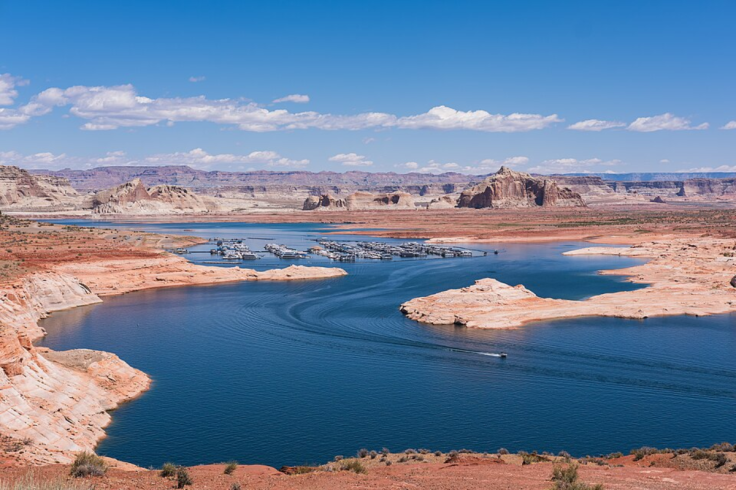
Lake Powell record low readings arrived over the weekend, and the numbers carry consequences well beyond a shrinking shoreline. The reservoir on the Arizona-Utah border sank to a surface elevation of 3,519.91 feet on Saturday, edging past the previous low of 3,519.92 feet set in April 2023. By Sunday it had fallen further, to 3,519.8 feet, according to U.S. Bureau of Reclamation data.
The margin between where the lake sits now and where serious infrastructure failure begins has narrowed to roughly 30 feet.
The Threshold That Matters
Glen Canyon Dam sits at the southern end of the reservoir, just inside Arizona. Its turbines stop producing electricity once the water drops below 3,490 feet.
At that point, according to a Bureau of Reclamation release issued in April, releases would have to move through four bypass tunnels known as river outlet works. These channels route water around the hydroelectric turbines entirely.
The agency has been direct about what follows. Depending solely on the outlet works would destabilize both regional power and water supplies while cutting generation substantially. Millions of people across the Southwest draw electricity produced at this dam.
A second, more severe threshold sits below that one. At 3,370 feet, the reservoir reaches dead pool — the point at which water can no longer pass through the dam at all.
How It Got Here
Three forces have converged over an extended period:
- Persistent drought conditions across the Colorado River Basin
- Thin snowpack from the most recent winter, which supplies the spring runoff the system depends on
- Decades of allocating more water than the river actually produces
That third factor is structural rather than seasonal. The river’s flow was divided among states based on measurements taken during an unusually wet stretch of the early twentieth century, and the paper allocations have exceeded the physical supply for a long time.
Lake Powell and the Colorado River deliver water to more than 40 million people, per the bureau.
Seven States, Uneven Exposure
Arizona, Colorado, California, Nevada, New Mexico, Utah and Wyoming all draw from the basin. The pain is not evenly distributed.
Newsha Ajami, a hydrologist and environmental policy expert at Stanford University, told SFGATE that California, Nevada, Arizona and New Mexico face the sharpest consequences from the current decline.
Northern California residents might reasonably assume this is somebody else’s emergency. Ajami says that assumption misreads how the plumbing works. Bay Area communities depend far less on Colorado River water directly, but the state’s system functions as an interconnected whole. Southern California draws from both the Colorado and the Sierra Nevada, and when the Colorado falls short, the region turns toward supplies originating in the north.
She described the situation as an enormous crisis unfolding openly — a slow-moving disaster affecting people who genuinely depend on the water.
Food Supply Adds Another Layer
Water pulled from the Colorado also irrigates farmland producing crops that reach California markets and beyond.
Ajami pointed out that disruption to that supply chain reaches everyone, because the food system is deeply interconnected. Reduced irrigation in one region shows up later as tighter supply and higher prices somewhere entirely different.
Lake Mead Is in the Same Condition
The problem is not confined to one reservoir. Lake Mead, the largest in the country, has also set record lows this month. Located on the Arizona-Nevada border near Las Vegas, it fell to 1,040.4 feet on Aug. 7, according to the Associated Press, and stood at 1,039.86 feet as of Monday afternoon.
Its own dead pool sits near 900 feet. Reaching it would halt downstream flows, cutting off water relied upon by Native American tribes and major cities including Los Angeles, as the New York Times has reported.
Declining levels at Mead have brought additional problems: reduced generation at Hoover Dam, hazards for boaters as submerged features approach the surface, and conditions favorable to toxic algae growth.
Historically Unprecedented
Jack Schmidt, who directs the Center for Colorado River Studies at Utah State University, told ABC News that the region has entered completely new territory.
His comparison puts the scale in perspective. Combining the contents of both reservoirs, he said, the last time storage was this low was 1957 — before Lake Powell existed at all. He called the current conditions truly unprecedented.
That framing matters because the two reservoirs were built specifically to buffer against drought years. A system designed as insurance is now itself the thing running out.
Infrastructure Nobody Thinks About
Ajami argued that officials and communities need to direct far more resources toward the river, the dams and the supporting infrastructure.
Part of the difficulty, she said, is invisibility. Water systems stay out of sight and therefore out of mind. Many people have no clear sense of whether they depend on this water, how essential it is to their daily lives, or how completely their livelihoods rest on it functioning.
That gap between dependence and awareness may be the hardest part of the problem to solve. Reservoir levels can be measured precisely. Public attention cannot, and it tends to arrive only after the taps and the lights have already been affected.
Author
-
Lucienne Albrecht is Luxe Chronicle’s wealth and lifestyle editor, celebrated for her elegant perspective on finance, legacy, and global luxury culture. With a flair for blending sophistication with insight, she brings a distinctly feminine voice to the world of high society and wealth.