Gaza reconstruction disarmament conditions were laid out bluntly this week by US envoy Jared Kushner, who said the Trump administration will not permit rebuilding in the territory until Hamas surrenders its weapons. The statement came after talks with Israeli Prime Minister Benjamin Netanyahu on Monday failed to produce agreement on implementing a roadmap Hamas has already accepted.
Speaking to Fox News, Kushner said a reconstruction plan exists but will remain shelved until demilitarisation takes place. Nobody wants to invest further in a place with this history, he argued, if the result is takeover by armed groups or renewed destruction.
Where the Roadmap Stands
The US-backed framework called for Hamas to disarm as part of a sequence that would also bring Israeli withdrawal and an end to attacks on the territory. Hamas agreed to those terms.
Israel rejected the proposal earlier this month, taking the position that it would offer no concessions until Gaza is fully demilitarised first.
That disagreement over sequencing is the entire impasse. One side wants withdrawal and disarmament to proceed together; the other wants disarmament completed before anything else moves.
Kushner, whose family maintains long-standing personal ties to Netanyahu, appeared in the interview to align with the Israeli position by stressing complete demilitarisation ahead of withdrawal.
The Question of Continued Strikes
Kushner also addressed Israeli military action directly, saying the administration would not restrict Israel’s right to defend itself against imminent threats, and that clarifying what that means had been necessary.
Israel has conducted near-daily attacks on Gaza. At least 1,265 people have been killed in the enclave since a ceasefire nominally took effect last year. The broader toll since October 2023 stands at 73,399 Palestinians killed.
Trump struck a different note earlier the same day, saying Israelis should not be striking in Gaza because Hamas had agreed to lay down its weapons.
The gap between the president’s statement and his envoy’s carve-out for self-defence leaves considerable ambiguity about what American policy actually requires.
Kushner’s Case to Israel
The envoy framed the arrangement as advantageous for Israel regardless of outcome.
If Hamas voluntarily hands over weapons and tunnels within the next 60 to 90 days, he said, that would remove an enormous security threat — an achievement he described as almost unthinkable.
If the group fails to follow through, his argument continued, its lack of sincerity about peace becomes visible to everyone, and Israel would then enjoy substantially more backing from the United States and others to finish the job in an appropriate manner.
That construction presents a diplomatic process whose failure produces license for expanded military action. Critics have noted that such framing gives one party little incentive to make the process succeed.
A Rare Direct Meeting
Kushner met with Hamas officials on Sunday, an unusual step given the group’s designation by Washington.
He described the discussions as very cordial but said the United States would evaluate Hamas on actions rather than words. They said all the right things, he noted, while adding that trusting an organisation responsible for the atrocities committed is extremely difficult.
Direct contact of this kind typically signals that mediators consider the situation urgent enough to bypass intermediaries.
The American Position More Broadly
Washington’s role extends well beyond mediation. Over the past three years the United States has provided Israel with roughly $25 billion in military aid.
It has also defended the Netanyahu government in international settings, including through sanctions imposed on International Criminal Court officials investigating events in Gaza.
That combination — principal arms supplier, diplomatic shield and mediator simultaneously — shapes how each party reads American statements. Pressure from a government supplying the weapons carries different weight than pressure from a neutral broker.
Reconstruction as Leverage
Using rebuilding as a bargaining instrument raises questions that go beyond the negotiating table.
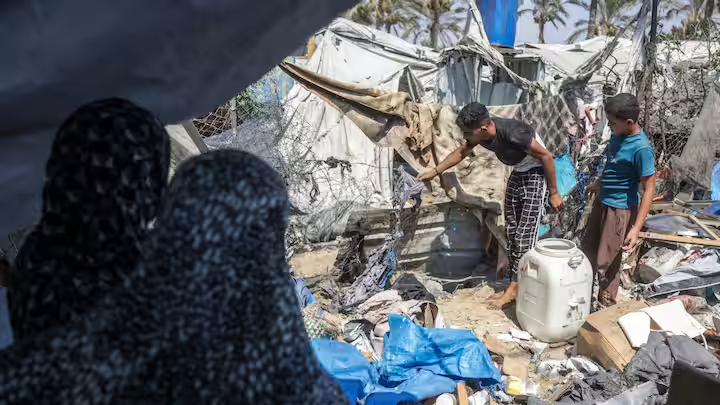
Gaza’s civilian infrastructure has been extensively destroyed. Housing, hospitals, water systems, schools and power networks all require reconstruction, and the population living amid the rubble is not party to the disarmament dispute.
Conditioning that work on political outcomes means:
- Civilians remain in damaged or destroyed housing indefinitely
- Health and sanitation systems stay degraded, with associated disease risk
- Economic recovery cannot begin, deepening dependence on aid
- Displaced families have nowhere to return to
Supporters of the approach argue that rebuilding without disarmament simply resets the conditions for the next war, wasting resources and lives. Opponents contend that withholding humanitarian reconstruction punishes a population for the actions of an armed group it does not control.
What Happens Next
The Monday meeting produced no breakthrough, and the positions on sequencing remain incompatible. Kushner’s 60-to-90-day reference offers a rough timeframe for judging whether Hamas complies, though no formal deadline appears to have been set.
Strikes continue in the meantime, as does the humanitarian situation the reconstruction plan was meant to address.
Author
-
Lucienne Albrecht is Luxe Chronicle’s wealth and lifestyle editor, celebrated for her elegant perspective on finance, legacy, and global luxury culture. With a flair for blending sophistication with insight, she brings a distinctly feminine voice to the world of high society and wealth.