Hawaii schools reopen Wednesday across nearly the entire state, along with government offices at both the state and county level, as recovery from Hurricane Lala moves into its next phase. One district on Hawaii island remains the exception.
Who Stays Closed
The Department of Education confirmed that all campuses will resume operations except for two in the Kau district: Naalehu Elementary School and Kau High and Pahala Elementary School. Both remain closed through Thursday.
That carve-out reflects conditions on the ground rather than a blanket approach. Kau sustained damage severe enough that officials concluded students could not safely return on the same timeline as the rest of the state.
Everyone gets a break again on Friday regardless, as public schools and government offices close for the Admissions Day state holiday.
A Superintendent’s Visit
Schools Superintendent Keith Hayashi traveled Monday to the Keaau, Pahala and Naalehu areas to see conditions directly.
His assessment afterward focused on families rather than facilities. Witnessing the effects on schools and communities firsthand, he said, made clear the difficulties many households are managing, especially where roads remain compromised and power and communication outages have dragged on.
That last point deserves emphasis. Extended communication outages complicate everything from checking whether a school is open to reaching a family member during the day.
Reopening Without Power
Some campuses will welcome students back despite lacking electricity.
The Department of Education noted that several schools on both Oahu and Hawaii island remain without power but can operate safely regardless. That judgment presumably rests on factors such as natural lighting, ventilation, water availability and whether food service can function.
Operating a school without power is workable for a limited period. It is not comfortable, and it is not sustainable indefinitely, but it beats keeping children out of classrooms when the building is otherwise sound.
The Scale of the Damage
Repair requests give the clearest picture of what the storm did to school facilities. By midday, storm-related work orders across the state had passed 600.
The breakdown:
- Oahu: 360 work orders
- Hawaii island: 81 work orders
- All remaining islands combined: 175 work orders
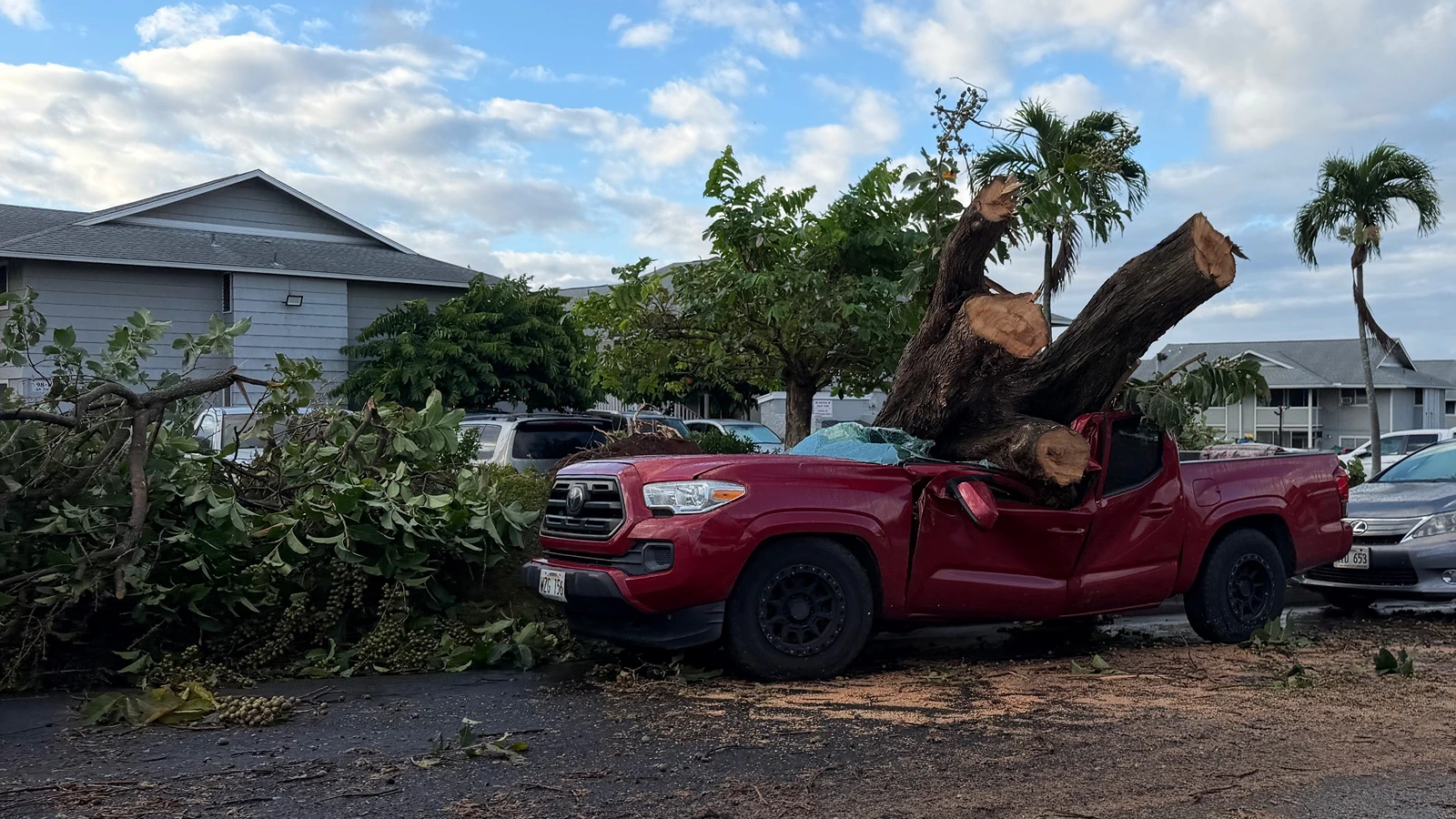
The reported problems span the range typical of a major storm, including downed trees, damaged roofing, water intrusion into buildings, and electrical issues alongside other facility impacts.
Water intrusion is the item that tends to cause trouble later. Initial cleanup addresses the visible mess, while moisture trapped in walls and ceilings can produce mold problems that surface weeks afterward.
Flexibility for Government Workers
State departments received guidance to permit telework where it makes practical sense.
The standard is straightforward: if roads are impassable and an employee can perform their duties remotely, remote work should be considered.
That approach acknowledges an uneven recovery. Road conditions in Hawaii vary dramatically over short distances, and a policy requiring everyone to commute would penalize workers based on geography rather than capability.
The Governor’s Reasoning
Governor Josh Green framed the extra day of closures as deliberate rather than reluctant.
Emergency crews and public employees needed additional time to clear roads, assess damage and confirm that workplaces and schools were safe, he said. The objective was to restore normal operations statewide by Wednesday, but he was explicit that no one would be asked to travel through unsafe conditions to make that happen.
He closed by describing recovery as the continuing priority, with work proceeding community by community until critical services and infrastructure are fully restored.
The distinction he drew matters. Reopening on schedule and reopening safely are not always the same decision, and officials face real pressure to choose the former.
What Families Should Keep in Mind
A few practical considerations apply as schools resume.
Conditions differ by campus. A school being open does not guarantee full services, particularly where power has not returned. Meal programs, air conditioning and technology access may be limited.
Transportation may run differently. Bus routes can change when roads remain blocked, and travel times may stretch beyond normal.
Communication may still be unreliable in some areas. Families in neighborhoods with ongoing outages should confirm arrangements in advance rather than assuming they can reach the school by phone.
Kau families need to plan through Thursday. With Friday’s holiday following, students at the two closed campuses face an extended stretch away from classrooms.
The Longer Recovery
Reopening schools is a visible milestone, but it marks progress rather than completion.
More than 600 outstanding work orders will take considerable time to clear, and repair crews typically prioritize safety hazards first, leaving cosmetic and comfort issues for later. Power restoration in remaining areas depends on utility crews working through damaged infrastructure that may require replacement rather than repair.
For now, most of Hawaii resumes its ordinary rhythm Wednesday, with a holiday arriving two days later and one district still waiting its turn.
Author