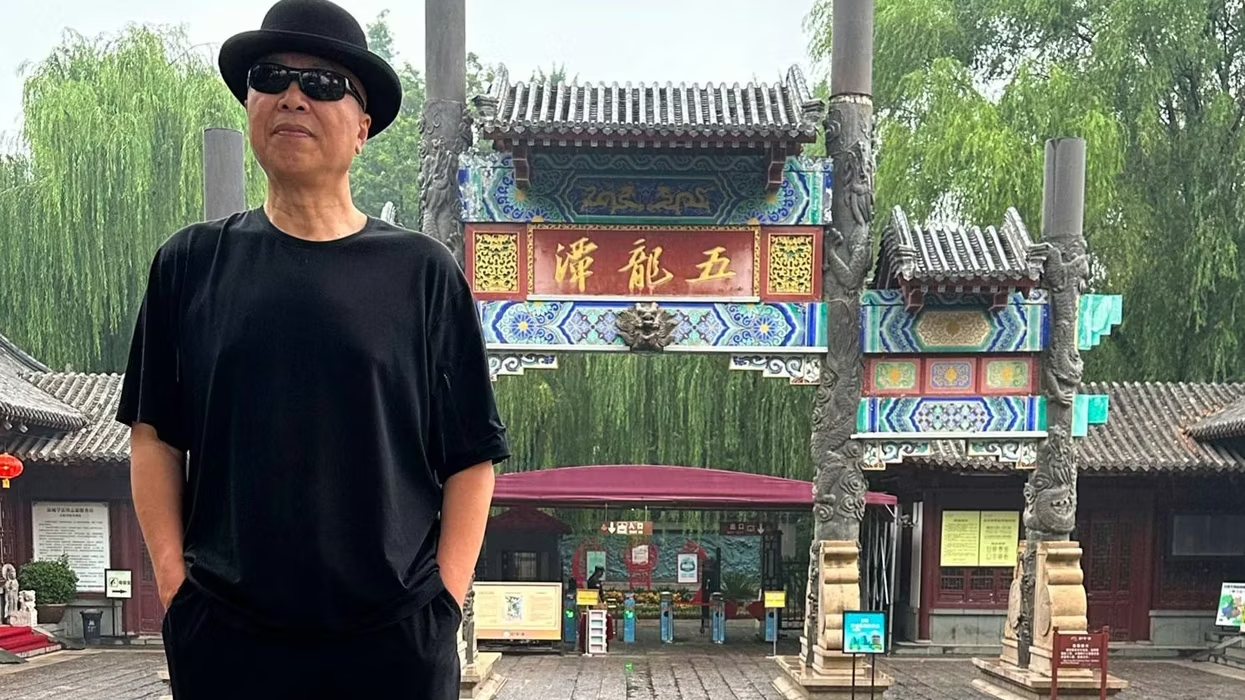
A Chinese artist sentenced Mao artworks case concluded Tuesday with a three-year prison term for Gao Zhen, convicted of infringing upon the reputation of heroes through satirical pieces depicting the founder of modern China.
Gao, who is based in the United States, was one half of an artistic partnership known internationally as the Gao Brothers.
How He Ended Up in Custody
The arrest came during an ordinary family visit. Gao traveled to China in August 2024 to see relatives and was detained. He has remained in official custody since.
The sentence was handed down by the Sanhei People’s Court in northern Hebei province, according to his wife, Zhao Yaliang.
The Works at Issue
Two pieces formed the basis of the charges, both created years before his arrest.
The first is a 2009 sculpture titled “Mao’s Guilt,” which portrays the former leader kneeling in a posture of repentance.
The second is the “Miss Mao” series, a set of caricatures depicting Mao with breasts and an exaggerated, engorged nose.
Both are unmistakably satirical, and both target a figure whose image occupies a protected position in Chinese public life.
The Retroactivity Problem
One detail complicates the case considerably.
Shane Yi, a researcher at Chinese Human Rights Defenders who has advocated on Gao’s behalf, pointed out that the artworks predate the law under which he was sentenced.
The relevant statute, banning criticism of the nation’s heroes, was passed in 2018. “Mao’s Guilt” was made in 2009.
Yi described the outcome as a clear violation of freedom of expression and said Gao intends to appeal.
Prosecuting conduct that occurred before the governing law existed runs against a principle recognised across most legal systems, and it is likely to feature prominently in any appeal.
The court did not immediately respond to a request for comment.
International Response
Amnesty International condemned the sentence, framing it as a message intended for artists generally rather than a judgment about one man.
Sarah Brooks, Amnesty’s China director, said the extended pretrial detention combined with the decision to convict and impose the maximum three-year term available for this offence demonstrates the authorities’ determination to discourage independent artistic expression.
She added that no artist should face criminal punishment for producing work that challenges official narratives or invites critical reflection on history.
The maximum-sentence detail matters. The court had discretion and chose the ceiling.
A Family Waiting
Zhao Yaliang had allowed herself to expect a different outcome.
She said two years felt like her limit, and described being deeply disappointed and unable to catch her breath at the news. She had prepared clothes for her husband in anticipation of his release, a reasonable hope given that Chinese courts frequently credit pretrial detention toward a sentence.
Her stated wish is simple: to be reunited with her husband and return to the United States, where the family had emigrated.
From Openness to Restriction
The Gao Brothers built their reputation during a period when China permitted considerably more latitude.
Their work engaged directly with authoritarianism and censorship, and it was exhibited both inside China and internationally. That combination would be difficult to imagine today.
The environment shifted with the 2018 law prohibiting criticism of national heroes. Since then, the state has tightened its control over expression, with particular sensitivity around historical political figures.
Mao occupies a specific place in that framework. His legacy is officially settled and not open to public reinterpretation, which places satire of him outside what the system will tolerate.
What the Case Signals
The prosecution carries implications beyond one artist.
It demonstrates that physical presence in China creates exposure regardless of where an artist lives or where the work was displayed. Gao’s American residence offered no protection once he entered the country.
It suggests older work remains actionable. Art produced during a more permissive period can be reassessed against later standards.
And the choice of the maximum penalty, in a case involving sculpture rather than organised political activity, indicates where the authorities have set the boundary.
For artists working on Chinese themes from abroad, the calculation about whether it is safe to visit family has just become considerably more complicated.
Author