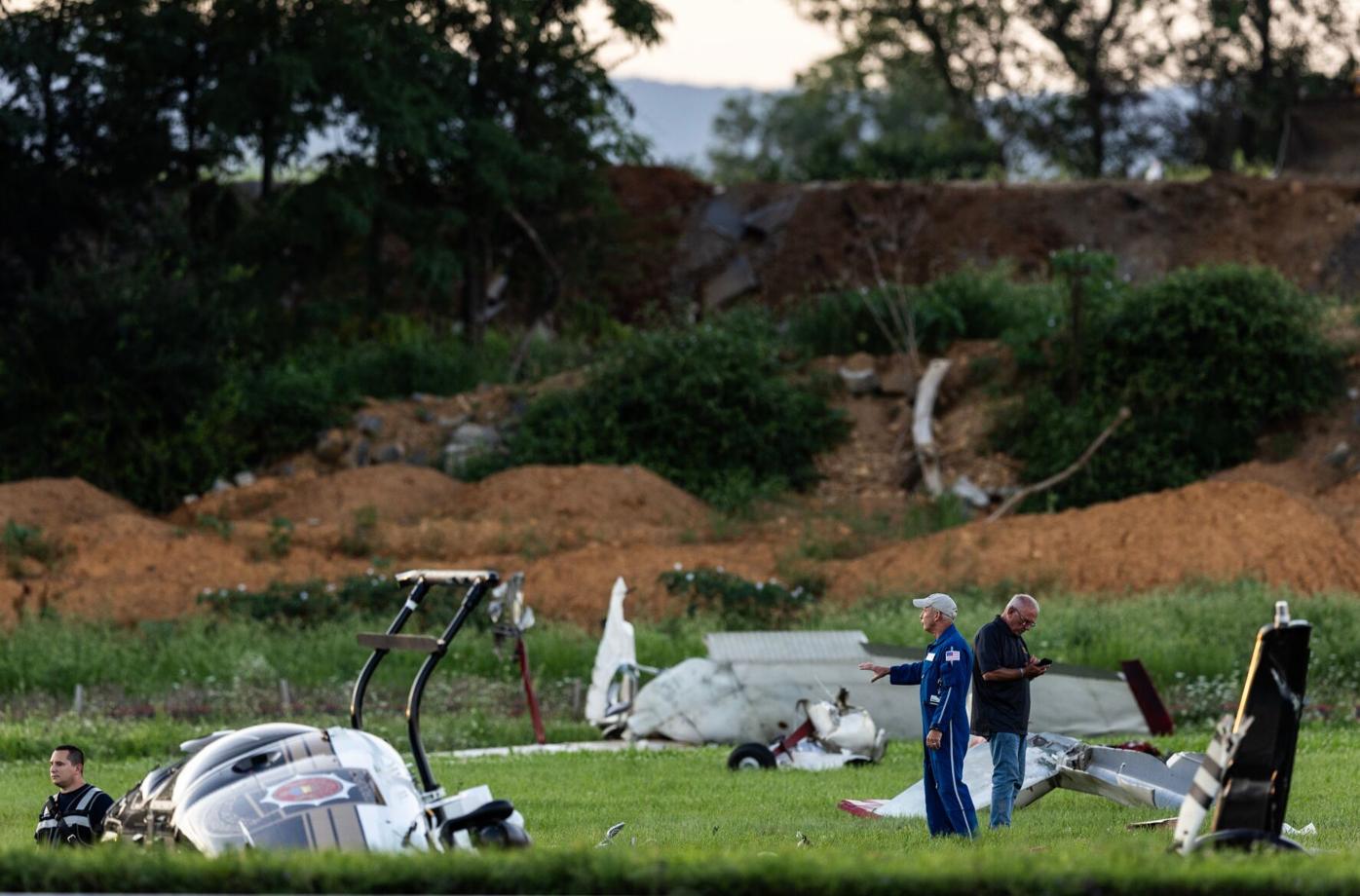
The Carlisle Airport collision killed one pilot and left two Pennsylvania State Police troopers injured Wednesday evening, after a small aircraft struck a police helicopter conducting a training exercise on the ground.
Investigators say the helicopter crew never had a chance to see what was coming.
What Happened
Around 6:50 p.m., a Pennsylvania State Police Bell 407 helicopter was hovering just a few feet above a grassy area beside a runway at Carlisle Regional Airport. The crew was running routine training, according to State Police Commissioner Colonel Christopher Paris.
A Cessna 150 approached from behind.
Investigators say the airplane veered sharply to the right at the last moment. It struck the helicopter’s rear tail rotor before continuing into the main rotor.
Paris described the impact in stark terms, calling it very violent and noting that the helicopter pilots would have had no ability to see the approaching aircraft given its position behind them.
The Aftermath on the Ground
The Cessna crashed a short distance away and broke apart into multiple pieces. Its sole known occupant died. Authorities withheld the pilot’s identity pending notification of family.
The helicopter fared little better. It lost its blades and tail boom, then rolled over and came to rest on its side and partially on its roof.
Both troopers were trapped inside the wreckage.
An Escape Under Pressure
Corporal Bryce Corman managed to push out a window and then helped Trooper Jason Mills get free. Mills appeared to have sustained more serious injuries and was bleeding significantly, according to state police.
They exited quickly amid concern the damaged aircraft might catch fire.
That detail deserves attention. Post-crash fire is one of the primary killers in survivable aviation accidents, and the window between impact and ignition can be extremely short.
Better News at the Hospital
Both troopers arrived at Penn State Health Milton S. Hershey Medical Center as Level 1 trauma patients, the highest activation level.
Dr. Ashley Ludwig, the hospital’s trauma medical director, reported a considerably better outcome than that designation suggested. Both men had only minor injuries and were in stable condition. One was potentially going home Wednesday night, while the other was admitted for observation.
Governor Josh Shapiro, speaking at the medical center, said Corporal Corman and Trooper Mills are expected to recover.
His assessment of the evening was direct: things could have been far worse.
He also praised the coordinated response from police, emergency medical personnel and hospital staff, describing it as an example of Pennsylvania at its finest.
The Investigation Begins
Federal investigators moved quickly. The FAA arrived at the scene Wednesday night, with the National Transportation Safety Board expected overnight.
Shapiro said he reached out to US Transportation Secretary Sean Duffy to request that the FAA expedite its response.
State police indicated that investigators have secured video and photographs that may help reconstruct exactly how the collision unfolded. Visual evidence is valuable in accidents like this, where the sequence happens faster than witnesses can reliably process.
A Critical Detail About the Airport
Carlisle Regional Airport has no air traffic control tower.
Instead, pilots coordinate among themselves using a shared radio frequency, announcing their positions and intentions as they operate in the area. Investigators will review communications on that frequency as part of the inquiry.
This arrangement is standard at thousands of smaller airfields across the country and generally works well. It depends entirely on participation, though. The system assumes every aircraft in the vicinity is transmitting, listening and interpreting correctly.
Whether that happened here will be one of the central questions.
What Investigators Will Examine
NTSB inquiries into collisions of this type typically focus on several areas:
- Radio transmissions on the common traffic frequency and whether both aircraft communicated position and intent
- Visibility conditions and sun angle at the time, given the early evening timing
- The Cessna pilot’s flight history, certifications and medical records
- Whether the helicopter’s position beside the runway was announced and understood
- Maintenance records and any mechanical factors on either aircraft
- The reason for the Cessna’s sharp right turn immediately before impact
That final point may prove pivotal. A last-second maneuver often indicates the pilot saw something and reacted, which would suggest late recognition rather than complete unawareness.
Why Ground Operations Carry Risk
Helicopters hovering near runways occupy an awkward position in the traffic pattern. They are not moving along a predictable path the way a taxiing aircraft would, and they may sit outside the areas where arriving pilots instinctively look.
Training operations compound the challenge, since they can involve repeated maneuvers in the same location over an extended period.
None of this establishes fault. It simply describes the environment in which the accident occurred.
What Comes Next
The NTSB will issue a preliminary report within roughly a month, typically containing factual observations without conclusions. A final report determining probable cause usually takes a year or longer.
For now, the cause of the Carlisle Airport collision remains undetermined, one family is awaiting official notification, and two troopers who were trapped in an overturned helicopter are expected to make full recoveries.
Author