The Strait of Hormuz crisis has settled into an uncomfortable holding pattern, and Qatar is once again trying to break it. Prime Minister Sheikh Mohammed bin Abdulrahman al-Thani travels to Tehran on Thursday hoping to restart diplomacy that stalled months ago.
His timing follows a fresh round of recriminations between Washington and Tehran over American plans to intensify economic pressure by sanctioning Iran’s trading partners.
Why Qatar
Doha occupies an unusual position. It borders Iran across the Gulf, hosts American forces, and maintains working relationships with both.
That has made it a reliable back channel throughout the conflict. Qatar played a direct role in producing the June ceasefire, which briefly halted hostilities before collapsing.
Iranian Foreign Ministry spokesperson Esmaeil Baghaei said the visit will cover the continuation of Qatari mediation along with broader regional developments.
Qatar’s own foreign ministry spokesperson posted on X that Sheikh Mohammed intends to raise freedom of navigation through the strait and the need to restore conditions as they stood before February 28. He will also explore with Iranian officials how to reduce tensions and build circumstances suitable for dialogue.
A War That Has Paused Without Ending
The conflict is approaching its sixth month.
Fighting has largely stopped. U.S. Central Command has not reported any attacks on Iran for close to a month.
But nothing has been settled. Washington appears to have shifted its emphasis from military operations toward economic strangulation, announcing plans to sever Iran from the partners it trades with through expanded sanctions.
The Waterway at the Centre of Everything
Hormuz is where the dispute concentrates.
Before the war began on February 28, roughly 20 million barrels of crude passed through the strait daily, about a fifth of global supply. Ship-tracking data showed that figure down to 5 million barrels on Monday, a three-month low.
Iran has held onto control of the passage as both leverage and revenue, attempting to charge vessels a commission. The United States has rejected that arrangement outright.
The June memorandum of understanding collapsed partly over exactly this question.
Still Dangerous
The strait remains hazardous for shipping.
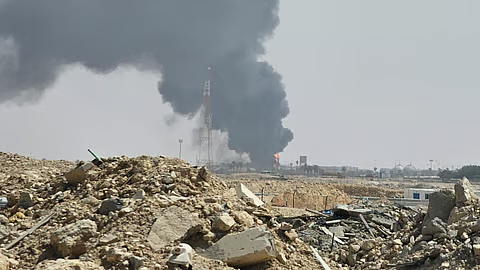
The United Kingdom Maritime Trade Operations agency reported early Thursday that an unidentified projectile struck a tanker, starting a fire that was subsequently extinguished. All crew members were accounted for and safe.
That incident joins a long list. The U.N.’s International Maritime Organization has recorded 70 incidents in the strait since February 28, in which 19 seafarers have been killed.
Confusion Over the Oman Talks
Iran and Oman have been negotiating on and off for weeks about managing traffic through the channel, which the two countries share.
Brigadier General Hossein Mohebbi, speaking for the Islamic Revolutionary Guard Corps, said Wednesday that the two sides had reached results acceptable to both regarding control of the strait and its revenues.
A senior Iranian source told Reuters something different, stating no agreement with Oman has been finalised and that discussions on details continue.
The contradiction suggests either internal disagreement in Tehran or a deliberate attempt to project progress that does not yet exist.
Iran’s Conditions
Mohebbi also set out what would be required to reopen the waterway.
He said the strait stays closed unless the United States meets the conditions Tehran laid out in the June memorandum. Those include ending the American blockade of Iranian ports, paying compensation, and lifting sanctions.
Both sides have imposed their own blockades and each claims authority over the channel, which is the practical reason nothing moves.
What Iran Retains
Early aerial bombardment severely degraded Iran’s conventional military.
Its missile and drone capability survived in sufficient measure, however, to threaten Gulf neighbours hosting American bases and to disrupt tanker traffic. That residual capacity is what gives Tehran a position to negotiate from at all.
The Human Cost
Thousands have died since the United States and Israel launched their campaign, with the heaviest tolls in Iran and Lebanon.
The stated objectives were preventing Iran from obtaining a nuclear weapon, supporting Iranians seeking to remove their government, and destroying the Iranian missile programme.
Six months in, none of those aims has visibly been achieved, while the economic damage has spread well beyond Iran through disrupted energy flows.
What Doha Can Realistically Do
Expectations for Thursday should be modest.
Qatar cannot deliver American concessions, and Iran will not reopen the strait without them. What mediation can accomplish is keeping communication open and preventing miscalculation during a pause that neither side has formally acknowledged as a ceasefire.
That is not nothing. Wars that stop without agreements tend to restart, and the presence of a trusted intermediary reduces the odds of an incident spiralling.
The tanker struck Thursday morning is a reminder of how thin the current calm is. One projectile, one casualty, and the pause could end.
Author