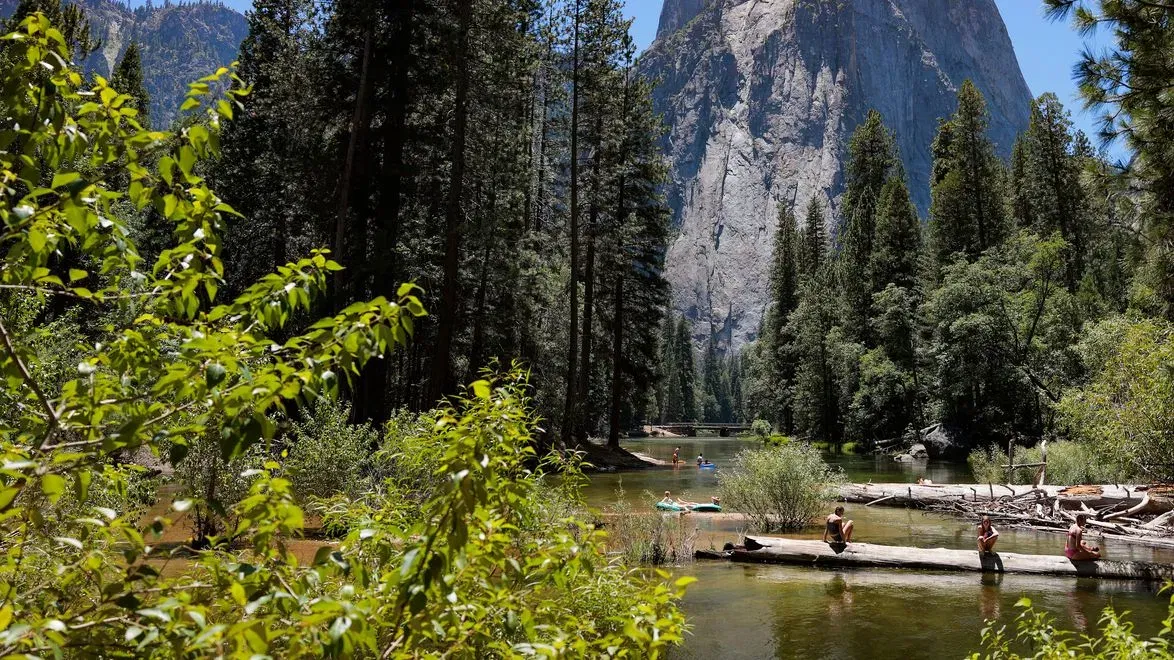
A proposed Yosemite land swap has drawn immediate opposition from former park officials and California’s top elected leaders, after reports that the Trump administration is weighing a deal that would hand a piece of the national park to a private developer.
The Department of the Interior says nothing has been finalized. Critics say the proposal should not be under consideration at all.
What Is Being Proposed
The developer at the center of the reported arrangement is Kingsbarn Realty Capital, a Nevada-based company holding an 83-acre parcel just beyond Yosemite’s boundary.
The company wants to build a private road running into the national park. To make that possible, it would need control of a section of land currently inside park boundaries.
Under the exchange described by the Los Angeles Times, Kingsbarn would hand over land of comparable value in return for the parcel within Yosemite. On paper, the trade balances. In practice, it would convert protected federal parkland into private holdings and open a new access route into an already crowded park.
A Former Superintendent Calls It Illegal
Don Neubacher spent 36 years with the National Park Service and served as Yosemite’s superintendent until his retirement in 2016. His objection was blunt.
He said he considers the proposal fundamentally illegal, adding that transferring public land to other entities is simply not something the agency does.
He also pointed to a recent attempt to secure legitimacy for the plan through the legislative branch. The matter went to Congress within the past year, he said, with backers seeking approval for the transfer. Congress declined.
That detail carries weight. If lawmakers already reviewed and rejected the arrangement, moving forward through administrative channels raises questions about whether the executive branch can accomplish what the legislature refused to authorize.
The Wildlife at Stake
Neubacher’s concerns extended beyond legal process to what the affected area actually holds.
He acknowledged that Yosemite already receives around five million visitors annually with existing access. But the specific parcel involved, he said, is ecologically distinctive.
The area supports Pacific fishers — a rare forest carnivore whose populations in the Sierra Nevada have declined significantly. It is also habitat for great gray owls, a species requiring large, undisturbed forest stands and meadow systems for hunting.
Both are exactly the kind of animals that respond poorly to roads, traffic, and construction. Development in such habitat does not simply reduce available space; it fragments what remains, cutting off movement corridors that these species depend on.
Neubacher’s broader point was about accumulated strain. The park already carries enormous pressure, he said, and considerable development exists outside its boundaries. The difference is that those projects operate within the rules rather than by carving out exceptions.
California Officials Line Up in Opposition
The response from the state’s political leadership was swift and uniformly negative.
Senator Adam Schiff said Yosemite ranks among California’s natural wonders, noting that courts had already struck down the project once. The administration, he said, appears determined to push ahead regardless, and the fight would be renewed.
Senator Alex Padilla was more compact. Posting on X, he wrote that Yosemite is not for sale.
California Attorney General Rob Bonta framed the matter in terms of ownership and stewardship, saying national parks do not belong to any single administration. His office, he said, is watching the situation closely — language that generally signals preparation for litigation should the deal advance.
The Legal History
Schiff’s reference to a prior court ruling matters. This is not the first time the project has faced judicial review, and it did not survive that review.
Combined with the congressional rejection Neubacher described, the proposal has now been turned away by two separate branches of government. Its reappearance through an administrative land exchange suggests an effort to find a path that avoids both.
Whether that path exists is uncertain. Land exchanges involving national park units are governed by specific statutory requirements, including provisions about equal value, public interest, and in many cases congressional consent.
The Precedent Problem
The concern voiced by opponents runs beyond this particular parcel.
National parks were established on a principle of permanence — that certain landscapes would be held in public ownership indefinitely, insulated from the ordinary pressures of development and market value. A completed exchange would test that principle directly.
If a private company can obtain parkland by offering comparable acreage elsewhere, the calculation changes for every park in the system. Land near park boundaries becomes a bargaining instrument, and the boundaries themselves become negotiable rather than fixed.
That is why former officials react strongly to proposals of this kind even when the acreage involved is small. The precedent operates independently of scale.
Where Things Stand
The Interior Department maintains that no final decision has been reached. President Trump has not addressed the reported deal publicly.
For now, the proposal exists in an uncertain space — reported but not confirmed, opposed but not formally blocked. California’s senators and attorney general have signaled they will contest it. The park service veterans who managed the land have said it should not proceed.
What happens next depends on whether the administration formalizes the exchange, and whether the legal footing it finds proves any sturdier than what courts and Congress have already rejected.
Author