The Ratko Mladić legacy did not end when he died in prison on Thursday. For the people who survived what he ordered, the harder truth is that his beliefs never went into the cell with him.
The world called him the Butcher of Bosnia. Survivors say even that name falls short of what he did.
The Scale of It
As commander of Bosnian Serb forces during the violent collapse of Yugoslavia in the 1990s, Mladić bore responsibility for an estimated 100,000 deaths — men, women and children.
His most infamous act was Srebrenica, where at least 8,000 Bosnian Muslim men and boys were killed in a systematic operation he designed.
The numbers surrounding the wider conflict are almost impossible to absorb. Between 20,000 and 50,000 women and girls were raped. Some 2.7 million people were displaced from their homes.
Thirty-one years after the Dayton agreement ended the war and lifted the 1,425-day siege of Sarajevo — the longest siege in modern warfare — the Balkans remain divided over how to regard him.
A Childhood Under the Guns
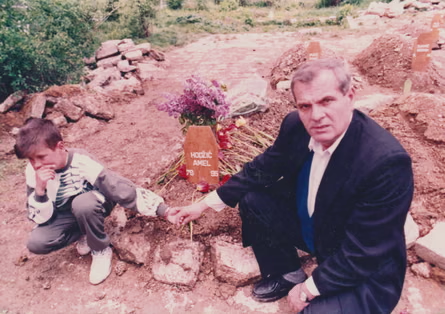
Džemil Hodžić was 12 years old when a sniper killed his 16-year-old brother Amel, who had been playing tennis in Sarajevo in May 1995.
Now 43 and the founder of the Sniper Alley photo project in Sarajevo, Hodžić described how Mladić existed in the minds of children living through the siege.
He was a kind of horror figure, Hodžić said. Every child knew the name and understood he was the source of what they were enduring.
They may have been too young to grasp the full picture, he said, but they connected the pieces they could see — the sniper fire, the shells landing on their schools, the friends and relatives who did not come home. All of it traced back to one man.
“I Have Sarajevo in the Palm of My Hand”
Zoran Kusovac, a Croatian journalist and geopolitical analyst who covered the Balkan wars, met Mladić on several occasions.
One meeting took place on a mountain plateau above Sarajevo, where Bosnian Serb forces had positioned heavy artillery aimed down at the city. Over the course of the siege, those guns and the snipers below killed more than 11,000 people, including 2,000 children.
Standing there, Kusovac recalled, Mladić told him he held Sarajevo in the palm of his hand — that he could destroy it or take it whenever he chose.
Kusovac described a man who functioned as a bully within his own command structure, someone whose superiors lacked the nerve to challenge him.
He also noted a detail that later mattered enormously in court. Mladić kept meticulous written records of what he did, documenting his actions with the complete confidence of someone who believed accountability would never arrive.
The Failure at Srebrenica
Srebrenica stands as one of the most disgraceful episodes in the history of international peacekeeping.
The town’s largely Muslim population had swollen with refugees seeking safety. It was formally declared a United Nations safe haven, and residents were instructed to surrender their weapons to international peacekeepers.
They complied. Then the UN left them to it.
One image from those days remains particularly difficult to look at: Mladić ruffling a child’s hair inside the enclave, filmed shortly before the men and boys were separated out and marched away to be killed.
The Other Version
In Serbia, a substantially different Mladić exists in public memory.
To many, he is not a war criminal but a defender — a man who believed in a Greater Serbia and who was, in this telling, the target of an international campaign against Serbs who felt then, and still feel now, misunderstood and unfairly cast as villains.
That interpretation has not softened with time or with the tribunal’s verdict. If anything, it has hardened into something closer to doctrine in parts of the region.
A State Funeral for a Convicted Génocidaire
On Thursday, the Serbian government in Belgrade made its position unmistakable.
Officials announced that Mladić — who died while serving a life sentence for genocide, war crimes and crimes against humanity — would be buried with all the military and state honours to which they consider him entitled.
He was either 83 or 84 at his death, depending on whether official records or family accounts are used.
The decision drew immediate international condemnation, which Belgrade has absorbed before and appears prepared to absorb again.
Why the Burial Matters
For survivors, the funeral arrangements are not ceremonial detail. They are a statement about whether what happened was a crime or a service.
State honours awarded to a man convicted of genocide communicate something specific to the families of his victims — that in one country, the verdict is not accepted, and the conduct is not regretted.
That is why the reaction from Bosnia has focused less on the death itself than on what follows it. Mladić being dead changes very little for people who lost brothers, sons and fathers. Mladić being honoured changes the terms under which they are expected to live alongside their neighbours.
What Remains
Hodžić still runs his photo project in Sarajevo, collecting images from the siege that shaped his childhood and killed his brother.
The city rebuilt. The bullet holes in some buildings are still visible if you know where to look.
The man who commanded the guns above it is gone. The idea that placed him there is not, and survivors say that is the part the world keeps failing to notice.
Author