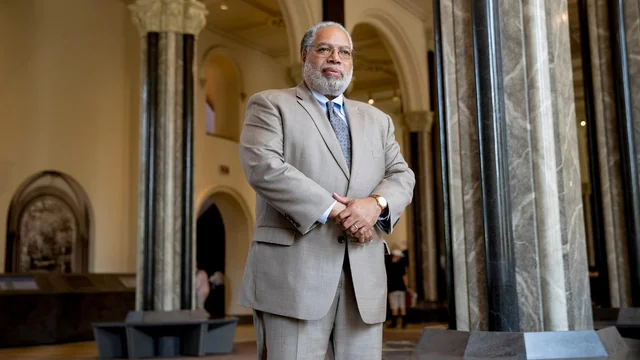
Lonnie Bunch Smithsonian leadership will end by the close of this year. The institution’s secretary announced Tuesday that he is stepping down after 38 years at the organisation, capping a tenure that began in 2019 and became, in its final stretch, an extended defence against pressure from the White House.
Bunch described his retirement as coming with very mixed emotions and heartfelt gratitude. He said he has spent close to half his life within the Smithsonian family and called it one of the great loves of his life, adding that he is enormously proud of what the institution accomplished during his time there.
He leaves at a genuinely precarious moment.
An Institution Under Sustained Attack
The Smithsonian is not a single museum but a sprawling network of dozens of museums, libraries, research centres and the National Zoo. Historically it has functioned independently of whichever party controls Washington.
That insulation has eroded. The Trump administration has repeatedly criticised how the institution presents American history, and last week the Interior Department escalated significantly, threatening to withdraw support and alleging that Smithsonian facilities promote a radical ideology that undermines a shared American identity.
According to a person familiar with the situation, the letter from Interior Secretary Doug Burgum was the tipping point. Bunch told friends afterward that the moment had arrived to step aside and help usher in new leadership.
He Stayed Longer Than He Planned To
The same person said Bunch would have retired a year earlier but felt obligated to remain and shield the institution from White House criticism.
Notably, there was no pressure from the Board of Regents, the body that governs the museums, for him to resign. The decision appears to have been his own.
Bunch made history in the role. He was the first Black person and the first historian to lead the Smithsonian, arriving in the top job after founding the National Museum of African American History and Culture.
Praise From the Chancellor
Chief Justice John Roberts, who serves as the Smithsonian’s chancellor, issued a statement tracing Bunch’s career across four decades.
Roberts noted his early work as a young curator at the National Air and Space Museum and the American History Museum, his role as founding director of the African American History and Culture Museum, and his seven years running the institution overall, describing the throughline as a pursuit of excellence in telling the nation’s story.
The Regents and the Smithsonian have benefited enormously from his wisdom, vision and leadership, Roberts said, adding that the board looks forward to working with him in the months ahead to ensure a smooth handover.
How the Conflict Began
Trump moved against the Smithsonian early in his second term. In March 2025 he issued an executive order instructing Vice President JD Vance to strip what it called improper, divisive or anti-American ideology from the institution’s programming.
The order claimed that an organisation once respected as a symbol of American excellence had fallen under the influence of a divisive, race-centred ideology, and asserted that this shift had encouraged narratives depicting American and Western values as inherently harmful and oppressive.
Vance sits on the Smithsonian Board of Regents by virtue of his office. The board also includes Roberts, members of Congress and public members. Two people who attended a regents meeting several months ago told NBC News that Vance criticised Bunch’s leadership directly during that session.
In August last year, Trump wrote on Truth Social that he had asked his attorneys to review the museums, complaining that they dwell excessively on the horrors of slavery. He described the institution as out of control, arguing that its content emphasises how terrible the country is while ignoring success, brightness and the future.
Bunch’s Response
In an interview recorded last week for PBS Newshour and broadcast Tuesday night, Bunch rejected the characterisation of the Smithsonian as politically slanted.
The most important thing to understand, he said, is that the institution is not run by left-wing crazy people but by people who love their country. He was equally direct on the question of whether the museums had bent under scrutiny, stating that nothing had been changed in response to political pressure.
The Independence Day Report
The criticism did not pause for national celebration. On July 4, as the country marked its 250th anniversary, the White House Domestic Policy Council released a report describing Smithsonian leaders as radical activists.
The report singled out the National Museum of American History, arguing that under current leadership and interpretive approach the institution cannot be trusted to tell the American story honestly, or in a manner that is inspiring, unifying and worthy of the republic.
Bunch offered his own framing the following day in an unrelated interview on NBC’s Meet the Press. What motivates him, he said, is the idea of a more perfect union rather than a perfect one. America’s greatest strength, in his view, lies not in running from its history but in understanding how that history shaped the country and continues to shape it.
What Happens Next
The Regents have begun assembling a search committee and are weighing internal candidates to steer the institution through the transition. Bunch has told them he will remain in place for three or four months to ease the changeover.
That leaves an obvious question hanging over the process. The next secretary will inherit not just a network of museums and research centres but an active political conflict over who gets to narrate the American past, and how.
Whoever takes the job will be doing so under conditions Bunch’s predecessors never faced.
Author