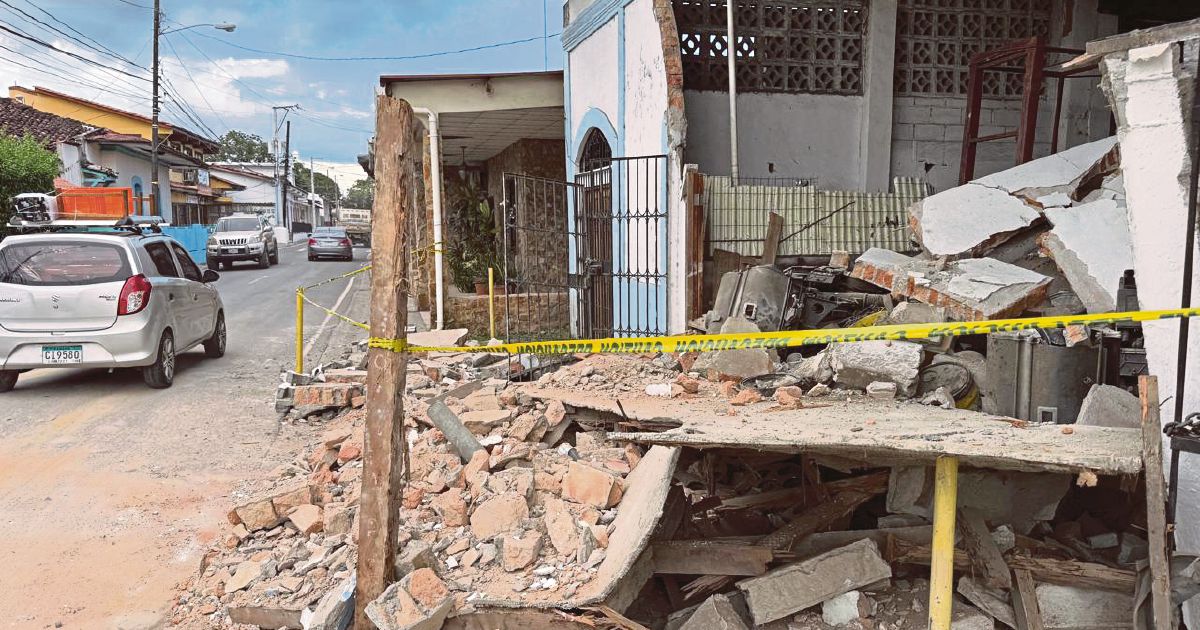
The Panama earthquake that struck on Friday afternoon was one of the strongest the country has seen in decades. Two powerful quakes, measuring 7.7 and 6.6, shook the south of the country, collapsing buildings near the epicenter and sending people running into the streets across the nation. As of Friday evening, authorities had not documented any deaths, though officials warned that could change.
The Quakes and the Aftershocks
The first and stronger tremor was centered about 10 kilometers southwest of the remote community of Pitaloza Arriba in the central province of Herrera, at a depth of 10 kilometers. The USGS first reported it as magnitude 8, then revised it to 7.6 and finally 7.7. It was felt as far away as Colombia.
A 6.6 quake followed, along with a stream of aftershocks, including several of magnitude 5.8, 5.5 and 5.2. Seismologists at the University of Panama recorded more than 45 aftershocks, though many were too weak to be felt.
Residents described fear and confusion. Rosendo Domínguez, 60, from Herrera, said things fell over in his kitchen and that everyone was outside, scared.
Damage and Casualties
President José Raúl Mulino called for calm and said no one had been confirmed killed so far. He cautioned that the situation could change in the coming hours or days, adding that nobody is ever ready for this kind of disaster.
Damage was concentrated in the central provinces of Veraguas, Herrera and Los Santos, according to Omar Smith of the National Civil Protection Service. He said there was no damage reported in Panama City. Reported impacts include:
- Several injuries, including one person hit by debris from a partly collapsed structure in Penonomé
- A partial collapse and cracks at the cathedral in Penonomé, plus damage to the governor’s office and the Dos Continentes hotel
- Reports that the colonial Church of San Atanasio in Los Santos, a National Historic Heritage Site since 1938, collapsed
- Deep fissures running along roads in Veraguas
Airport, Canal and Tsunami Alerts
Tocumen International Airport, one of the region’s busiest, briefly suspended operations but announced it was reopening on Friday afternoon. The Panama Canal Authority said operations were continuing normally while technical teams inspected facilities.
A tsunami warning for the coasts of Panama, Colombia, Ecuador, Nicaragua and Guatemala was lifted, as were alerts in El Salvador and for Chile’s Easter Island. Waves of one to three meters were expected around Isla Cañas and the southern coast of Los Santos, where seawater reached some homes.
A Region Already on Edge
The quakes add to a run of disasters in the region. Back-to-back 7.2 and 7.5 earthquakes in Venezuela’s La Guaira state in June killed more than 6,500 people. In August, a 7.4 quake in Colombia killed at least 289.
Panama’s lower toll so far may reflect its strict building codes, especially for skyscrapers in the capital, according to seismologist Carlos Valdés. The country’s last widely destructive quake was in 1991, a magnitude 7.4 event centered in Costa Rica that killed 23 people. Panama sits on the Pacific Ring of Fire, where several tectonic plates meet.
International Support
Leaders from across the region offered help. Mulino said he spoke with the presidents of Chile, Uruguay and Guatemala, among others. US Secretary of State Marco Rubio said Washington was rapidly mobilizing resources and personnel at Panama’s request. Colombian President Abelardo de la Espriella said Panama is not alone, and leaders of Venezuela, Costa Rica, Ecuador and Peru also offered assistance.
What to Watch Next
- Any confirmed deaths or injuries as search efforts continue
- Further strong aftershocks in the coming days
- Damage assessments in Veraguas, Herrera and Los Santos
- International aid arriving in affected provinces
The Bottom Line
Panama appears to have avoided the worst, with no deaths confirmed yet, but the situation is still developing. Strong building standards likely helped, though the damage in the central provinces shows how close the country came to a far more serious disaster.
Author