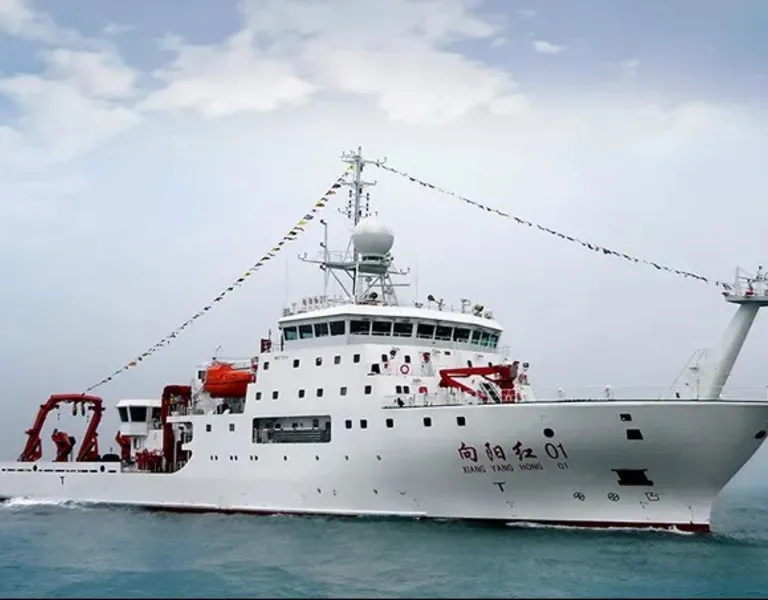
The Armed Forces of the Philippines (AFP) has raised the alarm over Chinese research activities in the West Philippine Sea, warning that they are illegal and may be aimed at gathering information on the country’s valuable mineral resources. The accusation adds a new dimension to the long-running maritime tensions between the two nations.
According to military officials, what China presents as scientific research could actually be a calculated effort to map out resources that lie within Philippine waters, raising fresh concerns about Beijing’s intentions in the contested region.
Research Without Permission
Speaking at a press briefing at Camp Aguinaldo, AFP special spokesperson for the West Philippine Sea, retired Rear Adm. Roy Vincent Trinidad, was direct in his assessment of the activities.
He stressed that marine scientific research conducted within Philippine waters must be coordinated with the coastal state, and that any data collected should be shared with Philippine authorities. By that standard, he argued, China’s actions fall outside the law.
Trinidad laid out two core problems with the activities:
- Research of this nature is illegal and must be coordinated with the coastal state
- Any data gathered should be shared with the Philippines, if such research truly took place
The Hunt for Minerals
Beyond questions of legality, Trinidad suggested a deeper motive behind the Chinese presence. In a separate interview with the Daily Tribune, he indicated that the vessels conducting research could be searching for information about mineral deposits within Philippine waters.
His warning was pointed, stating that China is after minerals used in microchips and other highly technical applications. These resources hold significant strategic and economic value, making them a potential prize in the broader competition over the region.
Guarding Bajo de Masinloc
Trinidad’s remarks came in the context of ongoing AFP efforts to protect Bajo de Masinloc, amid fears that China could try to replicate there what it has already accomplished elsewhere in the region.
To counter such attempts, the AFP continues to carry out a range of operations, including:
- Maritime domain awareness operations
- Sovereignty patrols across Bajo de Masinloc, northern island territories, and other areas of the West Philippine Sea
According to Trinidad, these patrols are specifically designed to prevent any move to establish control similar to what unfolded at Mischief Reef, also known as Panganiban Reef, which China now occupies despite its location within the Philippines’ exclusive economic zone.
A Tense Encounter at Sea
The challenges of asserting Philippine sovereignty were illustrated by a recent incident Trinidad highlighted involving the Philippine Navy’s BRP Diego Silang during a unilateral patrol near Bajo de Masinloc.
He described the vessel as being “armed with the 2016 arbitral tribunal ruling,” a reference to the international decision favoring the Philippines. Yet the ship was reportedly met by four PLA Navy warships, which Trinidad characterized as being “armed with a non-existent claim.” The contrast underscored the gap between legal rulings and the realities on the water.
Despite encounters like this, Trinidad made clear the AFP would not back down. He affirmed that the military would continue conducting unilateral patrols as well as bilateral and multilateral activities with allied countries in the area.
He expressed confidence in the Philippine Navy’s capabilities, noting that the force has sufficient numbers, more capable platforms, greater reach, and more effective sensors to sustain these operations.
Lessons From the Past
A central theme in Trinidad’s warnings was the danger of being deceived twice. He drew a direct comparison to events in 1995, when China initially portrayed its activities at Mischief Reef as harmless.
He recalled how the Philippines and the wider world were misled by such reassurances, only for Mischief Reef to become a fully functional military base over time. Notably, the Chinese Embassy in Manila acknowledged in May that Chinese vessels had conducted marine scientific research activities near Bajo de Masinloc, echoing the kind of benign framing used decades earlier.
Trinidad insisted history would not repeat itself. He declared that the country and the world would not allow themselves to be fooled a second time over Bajo de Masinloc or Scarborough Shoal, pledging that the Armed Forces would keep a very close watch on developments in the area.
The Bottom Line
The AFP’s warning about Chinese research activities in the West Philippine Sea reflects deep-seated concerns rooted in past experience. By framing the research as both illegal and potentially aimed at exploiting Philippine mineral resources, military officials are signaling vigilance against a repeat of the Mischief Reef scenario.
As the Philippines continues its patrols and asserts its rights under international law, the situation highlights the ongoing struggle to defend sovereignty in contested waters. For now, the AFP’s message is clear: it is watching closely and is determined not to be caught off guard again.
Author