New Jersey tornadoes confirmed by the National Weather Service now number at least four, the result of Tuesday’s violent round of storms and a Wednesday of survey teams walking through splintered treelines to piece together what actually happened.
The findings share a common thread. In a state this densely settled, the difference between a forgettable weather event and a catastrophe often comes down to a few hundred yards of open ground.
Where the Tornadoes Touched Down
Survey crews confirmed three separate tornadoes in the northern portion of the state:
- Stanhope
- Lower Berkshire Valley
- Pine Brook
A fourth was confirmed far to the south in Cape May, and its origin story differs from the others. That one began life over water as a waterspout before moving onshore and continuing as a tornado.
Waterspouts making landfall are not unusual along coastal New Jersey, particularly during unstable summer patterns. What makes them tricky is timing — they can develop with little advance signature and reach populated shoreline quickly.
How Damage Surveys Actually Work
The confirmations did not arrive automatically. Radar can indicate rotation, but it cannot prove a tornado touched the ground.
That determination requires people walking the terrain and reading physical evidence:
- The direction trees and debris fell, which reveals rotational versus straight-line wind patterns
- The width and continuity of the damage path
- The severity of destruction at various points along that path
- Interviews with residents and any available video
Straight-line winds can be every bit as destructive as a weak tornado, and distinguishing between them matters for climatology, warning verification, and future forecasting. That is why teams were on the ground Wednesday rather than issuing conclusions from radar loops alone.
Sussex County Took the Brunt
The strongest impacts in the northern part of the state concentrated around Sussex County, particularly Stanhope and Budd Lake.
Intense wind and rain combined to produce flash flooding and shear the tops off trees along a wooded corridor running from Route 183 over to Continental Drive, a stretch that crosses Interstate 80.
The damage was substantial. But it landed almost entirely on vegetation.
The Thousand-Yard Margin
Stanhope homeowner Steve Gumeny put the outcome in perspective in a way no official statement could match.
His assessment was that the community got very lucky, because shifting the path another thousand yards in any direction would have sent the storm through neighborhoods rather than woods.
That is the entire story of Tuesday in northern New Jersey. Not preparedness, not infrastructure, not response time. Geography and chance.
It is a sobering thing to sit with. The same storm, offset slightly, produces a completely different set of headlines.
Caught With No Warning
The most unsettling detail from the ground concerns how little notice people had.
Marcello Ramirez was leaving work at The Plumbing Store along Route 183 in Stanhope when the storm hit. He described having little to no warning from where he was, driving home when conditions deteriorated fast.
Rain came down so heavily that seeing through his windshield became nearly impossible. He made a judgment call — turn around, get back to the store, take shelter.
That decision was almost certainly the right one.
Why Vehicles Are the Worst Option
Ramirez’s instinct deserves attention because the alternative kills people every year.
A car offers essentially no protection in a tornado:
- Vehicles can be lifted or rolled by relatively modest winds
- Glass shatters into the passenger compartment
- Flooded roadways can sweep a car away in inches of moving water
- Zero visibility makes driving itself the immediate hazard
Highway overpasses, a persistent piece of bad folk advice, are worse than useless — they can accelerate wind through the underpass channel.
Turning around and reaching a sturdy building was the textbook response, made under pressure with no time to deliberate.
The Aftermath on Route 183
Once conditions calmed, Ramirez looked outside to find trees down across the road in front of the store, the roadway itself flooded beneath them.
Crews have since cleared the local roads of fallen timber.
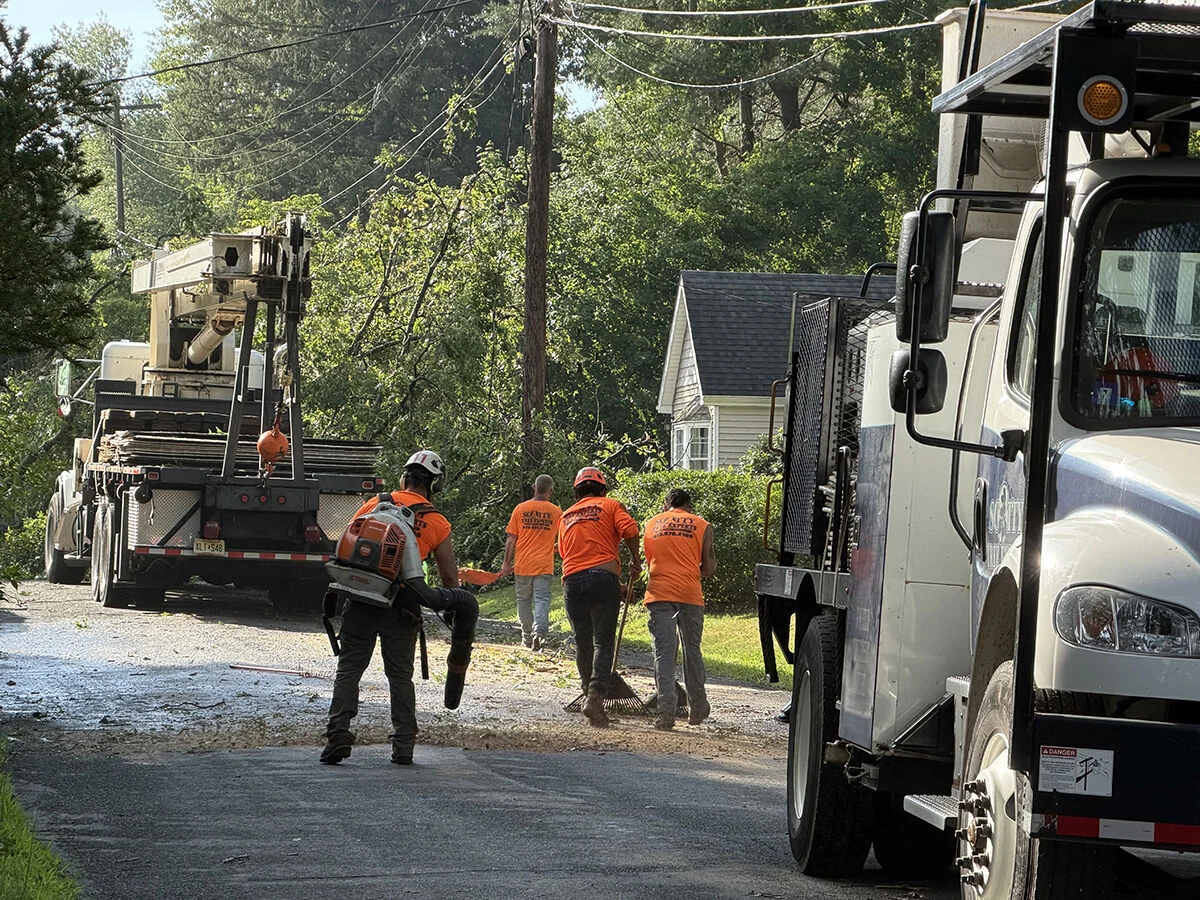
That cleanup work rarely gets attention, but it represents hours of chainsaw labor by municipal and utility crews working around downed limbs and standing water to reopen routes that emergency vehicles depend on.
What Nobody Lost
Here is the line that matters most in the entire account: the damage was confined to trees, not property.
No structural destruction. No reported injuries in the affected corridor.
For four confirmed tornadoes across a state as populated as New Jersey, that is a genuinely remarkable result — and one that owed more to fortunate positioning than to anything anyone did.
The Takeaway for Next Time
Tuesday exposed a real gap. Ramirez’s experience of receiving little to no warning where he was is a common one in fast-developing summer convection, where storms can spin up rotation faster than warnings can propagate to individual drivers on individual roads.
A few habits close that gap meaningfully:
- Enable Wireless Emergency Alerts on your phone rather than relying on sirens
- Treat sudden blinding rain as a signal to stop, not to slow down
- Identify sturdy shelter before you need it, particularly along commutes
- Never attempt to outrun a storm in a vehicle
New Jersey does not think of itself as tornado country, and statistically it is not. But four confirmations in a single afternoon is a reasonable argument for treating severe thunderstorm warnings with the seriousness usually reserved for something rarer.
The trees along Route 183 made that case pretty clearly.
Author
-
Lucienne Albrecht is Luxe Chronicle’s wealth and lifestyle editor, celebrated for her elegant perspective on finance, legacy, and global luxury culture. With a flair for blending sophistication with insight, she brings a distinctly feminine voice to the world of high society and wealth.