Iran war resumption is the deadline nobody in Washington is talking about as loudly as Tuesday’s midterm elections, yet it may matter far more for the world. With American forces massed in the Gulf and negotiations limping along, the question of whether the United States and Israel restart full-scale operations against Iran will come into sharp focus once the votes are counted. Eight months into the conflict, the central problem remains unchanged: Washington has overwhelming military power but no clear idea of what it wants that power to achieve.
Three Goals, Three Different Wars
The United States has never settled on a single objective. At various points the administration has spoken of forcing Iran into surrender and regime change, of wiping out its nuclear and missile capabilities, and of reaching a negotiated settlement that limits those programmes while guaranteeing free passage through the Strait of Hormuz. Each of these demands a different military approach and carries a different level of risk. Pursuing them simultaneously, or drifting between them, has produced a campaign that ends up back where it started.
Tehran, meanwhile, is not sitting idle. Supreme Leader Mojtaba Khamenei recently met his senior military commanders and instructed them to prepare an immediate and effective response without geographic limits, with the stated aim of maximum deterrence. His message was pointed: America may choose when a war begins, but Iran will decide when and how it ends.
Preparing for War While Talking Peace
CENTCOM commander Admiral Brad Cooper briefed President Trump last week on the state of play. Washington is pursuing two tracks at once, readying a second phase of Operation Epic Fury while keeping diplomatic channels open. The military build-up is formidable: more than 50,000 troops, additional F-15s and refuelling aircraft, extra Patriot and THAAD batteries to shield bases and allies, and three carrier groups accompanied by around 20 other warships.
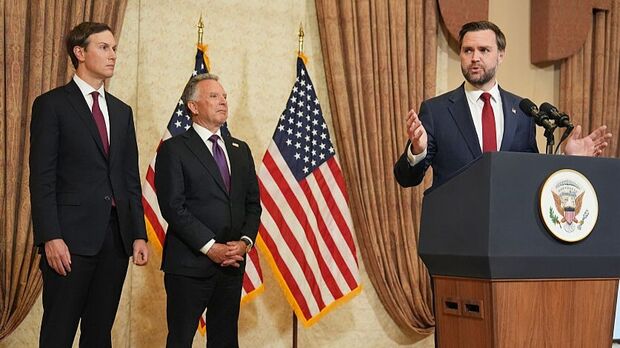
On the diplomatic side, a group of regional mediators led by Qatar is working to prevent a relapse into open conflict. A direct channel has opened between Vice President J.D. Vance and Mohsen Rezaei, secretary of Iran’s Supreme National Security Council. Vance has reportedly insisted the nuclear issue be on the table. Iran’s position is that the naval blockade must be lifted, frozen assets released and oil sales permitted before it will discuss its nuclear programme.
The deeper obstacle is trust. Having been attacked twice during negotiations over the past year, Tehran has little confidence that any agreement with the current administration would hold.
The Blockade and the Stalemate
The American blockade has inflicted real economic pain on Iran, while the US has managed through various means to bring oil flows through Hormuz back toward pre-war levels. Iran has struck at least 30 to 34 commercial vessels in the strait but has refrained from attacking at scale. The outcome is a condition of neither war nor peace, one that requires the continuous deployment of a large portion of the US military to the Hormuz mission. How much hardship Tehran can absorb remains the critical unknown.
What Eight Months Have Revealed
Few doubted that the US and Israel could inflict enormous damage on Iran, which is clearly outmatched in the air and at sea. The real question was what that damage would accomplish. On each of Washington’s apparent goals, the answer so far is: not much.
Regime change has proven the most elusive. Iran lacks a unified opposition, and toppling the government would require a ground invasion and a long occupation, something neither Washington nor Jerusalem has any stomach for after Iraq and Afghanistan. The alternative, destabilising the regime through targeted killings, appears to have been anticipated. The Islamic Revolutionary Guard Corps has restructured along decentralised lines, and the leadership has chosen to endure rather than capitulate.
On the nuclear programme, Trump declared victory back in June 2025. Subsequent strikes have levelled every known facility except Pickaxe Mountain, which lies beneath solid granite. Yet Iran reportedly still holds enough highly enriched uranium for roughly a dozen weapons, an unknown number of functioning centrifuges, and, most importantly, the scientific expertise and political determination to rebuild.
The missile arsenal has been significantly degraded but not eliminated. Iran retains a substantial stockpile and can assemble new missiles from stored components, all housed in extensive underground complexes that are difficult to reach. This remains the backbone of its defence.
Unintended Consequences
The war has also delivered surprises. Iran discovered how much leverage its position on the northern shore of Hormuz provides. It demonstrated missiles of greater sophistication, accuracy and evasiveness than many expected, exposing the limits of American protection for Gulf partners. US facilities across the region sustained heavy damage, pushing American power out to sea or back toward the continental United States.
Perhaps the gravest risk is that relentless pressure drives Iran to abandon the Nuclear Non-Proliferation Treaty altogether and build a bomb. The decision to assassinate Ayatollah Ali Khamenei, the figure who had long blocked that path, may come to be seen as a strategic blunder of the first order.
Iran’s Clearer Objectives
In contrast to Washington’s shifting aims, Tehran’s goals are straightforward: an end to American military action, credible guarantees against future attack, sanctions relief, protection of its regional interests and a role in governing a strait through which a large share of the world’s oil flows. What it would concede to achieve these, and whether Washington would agree, is unclear.
The Stakes for India
India has every reason to worry. The country imports close to 90 percent of its crude, and a renewed war would arrive as higher energy prices, disrupted shipping, inflation and pressure on the rupee. At 120 dollars per barrel, India’s annual oil import bill could approach 200 billion dollars. Between nine and ten million Indians live in the region, many in the Gulf, where airspace closures and stalled projects translate into job losses and hiring freezes. Remittances from the Gulf hit a record 110 billion dollars last year.
New Delhi has limited ability to shape events, but it cannot afford to be passive. Its statements have called for restraint, de-escalation, protection of civilians and respect for sovereignty, while it balances strategic ties with the US and Israel against heavy investment in the UAE and Saudi Arabia and a continuing relationship with Iran. That carefully neutral stance has yet to yield any tangible reward.
A Case for Asian Coordination
The nations most exposed to disruption in Hormuz are Asian: India, China, Japan and South Korea together purchase a large portion of Gulf oil. They could collectively support Qatar’s mediation, develop shared frameworks for navigation and insurance in the strait, and deliver a joint message to Washington that resuming the war would impose serious costs on them. They have been collateral victims of this conflict. There is no compelling reason for them to remain spectators.
Author