Zelenskyy Vows Ukraine Will Respond in Kind After Russia Breaks Ceasefire Proposal
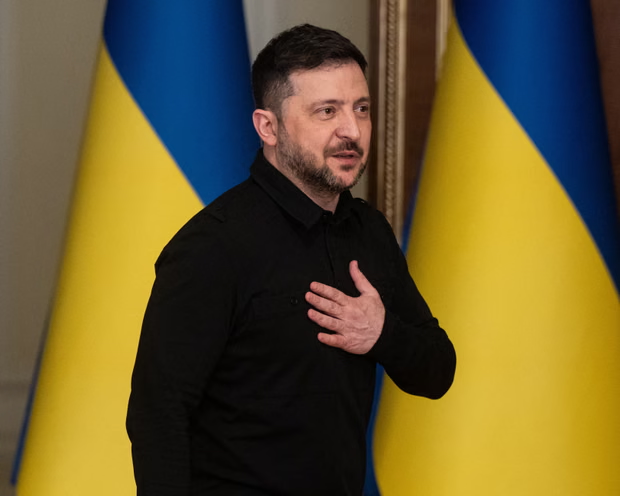
The Ukraine ceasefire Russia was offered has collapsed almost as quickly as it was proposed, prompting a sharp warning from Ukrainian President Volodymyr Zelenskyy. In an evening address on Wednesday, the Ukrainian leader accused Moscow of responding to Kyiv’s diplomatic efforts with relentless strikes and made it clear that Ukraine will not stand by quietly.
Zelenskyy’s Strong Message to Moscow
Speaking directly to the Russian leadership and the international community, Zelenskyy said that Russia had answered Ukraine’s ceasefire proposal with nothing but more attacks. He emphasized that Kyiv’s response would be shaped by what happens in the coming hours and days, signaling that retaliation could be on the table.
The president also stressed that Russia had been given a clear, formal proposal from Ukraine regarding both a ceasefire and broader diplomacy. He pointed out that the Kremlin knows exactly how to reach Ukraine or its international partners if it wants to negotiate seriously. However, he suggested that the man at the top in Moscow appears more interested in staging a military parade than in pursuing peace.
Two Competing Ceasefire Proposals
The situation has been complicated by two very different ceasefire offers being put on the table this week.
First, Russia announced what it called a “Victory Day truce” planned for 8 and 9 May. The two-day pause was timed to coincide with Russia’s annual Victory Day parade in Red Square, one of the most symbolically important events on the Russian calendar.
In response, Ukraine offered its own ceasefire proposal, with a starting time of midnight on 6 May. Kyiv argued that its longer window would provide a real test of whether a genuine pause in fighting could actually be established. The hope was that this would push Moscow into demonstrating real intent rather than simply pausing for political theater.
1,820 Violations in Just 10 Hours
According to Zelenskyy, the results of Ukraine’s proposed truce were telling. Within the first 10 hours alone, Russian forces violated the ceasefire 1,820 times. These were not minor incidents either. The violations included strikes on civilian infrastructure and waves of drone attacks on populated areas.
One of the most painful incidents took place on Wednesday morning, when Russian forces hit a kindergarten in the northern Sumy region. Two people were killed in the strike. Although no children were present at the time, the attack on a school building underlined how far the war remains from any real de-escalation.
Russia’s Victory Day Plans Under Pressure
With Ukraine’s ceasefire proposal effectively rejected, all eyes are now turning to how Russia’s Victory Day events will unfold. The parade, held to mark the end of World War II, has long been one of the Kremlin’s most significant public spectacles.
Since 2022, when Russia launched its full-scale invasion of Ukraine, the event has been used to draw a direct line between the Soviet defeat of Nazi Germany and the current war. Officials have repeatedly framed the conflict in Ukraine as a continuation of that historic struggle.
This year, however, the picture looks very different. The Kremlin has ordered a scaled-back version of the parade, with no major military hardware set to be displayed. The reason is straightforward. There are growing fears that Ukrainian forces could target the event, and Russian leaders appear unwilling to take that risk.
In annexed Crimea, the situation is even more striking. Russian-installed occupation authorities have cancelled Victory Day celebrations entirely, citing safety concerns. The decision marks a significant departure from past years when the peninsula hosted large-scale events designed to project Russian power.
Ukraine’s Long-Range Strike Capabilities
Russia’s caution is not unfounded. In recent months, Ukraine has shown that it can strike targets deep inside Russian territory, far beyond what was once thought possible.
Just this week, Ukrainian forces successfully hit a critically important military-industrial complex in Cheboksary, located roughly 1,000 kilometres inside Russia. The attack served as a clear demonstration that no part of Russia’s vast geography is fully out of reach.
Among the developments that have unsettled Russian planners are:
- Long-range drone strikes capable of penetrating deep into Russian regions
- Successful targeting of military-industrial facilities far from the front lines
- The growing reach and accuracy of Ukrainian-developed weapons systems
- Increasing pressure on Russian air defence networks
These advances change the calculus for major events like the Victory Day parade, where massed crowds and political leaders gather in highly visible locations.
A War That Refuses to Pause
Zelenskyy’s warning highlights a painful truth about the current state of the conflict. Even as international voices call for de-escalation and humanitarian relief, the fighting continues at a relentless pace. Ceasefire proposals on both sides have so far failed to translate into any meaningful pause.
For ordinary Ukrainians, this means more sleepless nights, more air raid alerts, and more loss. For Russian civilians, it means a Victory Day stripped of its usual grandeur, marked by quiet streets and absent military convoys rather than the loud public celebrations of past years.
What Comes Next
The coming days will be critical. If Russia continues to launch attacks despite its own announced truce, Ukraine has signaled that it will take action of its own. Zelenskyy has not specified exactly what those responses might look like, but his words suggest that Kyiv is prepared to act decisively.
International mediators, including those in Washington and across Europe, will likely intensify their efforts to prevent the situation from spiraling further. Yet history shows that without genuine willingness on both sides, ceasefire announcements often serve more as political messaging than as real steps toward peace.
For now, the world watches and waits. Whether Victory Day in Moscow becomes a moment of muted celebration, an opportunity for renewed diplomacy, or a flashpoint for further escalation will depend largely on the choices made in the next few hours and days. Zelenskyy has made Ukraine’s position clear. The next move belongs to Russia.
Author