





Israeli strikes in Gaza claimed at least four lives on Tuesday, according to health and security officials in the territory, with the dead including a member of Hamas’s internal security apparatus and a 17-year-old girl. The deaths add to a steadily rising toll recorded since a US-brokered ceasefire came into effect last October, an agreement that has slowed but not halted military operations across the enclave.
What Happened in Khan Yunis
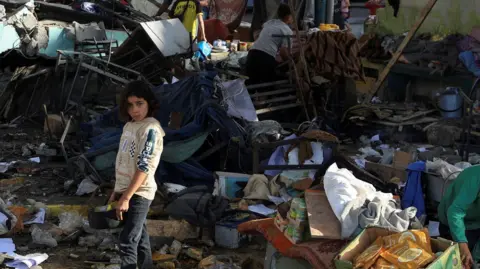
The deadliest incident unfolded in the south, near Khan Yunis. Medical staff at Nasser Hospital reported that three people were already dead when they were brought in after an Israeli strike hit a tent housing displaced families west of the city. Several others arrived with injuries.
The targeted area sits close to Al-Mawasi, a coastal strip that was repeatedly designated as a humanitarian zone during the war and became home to tens of thousands of people forced from their homes elsewhere in Gaza. Tents remain the primary shelter for many residents there, offering no protection from aerial attacks.
Hamas Confirms Loss of Security Officer
Separately, the Hamas-run interior ministry announced that one of its internal security personnel, identified as Mohammed Shalouf, died in an airstrike in Al-Mawasi. The ministry did not provide further details about the circumstances of his death or whether he was the intended target.
When asked about the incident, Israel’s military told AFP it had carried out a strike against what it described as military operatives in the area. It offered no additional information about who was targeted or what intelligence prompted the operation.
Teenage Girl Killed in Gaza City
A second strike took place far to the north, in Gaza City. According to Mahmoud Bassal, spokesman for Gaza’s civil defense agency, an Israeli drone fired on a tent pitched in a public park, killing a young girl.
Staff at Al-Shifa Hospital, the territory’s largest medical facility, identified her as Rimas Al-Madhoun, aged 17. She was declared dead on arrival. No information has been released about why the tent was struck.
A Ceasefire That Has Not Stopped the Fighting
The strikes highlight the fragile nature of the truce that Israel accepted in October 2025 following mediation led by the United States. While the agreement was meant to bring large-scale hostilities to an end, Israeli forces have continued to push deeper into parts of Gaza, and air and drone operations have persisted.
Prime Minister Benjamin Netanyahu has made clear that his government does not intend to ease its campaign against Hamas. He has stated that Israeli troops will not withdraw from Gaza until the group fully disarms, and that strikes on Hamas targets will continue in the meantime. Hamas, for its part, has not agreed to surrender its weapons, leaving a central condition of any lasting settlement unresolved.
The result is a situation that falls somewhere between war and peace. Formal ceasefire terms exist, yet lethal incidents occur on a near-daily basis, and civilians continue to bear much of the cost.
The Human Toll Since October 2025
Figures from the Gaza health ministry illustrate how much violence has continued despite the truce. The ministry reports that nearly 1,600 people have been killed by Israeli strikes since the ceasefire was announced. Although the ministry operates under Hamas authority, the United Nations considers its casualty data generally reliable, and international organizations routinely cite it.
On the Israeli side, the military has acknowledged seven deaths among its soldiers during the same period, along with the death of one civilian contractor.
How the War Began
The current conflict traces back to October 7, 2023, when Hamas led an unprecedented assault on southern Israel. According to an AFP tally drawn from official Israeli figures, 1,221 people were killed in that attack. The attackers also abducted roughly 251 people and took them into Gaza, including 44 who were already dead at the time of their capture.
Israel responded with a military offensive of enormous scale. Over the following two years, the campaign flattened much of Gaza’s infrastructure, displaced the vast majority of its population, and triggered a humanitarian emergency. The Gaza health ministry puts the overall death toll at more than 74,600 people.
Why These Incidents Matter
Each new strike carries significance beyond the immediate casualties. The ceasefire framework depends on both sides showing restraint, and continued Israeli operations give Hamas grounds to argue that the agreement is not being honored. Conversely, Israel maintains that Hamas’s refusal to disarm leaves it no choice but to keep targeting the group’s operatives wherever they are found.
Caught in the middle are civilians like the families sheltering in tents outside Khan Yunis or in a Gaza City park. With homes destroyed and nowhere safe to go, displaced Palestinians have little ability to avoid areas that may come under attack.
Humanitarian agencies have repeatedly warned that the territory cannot recover while strikes continue. Reconstruction, the reopening of hospitals and schools, and the restoration of basic services all require a degree of stability that remains elusive.
What Comes Next
The immediate outlook offers little clarity. Netanyahu’s government shows no sign of changing course, and Hamas has not indicated any willingness to meet the disarmament demand. International mediators, including the United States, have so far been unable to translate the ceasefire into a durable political arrangement.
Until that changes, officials in Gaza are likely to keep reporting days like Tuesday: a security officer killed in one strike, a teenage girl in another, and a growing list of names added to a toll that was supposed to have stopped climbing a year ago.
Author