America’s 250th anniversary has arrived as one of the most significant milestones in the nation’s history, yet it lands at a moment when the country feels anything but united. As citizens across the political spectrum step outside this week to celebrate the founding document that launched the republic, a quiet question hangs in the air: will the festivities bring Americans together, or simply spotlight how far apart they have drifted?
A Writer’s Words for a Divided Age
More than a century ago, one of America’s sharpest literary voices offered a definition of patriotism that feels strikingly relevant today. Mark Twain, writing in 1905, argued that genuine patriotism meant loyalty to the nation at all times, but loyalty to the government only when it earned that support.
Those words capture the spirit of this anniversary perfectly. Americans who believe the current president deserves their backing and those who firmly do not are, for once, participating in the same celebration. They are marking 250 years since the adoption of the Declaration of Independence, even as they disagree about nearly everything else.
Many Ways to Love a Country
Patriotism, it turns out, comes in several forms, and this milestone reveals them all. The nation’s affection for itself is far from uniform:
- Some love the country exactly as it is, embracing the present without hesitation.
- Others love what it might become, channeling their energy into activism and protest in pursuit of a more perfect union.
- Still others love what it once was and hope to restore, a sentiment that fuels much of the MAGA movement.
Yet beneath these varied expressions lies a sobering trend. Belief in American exceptionalism has clearly faded. According to an April survey from The Associated Press-NORC Center for Public Affairs Research, more people now see the United States as merely one of the best countries rather than the single greatest. A notable 44 percent placed America in that “one of the best” category, a far cry from the unshakable confidence of earlier eras.
A Different Nation Than Roosevelt’s
This is no longer the America that Theodore Roosevelt embodied, a fitting contrast given that the president visited Roosevelt’s presidential library in North Dakota this week. Roosevelt personified a young nation bursting with ambition, industrial might, and swagger.
Today’s America presents a more complicated portrait. The current president projects his own brand of boldness, but millions of the people he governs quietly wonder whether the country is fracturing beyond repair. The gap between national bravado and private unease defines this anniversary in ways Roosevelt would scarcely recognize.
A Celebration With Two Captains
Perhaps nothing illustrates the nation’s division more vividly than the fact that two competing organizations each claim to be leading the commemoration, largely ignoring one another in the process.
Ten years ago, Congress established the bipartisan America250 group and legally tasked it with organizing events at the local, national, and international levels. The president complicated that arrangement by issuing an executive order that named his own Freedom 250 group as the official body in charge.
As a result, the marquee attractions fall under the president’s Freedom 250 banner. These include:
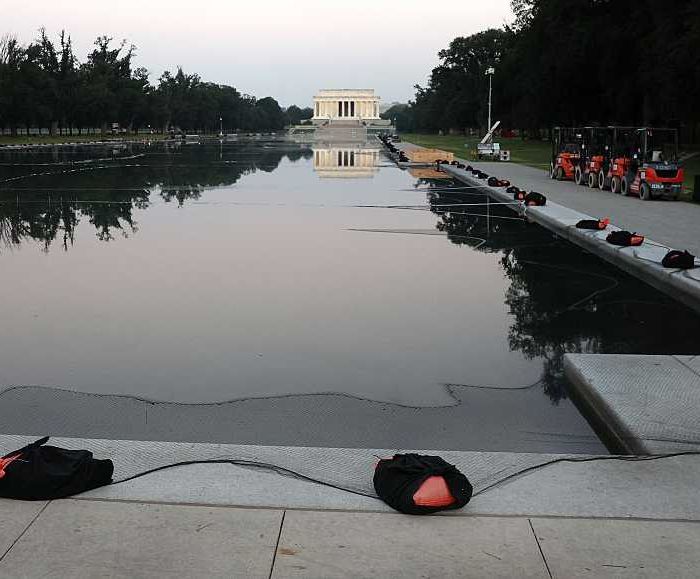
- The Fourth of July fireworks on the National Mall
- A parade of tall ships in New York
- The Great American State Fair along the National Mall
The tension surrounding these events became obvious when several musical stars who had agreed to perform at the fair’s flashy opening pulled out. Their concern was that the celebration would become overtly political and centered on the president himself. Rather than shrink from the controversy, he embraced it, declaring himself the number one attraction and delivering a speech on American greatness and his own accomplishments. He is also set to headline the official Fourth of July events in the capital, promoting them as the most spectacular rally yet.
Meanwhile, America250 pursued its own path with America’s Block Party, a coordinated series of gatherings nationwide. Its centerpiece is a Fourth of July benefit concert in Los Angeles hosted by Queen Latifah, featuring performers such as Chris Stapleton and the Smashing Pumpkins.
A Message to the Future
One of the more poignant undertakings comes courtesy of America250, which is burying a massive 900-pound time capsule in Philadelphia. Filled with contributions from every state and all branches of government, the capsule is meant to remain sealed for 250 years.
When Americans of the year 2276 finally open it, they will discover a fascinating snapshot of this era, including a major league baseball lineup, poems from several states, postcards, beaded artwork from Montana, an Oklahoma belt buckle, a message tucked inside a vintage Coca-Cola bottle, and a pocket Constitution signed by the nation’s justices, among many other treasures.
Philadelphia, the very city where the founders signed the declaration, will also host a striking spectacle. There, 250 people will form the outline of the Liberty Bell in a parade featuring 50 marching bands and representatives from every state.
Celebrations Born From the Grassroots
Of course, Americans have never needed official permission to throw a party. Beyond the government-organized spectacles, countless smaller gatherings are blooming across the country, each reflecting its own community’s character.
In one Pennsylvania town, a choir will perform patriotic songs a cappella alongside a trivia contest and a barbershop quartet. In Pocatello, Idaho, drag performers organized a reading of patriotic picture books for children, including the story of Katharine Lee Bates, the woman whose journey through the Colorado Rockies inspired the words that became “America the Beautiful.”
These homegrown events reveal something essential about the national character: a stubborn, joyful independence that thrives without any central authority orchestrating it.
The Enduring Tension in American Identity
Twain, ever the satirist, both mocked and adored his country. He poked fun at its government and its imperial ambitions, yet cherished its natural beauty and, at times, its people. He once mused that Americans could occasionally astonish even their creator.
Long before any modern political slogan captured the public imagination, Twain was already lamenting the loss of better days. He famously observed that Americans were known as a nation of inventors, and rightly so. But he suggested they could have earned the highest honors by resting on their very first invention: human liberty itself.
That reflection captures the heart of this 250th anniversary. The country celebrates a profound idea while wrestling with how faithfully it has lived up to that idea. Whether this milestone offers a moment of shared pride or deepens existing divisions remains genuinely uncertain, but the celebration itself, messy and contradictory as it is, may be the most American thing of all.
Author