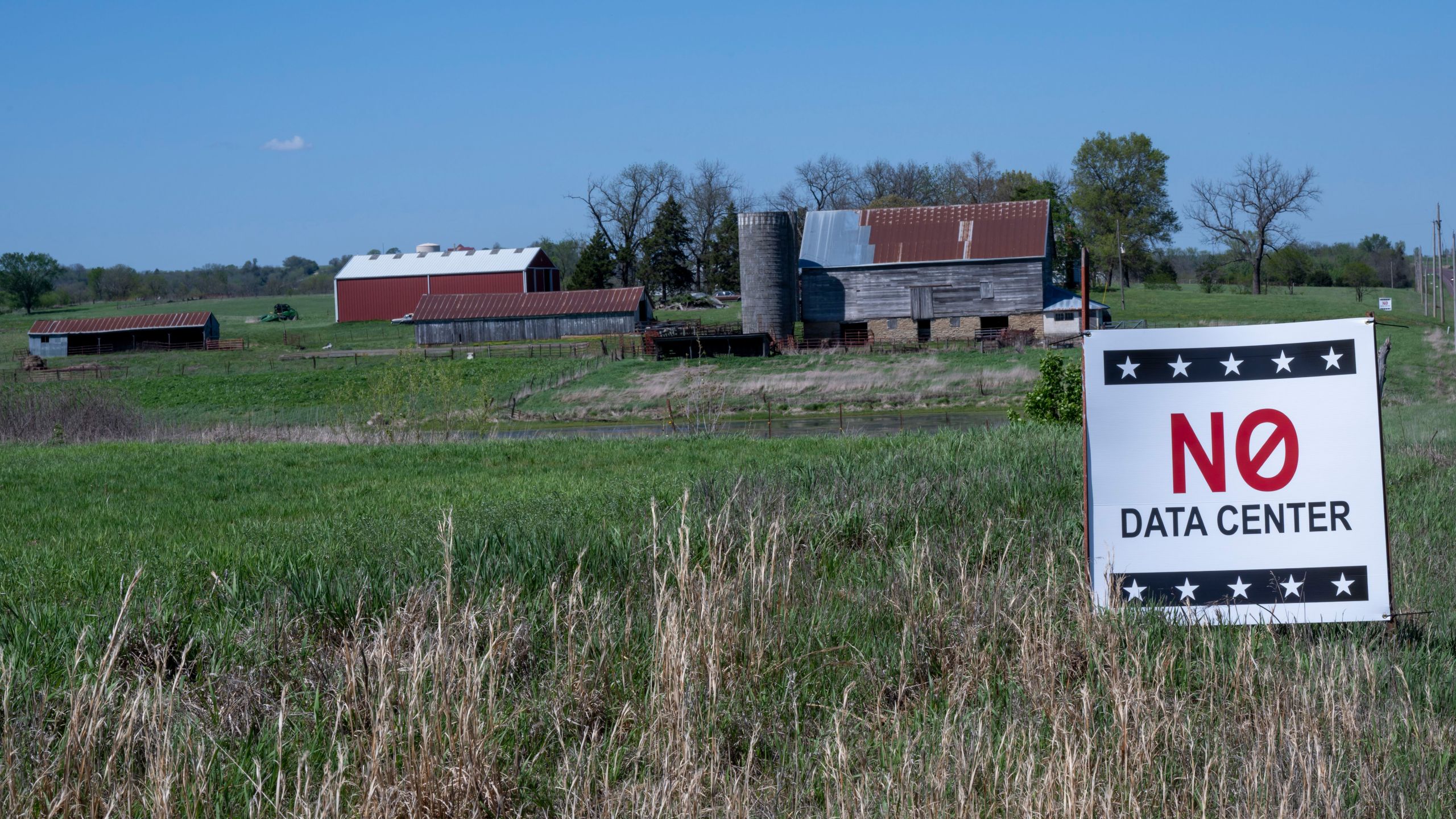
Data center farmland opposition has become one of the more unexpected political flashpoints in rural America, and Blake Hurst has just placed himself squarely on the unpopular side of it.
Hurst, a farmer in Atchison County, Missouri, who led the Missouri Farm Bureau from 2010 to 2020, used a Wall Street Journal opinion piece to issue an open invitation to data center developers. His message was blunt: make me an offer.
The Project Next Door
Hurst’s farm sits roughly 40 miles from the proposed White Cloud Acres campus in neighbouring Nodaway County, a project local reporting has valued at 6.3 billion dollars.
County commissioners halted it on July 21 with a moratorium lasting up to six months. That pause was enacted while officials negotiate a development agreement with Scale Microgrids, the company behind the proposal.
Local resistance has been substantial. A petition opposing the project collected more than 7,000 signatures in roughly two months, according to the Northwest Missourian, and the mayor of Maryville has stated his opposition.
Hurst’s Argument
His case rests on demographics rather than technology enthusiasm.
Nodaway County’s population fell from 23,402 in the 2010 census to an estimated 20,300 in 2025, a decline of about 13 percent. Its largest employer is a university experiencing falling enrolment.
Against that backdrop, he points to project projections of 130 on-site jobs and more than 1 billion dollars in tax revenue across the facility’s projected 35-year lifespan.
His sharpest point concerns what rejection actually accomplishes. A blocked project, he argues, does not cease to exist. It relocates. The county loses the tax base while the campus gets built elsewhere.
The Numbers Working Against Him
Public opinion has moved decisively in the opposite direction, and quickly.
Emerson College polling found opposition to nearby data centers rose from 42 percent in December 2025 to 63 percent by July. A March Gallup survey placed opposition at 70 percent, with 48 percent describing themselves as strongly opposed.
That shift has translated into policy. Restrictions have now passed in more than 500 jurisdictions nationwide.
At the state level, New York Governor Kathy Hochul signed the country’s first statewide moratorium on July 14, suspending permits for projects of 50 megawatts or larger. Maine’s legislature passed a similar measure before Governor Janet Mills vetoed it.
The Refusals That Made Headlines
Turning down data center money has become a recognisable story in its own right.
A Kentucky family declined 26 million dollars for roughly 900 acres in Mason County, an offer representing about ten times the local going rate of 6,000 dollars per acre. A neighbouring cattle farmer rejected offers of 35,000 dollars per acre, more than four times market value.
These refusals get told as stories of principle over profit, and the landowners involved have made clear they resent being underestimated.
But the Mason County outcome complicates the narrative. The developer simply redrew its site plan around willing sellers and proceeded.
That detail supports Hurst’s central claim. Holdouts have succeeded in driving up land prices near transmission corridors. They have not stopped a single hyperscale campus outright.
Why the Opposition Runs So Deep
The resistance is not simply reflexive. Communities cite a consistent set of concerns:
- Electricity demand that strains grids and potentially raises residential rates
- Water consumption for cooling in areas already managing scarcity
- Job figures that look modest relative to land area and tax incentives granted
- Permanent conversion of agricultural land
- Noise from cooling infrastructure operating continuously
- Uncertainty about whether facilities remain viable across decades-long tax agreements
The jobs question is particularly contentious. A figure like 130 positions sounds substantial in a county losing population, but critics note that comparable investment in other sectors often produces more employment per dollar.
The Counterargument Nobody Wants to Make
What makes Hurst’s intervention notable is his background. He spent a decade running the organisation that lobbies on behalf of exactly the farmers now refusing these offers.
His position amounts to an uncomfortable observation about rural economics: counties losing 13 percent of their population over 15 years, anchored by a university with declining enrolment, do not have an abundance of alternative development options.
Whether 130 jobs and a long-term tax stream justify the trade-offs is a legitimate question. Hurst’s argument is that the question is being answered as though better options exist.
Where This Goes
Nodaway County’s moratorium buys six months, not a resolution. Commissioners will eventually either negotiate terms with Scale Microgrids or decline the project.
The broader pattern suggests that individual refusals redirect development rather than preventing it. Statewide moratoriums like New York’s may prove more consequential, since they remove entire regions from consideration rather than particular parcels.
For now, one former farm lobby leader has publicly volunteered his land, and the response will say something about whether developers still want it.
Author
-
Lucienne Albrecht is Luxe Chronicle’s wealth and lifestyle editor, celebrated for her elegant perspective on finance, legacy, and global luxury culture. With a flair for blending sophistication with insight, she brings a distinctly feminine voice to the world of high society and wealth.