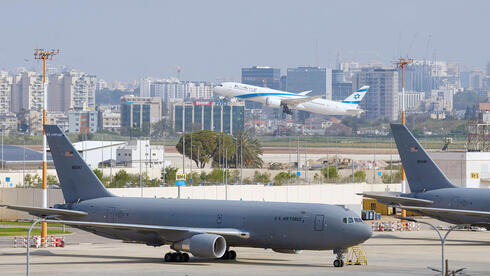
The US refueling tankers Israel is receiving will operate from military airbases rather than Ben Gurion Airport, according to the Israeli military — a logistical decision with real consequences for civilian travellers.
Dozens of additional aerial refueling aircraft are being sent by the American military. All of them will land and be stationed at Israeli airbases.
Why the Location Matters
The stated reasoning is straightforward: minimising disruption to civilian transportation.
Ben Gurion is Israel’s primary international gateway. Large military aircraft occupy substantial ramp space, require dedicated ground handling, and complicate the choreography of an airport already operating near capacity during peak season.
Israel’s Transportation Ministry had already imposed a cap of 20 tankers at Ben Gurion in an effort to limit summer flight disruptions. Adding dozens more to that total would have made the existing cap meaningless.
Routing them elsewhere preserves it.
How the Decision Was Made
The choice came from the United States, made in coordination with the Israeli military.
That coordination gave the Israeli Air Force advance notice to prepare — a practical necessity, since accommodating a large influx of foreign refueling aircraft requires fuel infrastructure, maintenance support, secure parking areas, and personnel arrangements at the receiving bases.
The military characterised its approach as enabling the American deployment as fully as possible while protecting Israel’s civilian aviation needs.
Two Competing Priorities
The announcement reflects a balance that isn’t always easy to strike.
On one side sits a significant U.S. military buildup that requires somewhere to base its aircraft. Aerial refueling tankers are essential enablers — they extend the range and endurance of combat aircraft, and a deployment of dozens signals sustained operations rather than a brief presence.
On the other sits an aviation system serving a small country during summer travel season, with limited alternative international airports and a population that depends on Ben Gurion for nearly all outbound travel.
Military basing solves both problems at once. Airbases have the fuel handling, security, and space that tankers need, and they’re already configured for exactly this kind of operation.
What Tankers Signal
The specific aircraft type is informative.
Refueling tankers don’t strike targets. They keep other aircraft airborne — extending combat radius, allowing longer loiter times, and enabling missions that would otherwise be impossible from regional bases.
A deployment measured in dozens indicates planning for sustained air operations over an extended period, not a short surge.
Their placement at hardened military installations rather than a civilian airport also reflects basic operational security. Tankers are high-value, vulnerable targets, and airbases offer protection that commercial terminals cannot.
The Civilian Aviation Picture
Ben Gurion’s summer disruptions have been an ongoing frustration.
Israel’s aviation options are structurally limited. There’s essentially one major international airport handling the overwhelming share of traffic, which means any capacity constraint there translates directly into delays, cancellations, and reduced schedules for travellers.
The Transportation Ministry’s 20-tanker cap was an attempt to protect that capacity. Friday’s arrangement effectively reinforces it by moving the additional aircraft outside the civilian system entirely.
For passengers, the practical outcome is that a substantial military deployment arrives without further degrading an already strained airport.
What This Reflects
Beyond the logistics, the arrangement says something about how the two militaries are working together.
The U.S. made the call, but did so in coordination with Israeli counterparts and with enough lead time for the Israeli Air Force to prepare receiving facilities. That’s a routine feature of close military relationships, but it isn’t automatic — hosting foreign aircraft at national airbases requires agreement on access, security, and support arrangements.
The Israeli military’s framing — maximising support for the American deployment while safeguarding civilian aviation — describes a deliberate accommodation rather than a concession forced by circumstance.
What to Watch
Two questions follow from this.
The first is scale and duration. Dozens of tankers represents a serious commitment of assets. How long they remain, and whether the number grows, will indicate the expected length of whatever operations they’re supporting.
The second is capacity at the receiving bases. Israeli airbases have their own operational requirements, and hosting a large foreign tanker fleet consumes ramp space, fuel, and support capacity that would otherwise serve Israeli aircraft.
For travellers, the immediate takeaway is simpler: Ben Gurion won’t absorb this particular pressure, and summer schedules should be spared additional strain from it.
Author