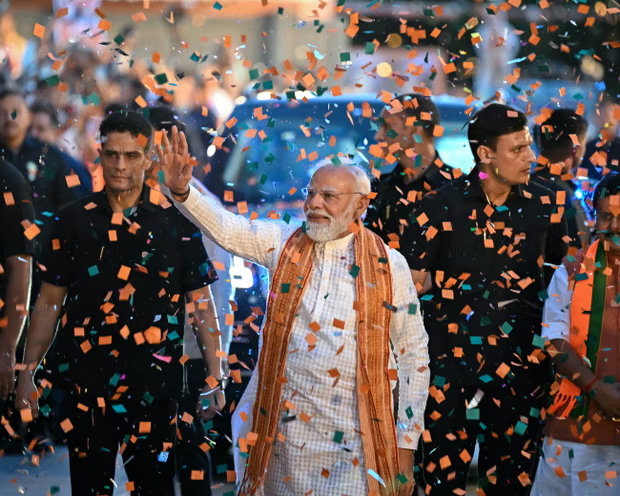
Modi BJP wins West Bengal for the first time in history, marking a political shift that few would have predicted even a year ago. After 15 years of dominance by Mamata Banerjee’s All India Trinamool Congress, the eastern Indian state has handed Prime Minister Narendra Modi’s Bharatiya Janata Party a sweeping victory that is set to reshape the country’s political map.
A Long Journey to a Historic Vote
For Seema Das, a domestic worker in New Delhi, the West Bengal election was important enough to justify a two-day journey home. She switched trains and traveled across the country to make sure her vote counted. In previous years, Das had always backed Mamata Banerjee, the popular leader known affectionately as “Didi,” meaning elder sister in Bangla.
This time, things were different. Das, a Hindu, said her mother-in-law had convinced her that Banerjee was favoring Muslims at the expense of Hindus. That sentiment, often echoed in BJP campaign messaging, was repeated in countless homes across the state. While the TMC has long stood for religious pluralism and the protection of minority rights, accusations of “appeasement” politics have followed Banerjee for years. This year, those criticisms struck deeper than before.
The Numbers Tell the Story
When the votes were counted on May 4, the scale of the BJP’s win became clear. Early results showed the party leading or winning 200 of the 294 assembly seats. Mamata Banerjee’s TMC, in contrast, was reduced to just 87 seats. To put that in perspective, the BJP’s previous best performance in West Bengal stood at 77 seats in 2021. The leap is enormous.
A record-breaking 92.93 percent of voters turned out, with around 68.2 million people casting their ballots. The election was one of five major political contests whose results were declared on the same day. Other key outcomes included:
- A surprise win for actor C. Joseph Vijay’s TVK party in Tamil Nadu
- A Congress victory over the Left in Kerala
- A BJP-led alliance winning Puducherry
- A sweeping return of Modi’s BJP in Assam
Yet none of these stories carry the same weight as West Bengal. The BJP’s victory there is being called the most consequential political development in India in years.
The Fall of Mamata Banerjee’s Citadel
Mamata Banerjee built the TMC in 1998 after breaking away from the Congress party. After more than a decade of struggle, she finally toppled the long-ruling Left Front in 2011 and emerged as one of the strongest regional leaders in India. Once Modi came to power nationally in 2014, Banerjee positioned herself as a key opposition figure, often pushing back fiercely against the BJP’s brand of Hindu majoritarian politics.
She also championed several women-centric welfare schemes, opposed controversial land acquisition projects, and defended the rights of Muslims in West Bengal, who make up over a quarter of the state’s population.
Despite all of this, anti-incumbency had begun to weigh heavily on her government.
According to Rahul Verma, an election observer at Shiv Nadar University in Chennai, Mamata personally remained popular, but voters were increasingly frustrated with how the TMC’s local machinery interfered in their day-to-day lives. He noted that while it was a difficult election for the BJP, it was never impossible. The party finally got the political opening it had been waiting for, and this time, everything aligned in its favor.
Why the TMC Lost Ground
Praveen Rai, a political analyst at the Centre for the Study of Developing Societies, said Banerjee’s party failed to offer anything new to voters and could not counter strong anti-incumbency sentiment. Some of the criticisms directed at the TMC included:
- A perception of arrogance and political bullying at the local level
- Hostility toward voters who did not align with the party
- Failure to address rising economic deprivation
- A weak response to the aspirations of younger and middle-class voters
- Inability to refresh its political messaging
According to Rai, the TMC had stopped reading the public mood, and the cost of that disconnect was steep. He also believes the loss damages Banerjee’s hopes of becoming a national challenger to Modi.
A Boost for Modi at the National Level
The implications of the BJP’s win extend far beyond Bengal. Just two years ago, Modi’s BJP fell short of a majority in the 2024 national elections and had to rely on coalition allies for survival. Monday’s results have delivered something the BJP badly needed: political momentum and renewed dominance.
Rai called the outcome a major moment for the BJP’s “hegemonic power,” arguing that the party’s grip on Indian politics has strengthened significantly. With key wins across multiple states, the opposition’s broader credibility has taken a serious blow, weakening the political capital of every major non-BJP party.
A Campaign Built on Polarisation
Religious polarisation played a central role in the BJP’s success. Neelanjan Sircar, a senior fellow at the Centre for Policy Research, traveled across West Bengal before the elections and noted a sharp urban-rural divide. Urban Hindu men, in particular, appeared to have polarised heavily in favor of the BJP. Since Bengal’s Muslim population is concentrated more heavily in rural areas, the urban consolidation gave the BJP a powerful advantage.
For years, analysts dismissed the idea that the BJP could win in a state where Muslims form more than 25 percent of the population. That assumption has now collapsed.
Suvendu Adhikari, the BJP’s state leader and a likely chief ministerial candidate, openly attributed the win to a “Hindu consolidation” of votes. He thanked Hindu Sanatani voters for their support and labeled the TMC a “pro-Muslim party,” a framing that mirrors years of BJP messaging.
The win also carries deep symbolic value for the party. Shyama Prasad Mukherjee, who founded the Bharatiya Jana Sangh in 1951, the predecessor of today’s BJP, was from West Bengal. Capturing the state for the first time gives the party a moment of historical significance.
Voter List Controversy Adds Tension
The election was not without controversy. Before voting, the Election Commission of India carried out a Special Intensive Revision of the electoral rolls. In West Bengal, this exercise removed over nine million people from the voter list, nearly 12 percent of the state’s 76 million voters.
Of those:
- Around six million were declared absentee or deceased
- The remaining three million could not vote due to a lack of tribunal hearings before the polls
Critics, including the TMC and several rights activists, argued that the exercise disproportionately disenfranchised Muslims and unfairly favored the BJP. Banerjee even challenged the process before India’s Supreme Court, calling it “opaque, hasty, and unconstitutional.” The court did not restore voting rights but ordered that affected voters be publicly listed.
Sircar pointed out that this revision changed the nature of the election entirely. Once vulnerable voters had to worry about whether they were even on the rolls, normal political engagement was disrupted.
A Heavy Security Presence
The Modi government deployed 2,400 companies of paramilitary troops in West Bengal for the elections, a record number for any provincial vote in India. The federal government insisted these forces were necessary to ensure peaceful elections. The TMC and other opposition parties, however, argued that the troops were used to intimidate voters and create an environment more favorable to the BJP.
Verma noted that even fence-sitters who feared TMC’s local strength may have felt empowered to vote against the ruling party with so many central forces present. Trust between Indian opposition parties and the Election Commission, he said, is at a particularly low point.
Banerjee Refuses to Back Down
Despite the loss, Mamata Banerjee is unlikely to fade quietly. In a video message to her party, she urged TMC workers to remain at vote-counting centers until every ballot was tallied. She accused the BJP of using central forces to crush the TMC, attack offices, and seize political space.
She told her workers, “We will fight like the cubs of a tiger,” signaling that the political contest in West Bengal is far from over. According to Sircar, more drama is likely in the coming weeks as Banerjee resists what she sees as a politically engineered defeat.
A Turning Point in Indian Politics
The fact that Modi BJP wins West Bengal carries weight far beyond a single state’s results. It signals the rise of a new political era where the BJP’s reach now extends into regions long considered out of bounds. It also reveals how religious polarisation, anti-incumbency, electoral roll changes, and political strategy can reshape long-standing power equations in remarkably short time.
For Mamata Banerjee, the road ahead will be tough. For the opposition across India, the challenge has just grown larger. And for Prime Minister Narendra Modi, the win confirms that his party’s dominance over Indian politics has only deepened. As the dust settles, one thing is certain: the political map of India looks very different today than it did just a week ago.
Author