Japan and Australia cooperation has taken a major step forward as the prime ministers of both nations agreed to deepen ties across energy security, defense, and critical minerals. The new commitments come at a time when global supply chains are under serious pressure due to the ongoing Iran war and rising tensions in the Middle East.
A High-Stakes Visit to Canberra
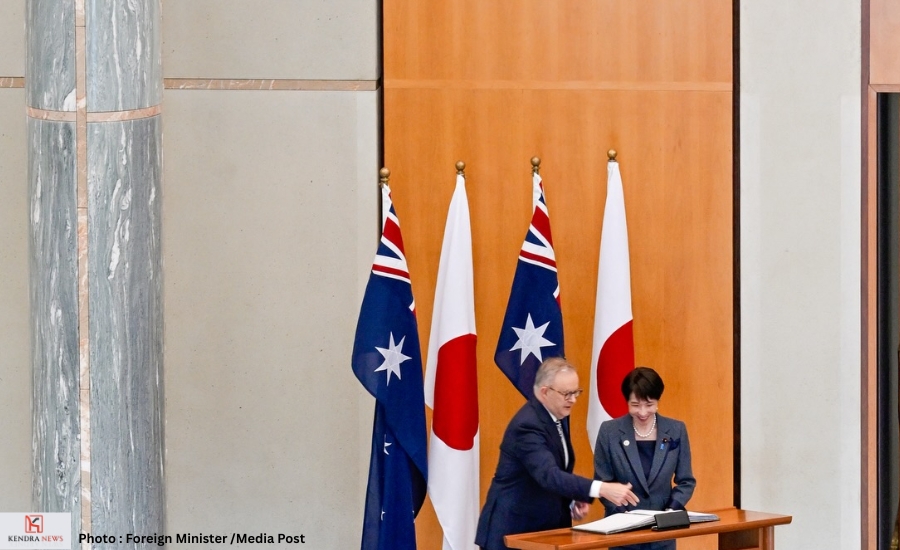
Japanese Prime Minister Sanae Takaichi made her first visit to Australia as national leader, meeting Australian Prime Minister Anthony Albanese at Parliament House in Canberra. The meeting brought together two close partners whose economies, defense networks, and energy systems are increasingly intertwined.
Takaichi described the visit as a chance to hold strategic discussions on a wide range of issues. These included:
- China and its growing regional influence
- Stability across Southeast Asia
- Pacific Island countries
- Nuclear-related concerns
- The long-standing issue of North Korean abductions
By covering such a broad agenda, the two leaders signaled how closely Tokyo and Canberra now align on key Indo-Pacific challenges.
Energy Security in a Time of Crisis
The biggest immediate concern hanging over the discussions was the global energy crunch. The effective closure of the Strait of Hormuz, caused by the conflict involving Iran, has rattled markets and exposed how vulnerable many nations are to disruptions in oil and gas flows.
Australia is the single largest supplier of liquefied natural gas (LNG) to Japan, providing nearly half of its imports. Japan, in turn, is one of Australia’s top five suppliers of refined gasoline and diesel. That deep mutual reliance has now become a strategic priority for both governments.
Takaichi noted that the closure of the Strait of Hormuz had been inflicting massive impacts across the Indo-Pacific. She emphasized that Japan and Australia would communicate closely and respond with a strong sense of urgency.
To shore up supplies, Albanese has been on a busy diplomatic circuit. In recent weeks, he visited Singapore, Brunei, and Malaysia to secure gasoline and diesel supplies following disruptions caused by U.S. and Israeli attacks on Iran starting in late February.
Reducing Vulnerability to Global Shocks
Albanese highlighted that the bilateral commitments would directly benefit the people of both Japan and Australia. He stressed that for Australians, the agreements would help reduce exposure to the kind of supply shocks now hitting global markets due to the Middle East conflict.
The leaders’ joint statement on energy security reaffirms their commitment to maintaining open trade in essential energy goods such as gas and liquid fuels. The deal essentially formalizes what has been a practical and necessary partnership and turns it into a long-term strategic understanding.
Tackling Economic Coercion
A major theme of the joint statement was economic security. Both nations expressed strong concerns about a range of practices that distort global markets. These include:
- Forms of economic coercion used by larger powers
- Non-market policies that lead to harmful industrial overcapacity
- Export restrictions, particularly on critical minerals
- Sudden disruptions tied to geopolitical tensions
While China was not named directly, the language strongly reflects worries about Beijing’s dominant role in the production and export of heavy rare earths. These minerals are vital for manufacturing powerful, heat-resistant magnets used in defense systems, electric vehicles, and renewable energy technology.
By targeting these issues openly, Japan and Australia are signaling that they intend to push back against actions seen as destabilizing or coercive.
Critical Minerals Take Center Stage
Critical minerals have now been formally elevated to the status of a “core pillar” of the Japan-Australia economic relationship. Both leaders agreed that securing reliable supplies is essential for industries ranging from defense to clean energy.
To back the new partnership, Australia announced it would provide up to 1.3 billion Australian dollars, equivalent to around 930 million U.S. dollars, to support critical minerals projects involving Japanese partners. This funding is meant to:
- Build new mining and processing capacity
- Reduce dependence on Chinese-controlled supply chains
- Encourage long-term private investment from both countries
- Strengthen integrated production lines that span both nations
For Australia, this is also a major economic opportunity, given its rich reserves of lithium, rare earths, nickel, and other strategic resources. For Japan, it offers a path toward greater resource security at a time when reliance on a single dominant supplier feels increasingly risky.
Defense Cooperation Reaches New Heights
The defense relationship between Tokyo and Canberra is also entering a new phase. Just two weeks before Takaichi’s visit, the Japanese and Australian defense ministers signed contracts for the first three of a fleet of Japanese-designed warships valued at around AU$10 billion, or roughly $6.5 billion in U.S. dollars.
Under this arrangement:
- Mitsubishi Heavy Industries will build the first three Mogami-class frigates in Japan
- Australia plans to build the next eight at a shipyard in Western Australia
- The deal will help expand Australia’s naval capacity over the coming years
- It provides Japan with valuable export opportunities in the defense industry
The agreement is one of the most significant defense industry partnerships either country has signed in years and underscores the depth of trust that now exists between them.
Aligning on Indo-Pacific Strategy
Beyond the immediate economic and defense agreements, the visit reflected a broader alignment on Indo-Pacific strategy. Both leaders emphasized close communication on regional flashpoints, including:
- Maritime security in the South China Sea
- Stability across the Taiwan Strait
- Strengthening relationships with Pacific Island nations
- Coordinating responses to provocations from North Korea
- Pushing back against any moves that threaten the rules-based order
By harmonizing their views on these issues, Japan and Australia are reinforcing their roles as central pillars of regional stability in an increasingly unsettled world.
A Lighter Note Between Leaders
Despite the seriousness of the talks, the two leaders shared a lighter moment that highlighted their growing personal rapport. Albanese, who is a keen disc jockey known to perform at charity events under the stage name DJ Albo, joked about Takaichi’s well-known love of heavy metal music.
He told reporters that the two would continue their discussions later in the day on important matters of state, including, with a smile, the topic of heavy metal music. The exchange showed that even in tense times, diplomacy can carry a human touch.
Why This Partnership Matters Now
The timing of these agreements is crucial. With the Iran war disrupting oil flows, China tightening its grip on rare earths, and security tensions rising across Asia, both Japan and Australia are operating in a far more volatile environment than they were just a few years ago.
By acting together, the two nations gain several key advantages:
- Greater leverage in dealing with major economic powers
- Stronger collective security in the Indo-Pacific
- Reduced exposure to single-supplier vulnerabilities
- Improved access to advanced defense technology
- A shared platform for coordinating with allies like the United States, the United Kingdom, and India
The joint statement and follow-on commitments effectively mark a new chapter in the relationship, one defined less by traditional trade ties and more by deep strategic cooperation.
A Defining Moment for Bilateral Ties
Takaichi’s visit and her partnership with Albanese suggest that the era of cautious, transactional cooperation between Japan and Australia is giving way to something far more substantial. From energy and defense to critical minerals and regional security, the two countries are working to build a relationship that can withstand global shocks.
For citizens of both nations, this means more reliable energy, stronger defense capabilities, and a clearer voice in shaping the future of the Indo-Pacific. As challenges multiply across the world, the deepening of Japan and Australia cooperation stands as a clear example of how like-minded democracies can strengthen each other in uncertain times.
Author