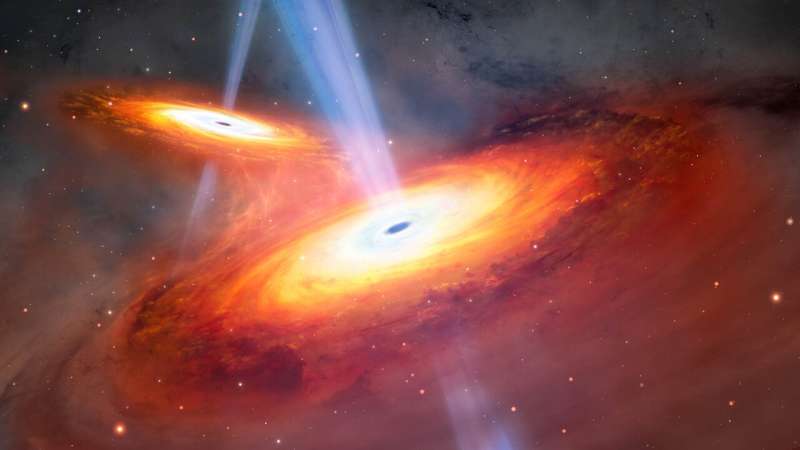
Quasar Pair J2037-4537: A Rare Cosmic Dance Captured by ALMA
Quasar Pair J2037-4537 has just become one of the most fascinating discoveries of the year in modern astronomy. Using the powerful Atacama Large Millimeter/submillimeter Array (ALMA), researchers have confirmed that this remarkable system is indeed a real quasar pair — two blazing quasars locked inside a pair of merging galaxies — captured during a time when the universe was less than a billion years old.
The findings, outlined in a paper submitted to the preprint server arXiv on April 7, mark only the second confirmed quasar pair ever found at a redshift greater than 5. That makes this discovery a major step forward in our understanding of how galaxies, black holes, and quasars evolved during the universe’s earliest chapters.
What Makes Quasars So Special
Quasars are among the brightest and most extreme objects in the universe. They sit at the centers of galaxies and are powered by supermassive black holes feasting on enormous amounts of gas and dust. When black holes are actively consuming material, they create blazing emissions that can outshine entire galaxies.
Some key facts about quasars include:
- They belong to a class of galaxies known as active galactic nuclei, or AGN
- Their immense brightness comes from material spiraling into supermassive black holes
- They can be observed across vast cosmic distances thanks to their luminosity
- Not all black holes are active at all times; they go through cycles of feeding and dormancy
Astronomers have long suspected that one of the most powerful triggers for quasar activity is a galaxy merger. When two galaxies smash together over millions of years, their gas gets funneled inward, feeding the central black holes and igniting them as quasars.
Why Finding Two Active Quasars Is So Rare
Spotting two quasars actively shining within the same merging system is extraordinarily rare, particularly in the early universe. This is precisely why J2037-4537 has captured so much attention.
Some reasons this kind of event is hard to find include:
- Quasar activity has to align in both galaxies at roughly the same cosmic moment
- Mergers usually unfold across hundreds of millions of years, narrowing observation windows
- Confirming two quasars rather than one bright object requires extremely high-resolution imaging
- Many candidate pairs turn out to be optical illusions caused by gravitational lensing
That last point is what made J2037-4537 such a tricky case to confirm.
The Initial Discovery and the Big Question
J2037-4537 was first reported in 2021 as a candidate for a close quasar pair, with both components sitting at the same redshift of z = 5.7. While this redshift suggested both quasars were at the same enormous distance from Earth, astronomers couldn’t immediately rule out another possibility — gravitational lensing.
Gravitational lensing happens when:
- A massive object, like a foreground galaxy, sits between Earth and a distant source
- Its gravity bends and magnifies the light of the background object
- This sometimes creates duplicate images of a single quasar
- These duplicate images can mimic the appearance of two separate quasars
Until that lensing scenario could be ruled out, astronomers couldn’t be sure if J2037-4537 was truly a rare quasar pair or simply an optical trick of cosmic gravity.
ALMA Settles the Mystery
A team led by Minghao Yue of the University of Arizona took on the challenge of confirming the system’s true nature. Using ALMA’s high-resolution observations, they zeroed in on the fine details of the system to see what was really happening.
Their analysis focused on:
- Mapping the [CII] (ionized carbon) emission lines, which trace cold, star-forming gas
- Examining dust continuum emissions to identify physical structure
- Checking whether the gas distribution matched a true merger or a lensed illusion
What they discovered was a major breakthrough. The [CII] emission stretched between the two quasars, forming a clear bridge between them. This kind of structure simply cannot exist if the two objects were duplicate images of a single quasar produced by gravitational lensing.
The bridge, known as a tidal bridge, forms when two galaxies merge, with their mutual gravitational pull dragging streams of material from each into the space between them. It is a hallmark sign of a real merger.
A Confirmed Quasar Pair in the Early Universe
With the lensing scenario ruled out, J2037-4537 has officially become one of only two confirmed quasar pairs ever found at a redshift greater than 5. This discovery offers astronomers an extraordinary glimpse into how massive galaxies and black holes interacted during the universe’s first billion years.
Some highlights of what was revealed include:
- A clear tidal bridge of dust and ionized carbon between the two quasars
- Evidence that the system is actively merging
- Direct visual confirmation through high-resolution imaging
- Strong physical proof that the two quasars are real and not optical doubles
It is a stunning example of how advanced instruments like ALMA continue to expand the boundaries of cosmic discovery.
Massive Galaxies and Furious Star Formation
In addition to confirming the quasar pair, the team measured the masses and activity levels of the two host galaxies, and the numbers are staggering. Each galaxy is a massive, star-forming powerhouse, churning out new stars at a tremendous pace.
Some of the most striking findings include:
- Each galaxy has a dynamical mass of at least 10 billion solar masses
- Each galaxy is forming stars at a rate exceeding 500 solar masses per year
- These rates dwarf the modest star formation seen in modern galaxies like the Milky Way
- The systems are still in early growth stages despite their already massive scale
The team also pointed out that their star formation estimates carry uncertainties because they depend on assumed dust temperature and emissivity. Future multi-band observations will help refine these numbers and provide an even clearer picture of these galactic giants.
A Long Cosmic Path Toward a Black Hole Binary
While J2037-4537 is a confirmed quasar pair, the system is still in the early stages of its merger. The two supermassive black holes are currently separated by thousands of light-years, meaning they are not yet a true gravitationally bound binary.
According to the research:
- It will take approximately 2.1 billion years for the system to evolve into a binary black hole
- That timeline places the eventual binary formation at around redshift z = 2
- The transition will involve the gradual sinking of both black holes toward the merged galaxy’s center
- Once bound, the black holes will continue spiraling closer over additional time scales
The slow, almost meditative pace of these cosmic mergers reminds us how vast both space and time really are.
Why Gravitational Wave Astronomy Cares About This
The discovery has implications well beyond galaxy evolution. When two supermassive black holes eventually merge, they emit low-frequency gravitational waves that ripple through the fabric of spacetime. These waves can be detected by Pulsar Timing Arrays (PTAs), which use precise timing of pulsars across the galaxy to identify cosmic vibrations.
This matters because:
- Recent PTA experiments have detected a gravitational wave background stronger than expected
- Current galaxy evolution models cannot fully explain this excess signal
- Systems like J2037-4537 offer real-world examples of how such waves could be produced
- More confirmed quasar pairs in the early universe could help reconcile theory with observation
If discoveries like this one become more common, astronomers may need to revise their understanding of how often early-universe galaxies merge and how supermassive black holes evolve over time.
A Reminder of How Far Astronomy Has Come
The confirmation of J2037-4537 underscores just how powerful modern observational tools have become. ALMA, in particular, has carved out a reputation as a game-changer in millimeter and submillimeter astronomy, allowing researchers to peer into structures that would otherwise remain hidden.
A few reasons ALMA has been transformative include:
- Its ability to detect cold gas and dust around extremely distant galaxies
- Its high-resolution imaging that distinguishes closely separated objects
- Its sensitivity to faint signals from the early universe
- Its role in confirming the chemistry and dynamics of merging galaxies
Combined with future observatories and gravitational wave detectors, ALMA’s discoveries are helping to build a much fuller picture of cosmic evolution.
What Comes Next for J2037-4537 Research
While the recent confirmation is a milestone, the work is far from over. Scientists plan to continue studying J2037-4537 with multi-band observations to refine their measurements and unlock even deeper insights.
Some of the next steps include:
- More precise estimates of the host galaxies’ star formation rates
- Detailed mapping of dust temperature and distribution
- Modeling of how the two black holes will spiral toward each other
- Cross-referencing with other potential quasar pair candidates
- Linking the system’s evolution to broader theories of galaxy and black hole growth
Each of these efforts promises to reveal even more about how the universe assembled its largest structures during its formative years.
Final Thoughts
The confirmation of Quasar Pair J2037-4537 is more than just a stunning visual reminder of cosmic violence and beauty. It is a major scientific breakthrough that adds vital evidence to one of the most active areas of modern astronomy: understanding how galaxies and supermassive black holes grew together during the earliest era of the universe.
With its rich tidal bridge, immense star formation rates, and looming black hole binary fate, J2037-4537 stands as a real-world example of cosmic evolution unfolding before our eyes. As technology continues to improve, discoveries like this remind us that even after decades of progress, the universe still has plenty of secrets waiting to be uncovered.
Author