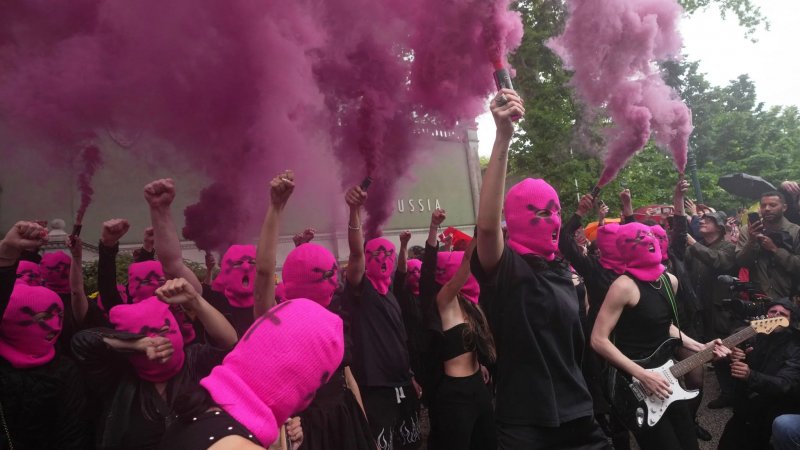
Pussy Riot Storms Venice Biennale 2026 Forcing Russian Pavilion to Shut Down
The Pussy Riot Venice Biennale protest has thrust politics back into the heart of the global art world. On just the second day of the festival’s preview, the Russian pavilion was forced to close after the famed activist collective staged a dramatic demonstration condemning Russia’s continued involvement in the prestigious event. What was meant to be a celebration of international art turned into a charged political stage where war, censorship, and freedom collided.
A Loud and Unmistakable Protest
Wearing their signature pink balaclavas, around 40 activists rushed toward the Russian pavilion. The group, which included members of the feminist collective Femen, set off pink, blue, and yellow flares while blasting punk music across the festival grounds. Slogans rang out into the air, including chants accusing Russia of turning bloodshed into art.
Some demonstrators had powerful messages painted across their bodies. Phrases like “Curated by Putin, dead bodies included,” “Russia kills, biennale exhibits,” and “Russian art, Ukrainian blood” left no room for ambiguity. A nearby statue outside the pavilion was wrapped in a Ukrainian flag, turning the sculpture itself into part of the political protest.
The group attempted to enter the Russian pavilion but was pushed back by police officers stationed at the entrance. No arrests were made, although the chaos drew a massive crowd of bewildered visitors who had only just made it inside after waiting in long queues.
Pussy Riot’s Founder Speaks Out
Nadya Tolokonnikova, one of the founding members of Pussy Riot, led the demonstration and shared her frustration with the festival’s organizers. She described feeling horrified after seeing footage from the previous day, when the Russian pavilion appeared to host a celebratory atmosphere with crates of prosecco being delivered and loud techno music playing inside.
Tolokonnikova questioned how Europe could continue to claim Ukraine acts as a shield for the continent while still opening its doors to Russian cultural influence. She called the situation heartbreaking and pleaded with Pietrangelo Buttafuoco, the president of the biennale, to stop accepting Russian money and engage directly with their group.
In a follow-up press statement, Pussy Riot also made a striking offer. The collective said it would be willing to curate the 2028 Russian pavilion itself, promising to feature works created by artists currently or formerly imprisoned in Russian correctional facilities.
A Diplomatic Storm Around Russia’s Inclusion
The protest comes amid a broader diplomatic row over Russia’s place at the Venice Biennale. Reports have surfaced that the European Commission warned both the Italian government and biennale organizers that allowing the Russian delegation to take part could amount to a breach of EU sanctions. Despite that warning, the pavilion remained part of this year’s lineup.
The buildup to the festival has been unusually tense. Politics has overshadowed much of the art on display, and the controversy is not limited to Russia. The international jury that traditionally selects the Golden Lion prizes resigned en masse before the event after refusing to consider entries from countries whose leaders are subject to international arrest warrants. That stance would have effectively barred both Russia and Israel from competition.
According to an Italian news outlet, the jury stepped down after being warned by the biennale’s legal team that they could be held personally liable if Israel chose to pursue legal action. A representative for the biennale has since confirmed the accuracy of that report.
The UK Government Skips Tradition
The fallout reached as far as the United Kingdom. At the official opening of the British pavilion, which is hosting Lubaina Himid this year, no government minister was present. A representative of the British ambassador confirmed that the absence was a direct response to Russia’s inclusion in the festival. Traditionally, a UK minister opens the British pavilion, although the entry itself is managed by the British Council rather than the government.
A government spokesperson explained the decision by stating that the UK strongly opposes Russia’s participation and stands in solidarity with the people of Ukraine, who have now endured more than four years of war. As a result, no ministers attended the festival on behalf of the UK.
Israeli Pavilion Also Targeted
Just an hour after the Pussy Riot protest, another major demonstration unfolded outside the Israeli pavilion in the Arsenale. The Art Not Genocide Alliance, known as Anga, organized the action against Israel’s inclusion in the festival amid its ongoing war in Gaza. The pavilion was locked from the inside while protesters gathered at its doors.
More than 200 participants at the biennale have already signed an open letter demanding the cancellation of the Israeli pavilion. The signatories described their stance as a collective refusal to allow the festival to platform a state they accuse of committing genocide.
Israel’s foreign ministry has hit back at Anga, branding the group’s actions as anti-Israeli political indoctrination and labeling them as a form of direct discrimination.
More Protests Expected
The unrest is far from over. A larger demonstration coordinated by Anga is expected on Friday. Organizers say it will include:
- Members of Italian labor unions
- Art workers employed at the festival
- Curators from various national exhibitions
- Nearly 20 artists who currently have work on display in national pavilions
The Guardian has reported that some artists may even form picket lines outside their own pavilions and ask visitors not to enter, turning the protest into a deeply personal act of resistance from within the art world itself.
A Long History of Politics at the Biennale
While the current controversies feel fresh and urgent, the Venice Biennale has a long history of becoming a stage for global politics. In 1968, the festival was rocked by protests that spilled over from the wider student movement, with much of the anger directed at the United States over the Vietnam War. Six years later, the entire event was dedicated to the people of Chile, then suffering under the dictatorship of Augusto Pinochet.
The 2026 edition is now adding a new chapter to that history. With wars raging in Ukraine and Gaza, and global attention firmly on cultural institutions, the biennale has become more than a showcase of art. It has emerged as a flashpoint where artists, activists, and audiences are demanding that creative spaces take a moral stand.
An Art World at a Crossroads
The Pussy Riot Venice Biennale protest has highlighted a deeper question facing the global art community. Should festivals continue to provide platforms for nations accused of grave human rights violations, or should art institutions take a clearer stance on global conflicts? For now, the answer remains divided. What is clear, however, is that this year’s biennale will be remembered just as much for the protests outside its pavilions as for the works displayed inside them.
Author