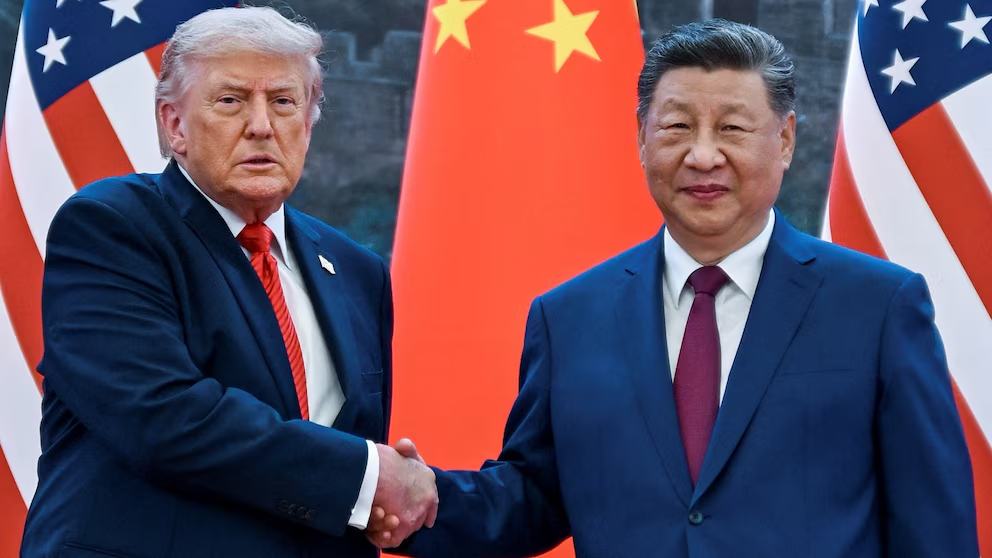
The Trump-Xi Beijing Summit wrapped up on Thursday after roughly two hours of face-to-face talks, leaving observers with plenty to unpack. President Donald Trump and Chinese President Xi Jinping met inside Beijing’s Great Hall of the People in a session that swung between warm personal compliments and pointed warnings, especially on the sensitive question of Taiwan.
A Grand Welcome in Beijing
Before the two leaders even sat down, China rolled out an elaborate reception for the American president. Trump was welcomed with a full guard of honor from the Chinese military, a 21-gun salute, and a group of children waving the flags of both nations while holding bouquets of flowers.
It was a carefully staged display of hospitality, and it set a notably cordial tone for what would follow.
Opening Remarks: Praise and Pleasantries
Xi spoke first once the summit got underway. He described the current global moment as one of “turbulence and transformation” and stressed that Washington and Beijing share a responsibility to cooperate, manage challenges together, and help steady an unsettled world.
Trump, in turn, was effusive. He called Xi “a great leader” and acknowledged that some people dislike hearing him say it, adding that he says it anyway because he believes it’s true. He also pointed to the working relationship between the two of them, noting that whenever a problem came up, a phone call between them tended to resolve it quickly.
The president didn’t stop there. He talked up the American business delegation that accompanied him on the trip, describing it as the biggest and most impressive group ever assembled. According to Trump, he personally invited the top 30 business leaders to join him, and every single one accepted. He said they had come to Beijing to pay their respects to Xi and to China.
What Is the Thucydides Trap—and Why Did Xi Bring It Up?
One of the more striking moments came when Xi raised the idea of the “Thucydides Trap.” He asked whether China and the United States could avoid falling into it and instead build a new framework for how two major powers relate to one another.
So what does the term actually mean?
The phrase was popularized by Harvard political scientist Graham Allison. It draws on the ancient rivalry between Athens and Sparta to describe a recurring historical pattern:
- When a rising power grows quickly, an established power often feels threatened.
- That fear and friction can pull both sides toward conflict—sometimes war.
- Allison applied this lens directly to the modern US-China relationship.
More than fifteen years ago, when Allison first laid out the concept in an op-ed, he urged leaders on both sides to speak far more honestly about potential flashpoints. He also argued that each country would need to make real, sometimes uncomfortable compromises to accommodate the core needs of the other.
By invoking the term himself, Xi signaled that Beijing is well aware of how dangerous the trajectory could become if both sides aren’t careful.
Xi’s Pointed Warning on Taiwan
The most consequential part of the meeting, at least according to Chinese state media, centered on Taiwan—the self-governing island that Beijing claims as its own territory.
Xi reportedly told Trump that Taiwan could become a genuine flashpoint between the two countries. State news agency Xinhua framed his message in conditional terms: handled properly, the broader US-China relationship could remain stable overall.
But Xi’s warning came with a sharp edge. If the Taiwan issue is mishandled, he cautioned, it could trigger clashes and even outright conflict—something that would put the entire relationship between the two nations at serious risk.
He went further still, describing the idea of Taiwanese independence and regional peace as fundamentally incompatible. In his words, the two are as irreconcilable as fire and water.
It was a clear line in the sand, delivered in a setting otherwise full of diplomatic warmth.
Trade Talks: Optimistic Tone, Few Specifics
On the economic front, the messaging was considerably more upbeat. Xi described healthy China-US economic ties as mutually beneficial and a genuine win-win for both sides.
According to state media, he pointed to progress made the previous day, saying the two countries’ economic and trade teams had produced outcomes that were broadly balanced and positive. He called that good news—not just for Americans and Chinese citizens, but for the world as a whole.
Still, the optimism stopped short of detail. Xi did not lay out specifics on contentious issues like tariffs, leaving the precise terms of any trade understanding unclear for now.
Why This Summit Matters
Reading between the lines, the Beijing meeting captured the strange duality of the US-China relationship in 2026. On one hand, there were compliments, ceremony, and talk of cooperation. On the other, there was an unmistakable warning about the one issue that could unravel everything.
A few takeaways stand out:
- Personal rapport is real but limited. Trump and Xi clearly maintain a functional working relationship, yet personal goodwill doesn’t erase deep structural tensions.
- Taiwan remains the fault line. Xi’s “fire and water” language shows Beijing sees little room for compromise on the island’s status.
- Trade is the easier conversation. Both sides seem motivated to keep economic ties productive, even if the hard details are still being worked out.
- The Thucydides Trap framing is telling. When the leader of a rising power openly references the risk of great-power conflict, it suggests both sides know what’s at stake.
The Bottom Line
The Trump-Xi Beijing Summit ended without dramatic breakthroughs or public ruptures. Instead, it offered a snapshot of two powers trying to manage their rivalry rather than resolve it—exchanging praise where they can, drawing boundaries where they must, and leaving the hardest questions for another day.
This remains a developing story, and the coming weeks will reveal whether the cautious optimism on trade holds, and whether the warnings on Taiwan were heard.
Author