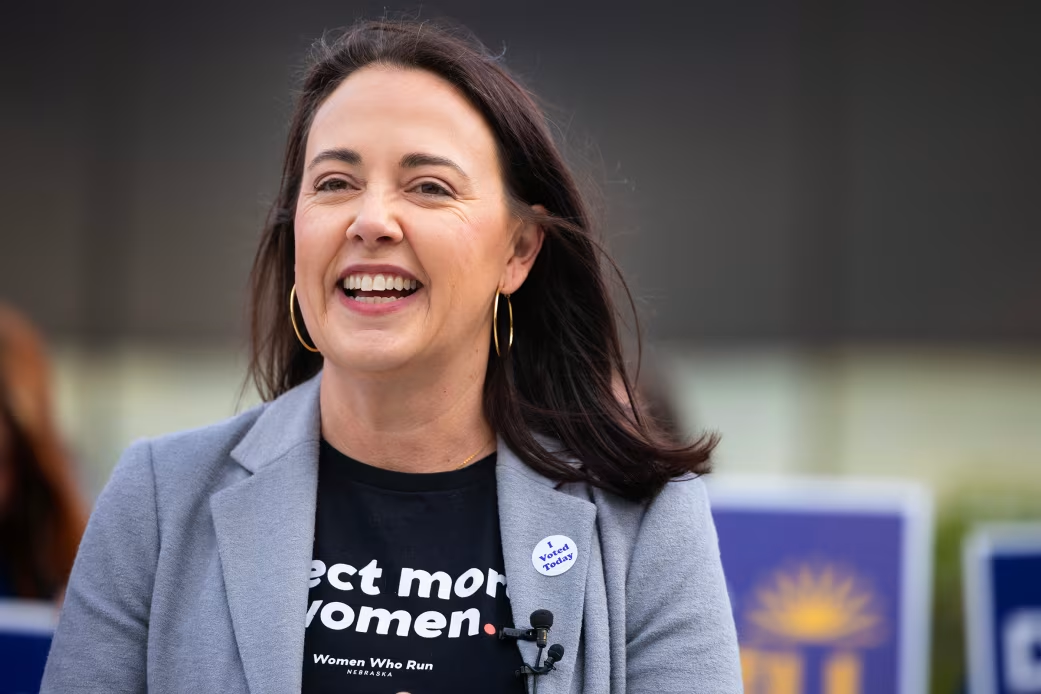
Denise Powell has won the Nebraska 2nd District Democratic primary, narrowly defeating State Sen. John Cavanaugh in one of the most closely watched House races in the country. The Associated Press called the contest on Wednesday, capping a primary that was simply too tight to decide when polls closed the night before.
A Race Decided by a Razor-Thin Margin
When voting ended Tuesday night, no winner could be declared. By Wednesday evening, with about 89 percent of ballots counted, Powell — a longtime political organizer — held a lead of roughly two percentage points over Cavanaugh, according to AP estimates.
That margin isn’t necessarily final. With remaining ballots still being tallied, the gap could shift slightly, though Powell’s lead was enough for the AP to make the call.
In the broader field, Powell took about 38.9 percent of the vote, with Cavanaugh close behind at 36.8 percent. Other candidates, including Crystal Rhoades, Kishla Askins, and Melanie Williams, split the rest.
What Comes Next for Powell
With the primary behind her, Powell now turns to the general election. She’ll face Republican Brinker Harding, who ran unopposed in his primary and carries an endorsement from President Trump.
The matchup is expected to be one of the marquee House contests of the 2026 midterms — and for good reason.
Why This Seat Matters So Much
Nebraska’s second congressional district isn’t just another House race. The eventual winner could help tip the balance of power in a narrowly divided U.S. House of Representatives.
A few factors make this district especially significant:
- The “blue dot” reputation. The district, which covers the Omaha area, was the only part of Nebraska to back Kamala Harris in 2024 and Joe Biden in 2020.
- An open seat. Republican Rep. Don Bacon currently holds the district but is retiring, leaving no incumbent in the race.
- A top Democratic target. Party strategists see the seat as one of their best opportunities to flip a Republican-held district.
All of that attention came with a hefty price tag. Outside groups poured more than $5.6 million into advertising around the Democratic primary alone, based on a review of Federal Election Commission filings by Nebraska Public Media.
The Scenario Nebraska Democrats Wanted to Avoid
Powell’s victory did more than settle a primary — it also sidestepped an outcome that worried many Nebraska Democrats.
Here’s the concern: Cavanaugh currently serves in the state legislature, with a term running through 2028. Had he won the congressional primary and eventually moved to Washington, Nebraska’s Republican governor would have had the power to appoint someone to finish out his state senate term.
Republicans already hold a supermajority in the Nebraska legislature. Losing another seat in a dependable district could have strengthened the GOP’s hand on a high-stakes issue: how the state distributes its electoral votes.
The Electoral Vote Connection
This is where Nebraska’s unusual rules come into play.
Nebraska and Maine are the only two states that don’t use a winner-take-all system for the Electoral College. Instead, Nebraska awards an electoral vote to the presidential candidate who wins each individual congressional district, in addition to votes tied to the statewide result.
That single “blue dot” electoral vote from the second district can carry real weight. In a tight presidential election, many Democrats fear that losing it — or losing the legislative leverage to protect the current system — could prove decisive. Powell’s win helps keep that worry at bay, at least for now.
How the Rest of Nebraska’s Primaries Shook Out
The second district drew the spotlight, but several other races were decided on the same night. Here’s a quick rundown based on AP results as of the morning of May 14, 2026.
Governor
In the Republican primary, incumbent Gov. Jim Pillen cruised to renomination with about 75.7 percent of the vote, far ahead of John Walz and a handful of other challengers. On the Democratic side, Lynne Walz dominated her primary, taking more than 91 percent against Larry Marvin.
U.S. Senate
Republican incumbent Pete Ricketts won his primary comfortably with roughly 81.8 percent of the vote. Cindy Burbank claimed the Democratic nomination with about 89.2 percent, easily outpacing William Forbes.
U.S. House — Other Districts
- District 1: Chris Backemeyer won the Democratic primary with about 57.5 percent over Eric Moyer. Republican incumbent Mike Flood ran uncontested.
- District 3: Republican incumbent Adrian Smith fended off a notable challenge from David Huebner, winning roughly 64.7 percent to 35.3 percent. Democrat Becky Stille was uncontested.
The Bottom Line
The Denise Powell Nebraska 2nd District win sets up a high-profile general election showdown with Trump-endorsed Brinker Harding — a race that could help determine which party controls the U.S. House after the midterms.
For Nebraska Democrats, the result delivered two things at once: a competitive nominee for a winnable seat, and relief from a chain of events that could have handed Republicans even more leverage in the state. With control of Congress hanging in the balance, the “blue dot” is once again poised to be one of the most consequential specks on the national political map.
Author