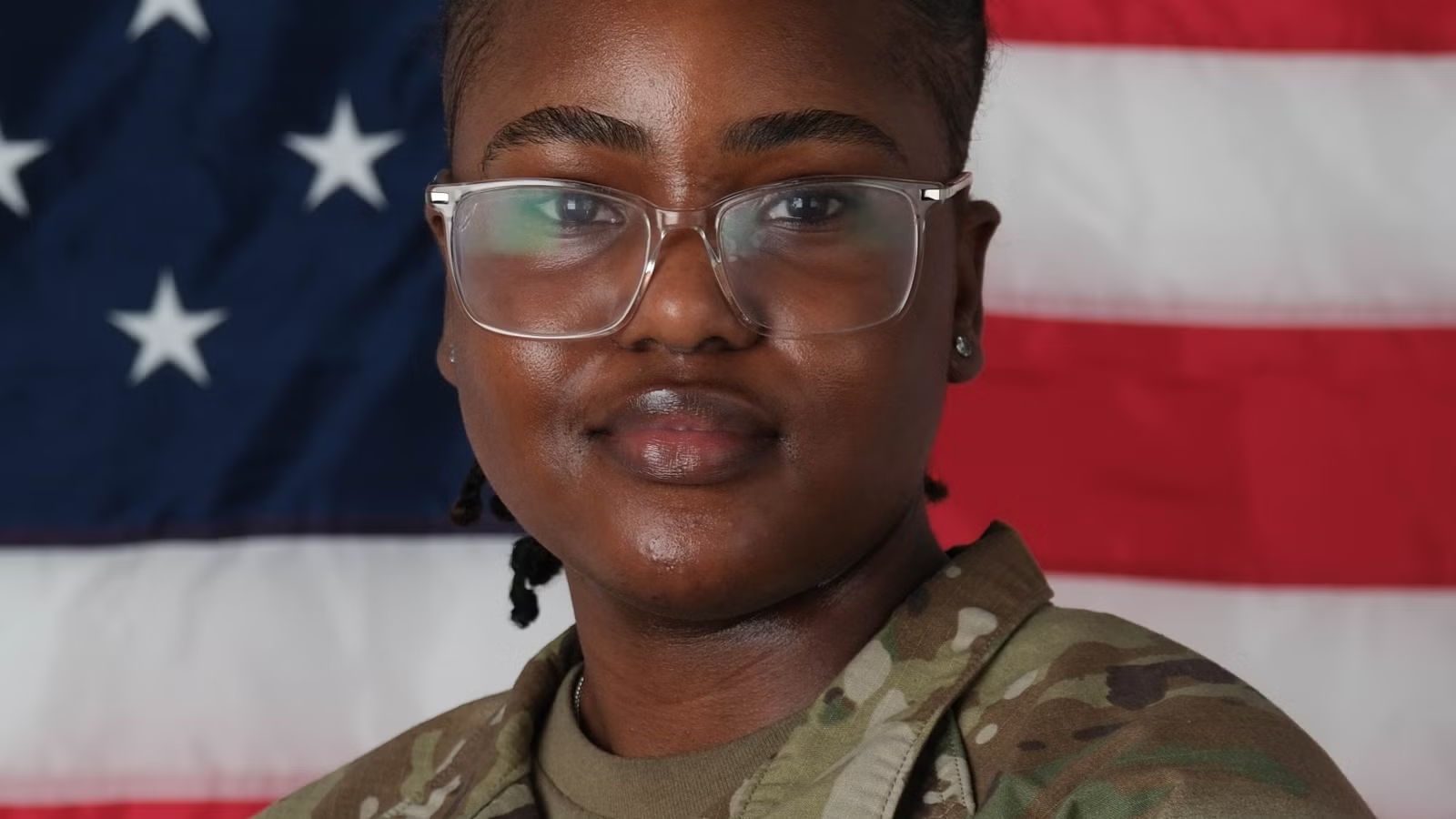
A U.S. soldier was recovered in Morocco this week, bringing a somber end to a search that stretched on for more than a week. The U.S. military announced Wednesday that the body of Spc. Mariyah Collington — the second of two service members who went missing earlier this month — had been found.
The Announcement
U.S. Africa Command confirmed the recovery in a joint statement alongside the U.S. Army Southern European Task Force, Africa. Officials said they mourn Collington’s loss and stand with her family and the 10th Army Air & Missile Defense Command community during a difficult moment of grief.
Her recovery closed out a search effort that had been underway since early May.
What Happened Off Morocco’s Coast
Collington, 19, and 1st Lt. Kendrick Lamont Key Jr., 27, disappeared on May 2 in the waters off Morocco’s southern coast, near the Cap Draa Training Area. Key’s body was found first, on May 9.
Collington’s remains were recovered the following Tuesday, located in a coastal cave roughly 500 meters from the spot where the two had entered the water.
The conditions made the operation especially difficult. According to the Army, rough ocean waters, rugged coastal terrain, and the hard-to-reach cave all complicated the search and recovery work from start to finish.
Once recovered, her remains were transported by helicopter by the Royal Moroccan Armed Forces to the morgue at Moulay El Hassan Military Hospital in Guelmim, Morocco. The Air Force is handling the return of both soldiers’ bodies to the United States.
How the Soldiers Went Missing
Both Key and Collington were in Morocco for an annual multinational training exercise known as African Lion, which drew thousands of troops. But defense officials have been clear on one point: their disappearance did not happen during the training itself.
According to a preliminary report, the sequence of events unfolded like this:
- A group of service members went on a hike to watch the sunset.
- One soldier, who could not swim, fell into the water.
- The second soldier jumped in to attempt a rescue but was struck by a wave.
- Other soldiers tried to reach them both but were unable to do so.
It was, in short, an attempted act of rescue that ended in tragedy.
A Test of Combined Operations
The search itself became a large-scale international effort. More than 1,000 U.S. and Moroccan military and civilian personnel took part, covering over 8,200 square miles of terrain and water.
The operation drew on a wide range of assets, including:
- Drones and fixed-wing aircraft
- Helicopters
- Boats and dive teams
- Mountaineering teams
- Ground search elements
AFRICOM and SETAF-AF described the search as an example of combined operations at their best. They credited the Royal Moroccan Armed Forces for contributing ground, air, and maritime resources — and, just as importantly, their full commitment from the first moment to the last. The exercise African Lion, officials noted, is meant to build exactly the kind of partnerships that matter most in moments like these.
Remembering Mariyah Collington
Collington was from Tavares, Florida. She served as an air and missile defense crew member with Charlie Battery, 5th Battalion, 4th Air Defense Artillery Regiment, within the 10th Army Air and Missile Defense Command.
Her path into the Army began in 2023, when she entered the Regular Army’s Delayed Entry Program. She started active duty service in 2024.
Those who served alongside her described a soldier whose energy left a mark on everyone around her. Capt. Spencer Grider, commander of Charlie Battery, 5-4 ADAR, said Collington was an outstanding soldier whose enthusiasm and positive spirit lifted up every environment she entered. He spoke of her warmth, her humor, and her ability to bring people together — qualities, he said, that would be deeply missed across the formation.
Brig. Gen. Curtis King, commanding general of the 10th Army Air and Missile Defense Command, called her death a profound loss for the command. He noted that while her recovery brought the search for both missing soldiers to a close, the work of caring for their families, friends, and teammates continues. He also expressed gratitude to both U.S. and Moroccan forces for their professionalism throughout the effort.
The Bigger Picture
The story of the U.S. soldier recovered in Morocco is, at its core, a story about risk and partnership. Two young service members lost their lives not in a combat operation or a training drill, but during what began as an ordinary hike to watch the sunset — one of them while trying to save the other.
The response that followed showed what cooperation between allied militaries can look like under pressure. For days, American and Moroccan forces worked side by side across thousands of square miles of unforgiving coastline until both soldiers were brought home.
Their loss is a reminder that service carries danger even in quiet moments, and that the bonds built through exercises like African Lion exist precisely for times when they are needed most.
Author