Bitcoin Macro Selloff Erases Clarity Act Gains as Crypto Liquidations Top $360 Million
The Bitcoin macro selloff on Friday delivered a harsh reminder that even promising regulatory news cannot shield crypto from broader market forces. A sharp jump in government bond yields set off a wave of selling that swept across stocks, gold, and digital assets alike, while crude oil pushed past $100 a barrel and traders scrambled to reprice what the Federal Reserve might do next.
By the time the dust settled, much of the optimism that had recently lifted Bitcoin toward $82,000 had evaporated.
Risk Assets Bounce Off the Lows
After a brutal morning, markets steadied somewhat into the afternoon. Risk assets clawed back a portion of their early losses, though they still finished the session sharply lower.
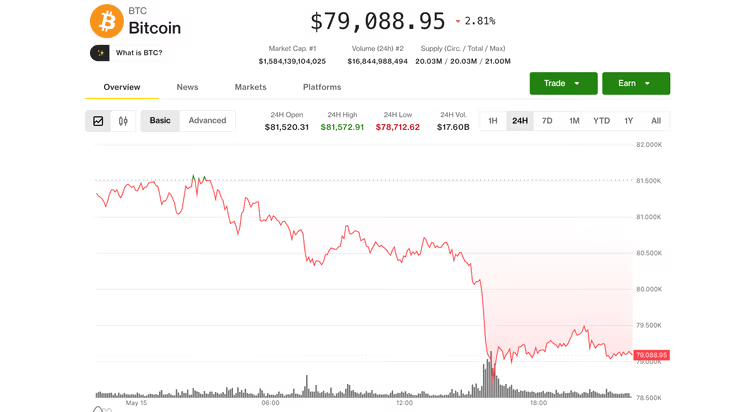
Bitcoin changed hands just above $79,000, down 2.8% over a 24-hour stretch, after dipping as low as $78,600 earlier in the day. Altcoins fared worse. XRP, Cardano, Chainlink, and Avalanche each shed around 5%, while Sui dropped roughly 8%, underscoring how the heaviest selling tends to land on higher-risk corners of the market.
Equities followed a similar pattern. The Nasdaq 100 trimmed its loss to 1.2% by the close, and the S&P 500 ended down about 1%, both well off their worst intraday levels.
A Broad Deleveraging Event
Beneath the price action, the derivatives market told the real story. CoinGlass data showed that more than $360 million in bullish crypto positions were liquidated within 24 hours, the largest flush of leveraged long bets since late March.
That forced unwinding stripped out much of the leverage that had piled up during Bitcoin’s recent climb. The rally toward $82,000 had been fueled in part by progress on the Clarity Act, the crypto market structure bill that advanced through the Senate Banking Committee. As the selloff hit, Bitcoin open interest, a gauge of how much leverage is in the system, fell from above $27 billion to roughly $25.5 billion, according to Coinalyze.
Crypto-Linked Stocks Take a Beating
The pain spread quickly to publicly traded companies tied to digital assets, as investors pulled back from the riskier slices of the market.
Among the notable declines:
- Coinbase, the major crypto exchange, finished down around 8%
- Circle, the stablecoin issuer, slid 7.4%, giving back gains from this week’s Clarity Act-driven rally
- Galaxy, the digital asset investment firm, dropped roughly 5.4%
- Robinhood, the retail brokerage expanding its crypto business, fell more than 3%
- Strategy, the largest corporate holder of Bitcoin, lost 5.4%
- Bitmine Immersion, an Ethereum-focused treasury firm, shed close to 6%
Bullish, the parent company of CoinDesk, was among the steepest fallers alongside Bitmine, with both sliding nearly 9.5% at points during the session.
Miners Hit Hardest of All
Bitcoin miners, a group increasingly linked to the buildout of AI infrastructure, absorbed some of the worst damage. MARA Holdings and Hut 8 each fell around 7%, Cipher Mining dropped nearly 9%, and Bitdeer sank almost 11%, leading losses across the mining sector.
Surging Bond Yields Spark the Rout
The trigger for all of this was a sharp climb in U.S. government bond yields at the start of Friday’s session, which sent investors rushing for the exits across multiple asset classes.
Bitcoin slid to as low as $78,600, a drop of roughly 4% from Thursday’s high near $82,000, before steadying just above $79,000. The selling was hardly confined to crypto. The Nasdaq 100 and S&P 500 opened with declines of 1.7% and 1.2% respectively, and gold fell 2.5% to around $4,500 an ounce.
Oil moved in the opposite direction. WTI crude front-month futures jumped 3% to clear the $100 mark, intensifying worries that energy costs could keep inflation stubbornly elevated.
The Fed Question Looms Large
What unsettled investors most was a shifting view of the Federal Reserve. Rising energy prices and the threat of resurgent inflation have raised the prospect that central banks could be pushed back toward tightening rather than easing.
The repricing has been swift. According to CME FedWatch data, market participants now see close to 50% odds of at least one rate hike before year-end, with almost no chance of a cut. Just a week earlier, the picture looked entirely different: traders had assigned a 28% probability to a rate cut and only about 1% to a hike.
That dramatic swing in expectations helps explain why a single day could undo so much of the momentum crypto had built. Regulatory progress like the Clarity Act may matter for the long term, but when the macro picture turns, leveraged bulls are usually the first to feel it.
Author