The Carney and Smith carbon pricing deal signed Friday in Calgary marks a notable moment in Canadian politics — one where a Liberal prime minister and a conservative Alberta premier publicly found common ground on one of the country’s most divisive issues. Against the backdrop of a possible separation referendum in Alberta, the agreement carries weight far beyond its eight pages.
A Handshake With High Stakes
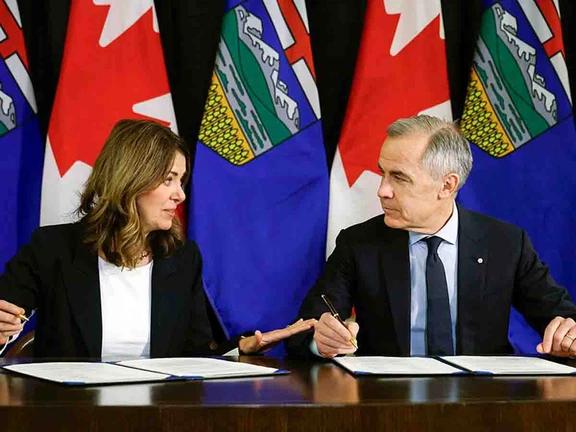
On Friday morning, Prime Minister Mark Carney and Alberta Premier Danielle Smith shook hands, signed official copies of an implementation agreement for the Canada-Alberta memorandum of understanding, and posed for the cameras. The document touches on climate change, resource development, economic sovereignty and, perhaps most pressingly, national unity.
Smith called it “a good day for Alberta” and “a good day for Canada.” Carney framed it as a step toward “building trust in a Canada that works” — a country grounded in cooperative federalism where governments build together both pragmatically and ambitiously.
The Heart of the Deal: A New Carbon Pricing Framework
At the core of Friday’s agreement is a new system for pricing greenhouse gas emissions from large industrial emitters. It applies first to Alberta and is expected to extend to other provinces that previously operated under the federal regime.
Both sides framed the outcome differently. Alberta presented it as a win because the new price is lower than what federal law had previously required. Ottawa, meanwhile, described it as a stronger, more durable pricing system overall.
The numbers tell part of the story. Alberta had frozen its industrial price at $95 per tonne, and inefficiencies in its system meant the effective price was even lower. Under the new deal, the province has agreed to lift the effective price to $130 per tonne by 2040, with a headline price climbing toward $140 per tonne by the same year. Even so, this remains well below the federal backstop, which was scheduled to reach $170 per tonne by 2030.
Climate Concerns and Political Trade-Offs
The compromise has not come without criticism. The agreement follows an earlier decision by the Carney government to abandon plans for a cap on oil and gas emissions, and climate groups argue the combined effect weakens Canada’s environmental commitments.
Rick Smith, president of the Canadian Climate Institute, warned that the implementation agreement places Canada’s net-zero-by-2050 target firmly out of reach. The Pembina Institute went further, estimating that the new pricing schedule could add roughly 230 megatonnes of greenhouse gas emissions over the next 15 years. The federal government, notably, offered no modelling of its own to counter these projections.
Carney pushed back on the criticism, insisting the deal represents genuine “climate action.” He argued that because both governments committed in writing to net zero by 2050, the agreement more than offsets any emissions increase tied to a new pipeline.
Reaction from other political leaders was sharp. Conservative Leader Pierre Poilievre praised Smith but criticized Carney for moving too slowly, saying Conservatives want a pipeline without a carbon tax. NDP figure Avi Lewis condemned the deal as a “surrender to the oil and gas lobby.”
The Pipeline Question
The carbon pricing framework is only one piece of a larger energy puzzle. The next major milestone is July 1, the deadline for Alberta to submit a proposal for a new pipeline to the West Coast. By October 1, the federal government aims to designate the project as being in the national interest, with construction potentially beginning as early as September 2027 and oil flowing by 2033 or 2034.
There are major caveats. No private company has yet stepped forward to build or own the pipeline — Alberta itself has been acting as the proponent. Carney also reiterated that the pipeline depends on oil companies committing to the Pathways carbon capture and storage project, an initiative the industry has promoted since 2022. Friday’s language appeared to soften expectations of how much Pathways would actually cut emissions.
The Oil Sands Alliance, the consortium behind Pathways, complained that even the reduced carbon price keeps costs uncompetitive for the oil sands. The Climate Institute, by contrast, estimated that a $130-per-tonne price would add only about 50 cents to the price of a barrel of oil.
Adding friction, B.C. Premier David Eby criticized the deal, accusing Ottawa of “rewarding bad behaviour” by prioritizing a project tied to a province threatening to leave Canada.
The Referendum in the Background
Hovering over everything is the prospect of a referendum in Alberta, scheduled for October 19, 2026, which could ask voters whether the province should remain part of Canada. Earlier in the week, an Alberta judge threw out a petition seeking to put separation to a vote, ruling it should never have been issued and that the province had failed in its duty to consult First Nations. Smith’s government plans to appeal.
The tension was unmistakable on Friday. Carney’s remarks leaned heavily on “trust” and “cooperation,” while the first questions at Smith’s news conference centred on the referendum. Smith suggested the deal would help convince Albertans that the new prime minister approaches federalism differently than his predecessor — and that Canada is worth fighting for.
A Country Worth Holding Together
No single agreement was likely to erase separatist sentiment in Alberta, and some voters have surely made up their minds. But Carney has now travelled to Alberta twice to negotiate, shake hands and make concessions. It has become harder to argue that Ottawa is the obstacle standing in the way of a pipeline.
Whether the deal ultimately strengthens national unity remains uncertain. What seems clearer is that it has not helped the separatist cause — and may have nudged the conversation, at least slightly, back toward keeping the country together.
Author