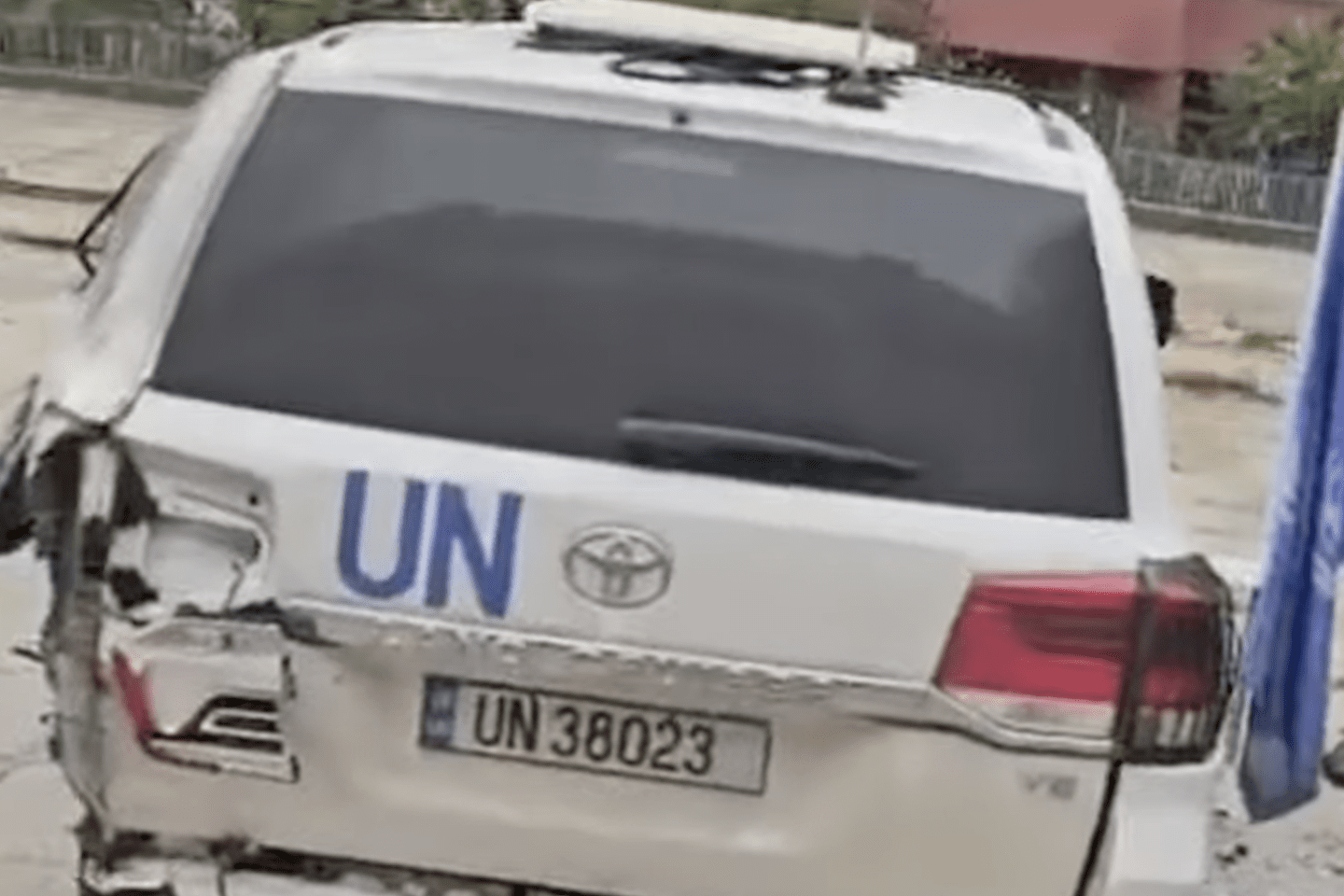
A Russian drone strike on a UN convoy in Kherson has drawn sharp attention — not only because a clearly marked humanitarian mission was hit, but because Russian channels later published footage of the attack while the United Nations declined to say who was responsible.
What Happened in Kherson
On 14 May, a UN humanitarian convoy was struck by FPV (first-person view) drones in Kherson, according to both the UN and Ukrainian regional authorities. The vehicles were plainly marked with UN insignia and were delivering aid to civilians in Ostriv, one of the city’s hardest-hit and least-accessible neighbourhoods.
The mission was carrying food and solar lamps to residents of an area that had gone without assistance for months. Shortly after the convoy crossed a bridge into the area, a drone struck one of its cars. While the team was still distributing supplies, a second drone hit another vehicle. No staff were injured, and the mission was later evacuated.
Andrea de Domenico, head of the UN Office for the Coordination of Humanitarian Affairs (OCHA) in Ukraine, was travelling with the convoy at the time. He said the mission had been carefully planned and that both Russian and Ukrainian authorities had been notified in advance, as is standard practice.
The UN Stops Short of Naming a Perpetrator
What stood out in the aftermath was the UN’s careful language. Despite the visible markings and prior coordination, de Domenico stated plainly that he did not know who carried out the attack.
UNHCR representative Bernadette Castel-Hollingsworth echoed that position. While condemning the violence, she pointed out that both Russian and Ukrainian sides had been informed of the mission beforehand — but stopped short of assigning blame. She described herself as alarmed by the repeated targeting of humanitarian workers and warned that such incidents raise serious questions about adherence to international humanitarian law.
Castel-Hollingsworth noted this was the second such incident within a single week. Just days earlier, a marked UN truck was struck while delivering aid in the Dnipropetrovsk region, leaving its driver in need of treatment. According to UNHCR figures, dozens of incidents affecting humanitarian operations were recorded in the first months of 2026 alone.
Ukraine Calls It a Deliberate Russian Attack
Ukrainian officials were far less hesitant. Oleksandr Prokudin, head of the Kherson Oblast Military Administration, said he met with the UN delegation shortly after the strike. He stated that the convoy had been deliberately attacked by two Russian drones while delivering aid to Kherson.
President Volodymyr Zelenskyy went further, saying Russian forces could not have failed to recognise what they were targeting given the clear UN markings on the vehicles. He confirmed that the head of the OCHA office and several other staff members were inside during the strikes.
Ukrainian Foreign Minister Andrii Sybiha urged the UN and its member states to openly condemn what he called a Russian terrorist attack, stressing that humanitarian workers must never be treated as targets. He noted that a single marked vehicle had been hit twice, in two different locations, with a notable gap between the strikes — a pattern he said pointed to intent rather than accident.
UN Deputy Secretary-General for humanitarian affairs Tom Fletcher also addressed the incident, calling the double strike near the front line “absolutely unacceptable” and demanding a full investigation and accountability.
Russian Channels Publish the Footage
In a striking turn, FPV drone footage of the attack was circulated by a Russian Telegram channel known as “From Mariupol to the Carpathians,” which routinely posts videos of Russian drone operations in Kherson.
The accompanying post described the convoy as a “dual-use target” — a justification frequently used by Russian sources to rationalise strikes on civilian or humanitarian vehicles. The channel even attributed the attack to a specific drone unit operating within Russia’s military grouping in the area.
The contrast was difficult to miss: footage filmed and shared by the side carrying out the strike, set against a UN insistence that the perpetrator could not be identified.
A Pattern of “Human Safari” Strikes
The Kherson attack is not an isolated event. Since Ukraine liberated the right bank of the Kherson region in 2022, the city has remained under constant FPV drone pressure from Russian-held territory across the Dnipro River.
Drone operators have repeatedly targeted civilian vehicles, emergency responders and aid convoys in waves of strikes that residents and local officials describe as a “human safari” — a campaign that appears to treat people moving through the city as prey.
This is also not the first time a UN convoy has been hit in the region. In October 2025, a clearly marked UN inter-agency convoy carrying World Food Programme supplies came under attack near Bilozerka, damaging trucks and destroying cargo. Investigations into that incident pointed to Russian forces using real-time, camera-equipped drones in a wider regional campaign — meaning operators could clearly see what they were striking.
A Troubling Question of Accountability
The 14 May strike highlights an uncomfortable gap between what the evidence appears to show and what the UN is willing to say publicly. Aid routes through Kherson continue to be hit despite clear markings and advance coordination, in what Ukrainian officials describe as the systematic hunting of civilians and humanitarian teams.
For aid organisations operating near the front line, the incident underscores a growing crisis: even clearly identified humanitarian missions can no longer count on protection. And as long as attribution remains officially unresolved, the question of accountability — and of how international humanitarian law is being upheld — stays unanswered.
This remains a developing and sensitive situation, and details may continue to emerge as investigations proceed.
Author