The making of Top Gun is one of Hollywood’s great stories of instinct, ambition and a fair bit of luck. Four decades after its release, the high-flying blockbuster that turned Tom Cruise into a superstar still holds a firm place in pop culture. To mark its 40th anniversary, producer Jerry Bruckheimer and co-writer Jack Epps Jr. have looked back on how it all came together — including the now-legendary moment Cruise vomited on himself during a fighter jet ride.
A Magazine Article That Looked Like Science Fiction
It started in 1983, not on a film set but on a page. Bruckheimer, now 82, was flicking through California magazine when a headline about elite navy pilots stopped him cold. Alongside it sat a striking photo taken from inside the cockpit of an F-14 fighter jet.
“It looked like Star Wars on Earth,” Bruckheimer recalls. He passed the article to his producing partner, Don Simpson, who immediately moved to secure the rights. That single magazine feature became the seed of one of the most influential action films ever made.
The pair pitched the concept to Jeffrey Katzenberg, then head of production at Paramount, who was intrigued. When Katzenberg later floated a handful of ideas to screenwriters Jim Cash and Jack Epps over breakfast, Top Gun was among them — and Epps, a licensed private pilot, jumped at it.
“We Have to Go Up in Real Planes”
For Epps, now 76, the appeal was personal. Even if the film never got made, he reasoned, he might still get a ride in a fighter jet. He had to talk the flight-averse Cash into the project, but he insisted on one non-negotiable creative principle: the aerial footage had to be real.
“We can’t have some special effects of planes,” he remembers telling the producers. “It has to be the real thing.”
That insistence shaped the pitch to the Pentagon. The military agreed to cooperate and lend its equipment — on the condition that Epps himself would have to fly in a navy jet. He was thrilled.
Inside the World of Naval Aviators
Epps was sent to Marine Corps Air Station Miramar to immerse himself in the tight-knit subculture of elite pilots. He interviewed around 30 of them, but the real breakthrough came when he was strapped into a jet himself.
Before flying, he had to complete training, including learning how to eject and surviving the “helo dunker” — an exercise where trainees are submerged underwater and must escape in a precise, systematic way. Once airborne, the pilots warned him they shouldn’t be doing what they were about to do, then put him through close passes and pulled six Gs.
The experience was, in his words, phenomenal. He learned that even with a pressure suit, you have to grunt to keep blood flowing to your brain under heavy G-forces. Watching the pilots execute hard turns, barrel rolls and high-speed passes, he realized something crucial. He called Cash and told him this was not the film they had imagined — these pilots were athletes, competing at speeds neither writer had ever witnessed.
Finding the Conflict
That athletic energy was inspiring, but it left Epps with a problem. The pilots at Miramar were defined by teamwork and unity. A story needs friction, and he couldn’t find any.
The solution came as a flash of insight: what if one pilot didn’t fit in? What if one wanted to be the star, to be the best at the school? That spark became the character of Maverick — the reckless, ambitious flier whose internal drive supplies the film’s central tension.
The Heartbreak at the Center
The film’s most devastating moment — the death of Maverick’s radar intercept officer, Goose — also came straight from real life. During his time at Miramar, Epps sat over coffee with a group of pilots who began talking about friends lost in Vietnam, fifteen years earlier. He was struck by how deeply they still mourned.
As a writer, he had a realization: if he could make audiences feel that same sense of loss, he would have achieved something meaningful. That was the origin of Goose’s mid-film death, a deliberate narrative risk designed to pull viewers emotionally into the cost of losing a friend and a fellow pilot.
Casting Tom Cruise
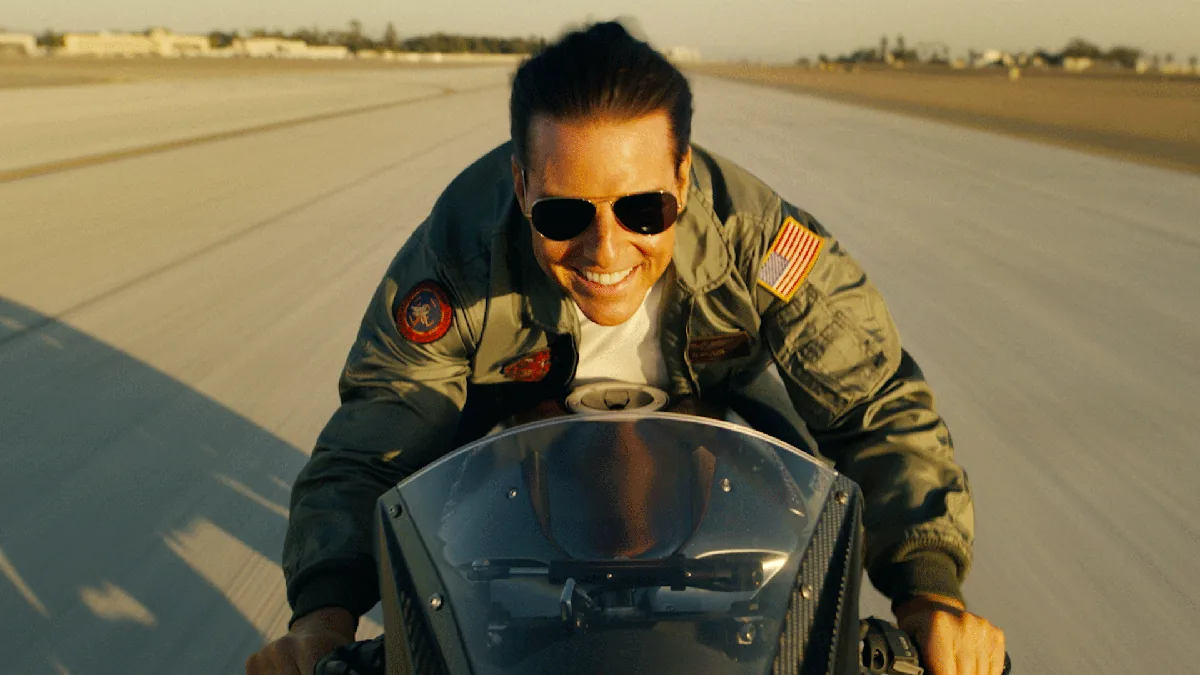
From the start, the writers had one actor in mind for Pete “Maverick” Mitchell. Epps was a Tom Cruise admirer and wrote the role specifically for him, drawn to Cruise’s energy and his ability to connect with an audience. When he handed the finished script to Bruckheimer, he told him plainly to picture Cruise as he read it. Bruckheimer and Simpson agreed instantly.
But landing Cruise wasn’t simple. The young actor — then sporting long hair and a ponytail grown for Ridley Scott’s film Legend — hadn’t committed. So Bruckheimer arranged for him to fly with the Blue Angels, the navy’s premier demonstration squadron, in El Centro, California.
The pilots, unimpressed by his appearance, decided to give “this hippy a real ride.” They shook him around the sky, and Cruise reportedly threw up on himself. His reaction afterward was simple: “I love this.” He walked straight to a phone booth, called Bruckheimer, and said, “I’m in.” That experience also inspired Cruise to become a licensed pilot.
Balancing Spectacle and Story
Under the bold visual eye of director Tony Scott, the production had to balance dazzling aesthetics with emotional substance. Bruckheimer admits early cuts leaned too far toward style. Scott was a brilliant visualist who over-indexed on imagery, so the team sat down scene by scene with the editor to pull the film back toward its story.
There were nervous moments too. An early test screening in Houston, held just after the Challenger space shuttle disaster, fell completely flat — no laughter, no reaction. The team feared a disaster, only to be stunned when the scores came back high.
A Lasting — and Debated — Legacy
Top Gun became the No. 1 film of 1986, earning $357 million worldwide, with a chart-topping soundtrack and an Oscar-winning song. It also drove a surge in military enlistment, prompting the navy to set up recruitment tables in cinemas.
That cooperation has long fueled criticism that the film is jingoistic pro-military propaganda. Epps pushes back, framing it instead through the real service members he met — people he sees as heroes who put their lives on the line, not as warmongers.
As Bruckheimer continues working on a third Top Gun film, he credits the franchise’s endurance to one person above all: Tom Cruise. He describes him as Hollywood’s hardest-working actor, blessed with sharp instincts and an unwillingness to let anything slide until it’s right.
Forty years on, the formula that started with a magazine article still flies.
Author