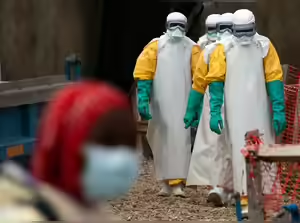
The Congo Ebola outbreak in the country’s eastern Ituri province has turned increasingly grave, with authorities reporting at least 80 deaths as health workers scramble to contain the disease. The toll has climbed quickly since officials first announced the outbreak, and residents describe a community living in fear amid near-constant burials.
A Rapidly Rising Death Toll
Officials confirmed the outbreak on Friday, initially citing 65 deaths and 246 suspected cases. Within a day, the reported death toll had risen to at least 80, underscoring how fast the situation is evolving.
Congolese Health Minister Samuel-Roger Kamba said late Friday that there had been eight laboratory-confirmed cases, including four confirmed deaths. The wider death figure reflects suspected cases that have not all been individually tested.
Marking this as Congo’s 17th Ebola outbreak since the virus was first identified there in 1976, the crisis is once again testing one of the world’s most outbreak-experienced nations.
Fear and Frequent Burials in Bunia
In Bunia, Ituri’s capital, the human cost is impossible to ignore. Residents told reporters they are frightened for their lives as funerals become a daily occurrence.
One local resident, Jean Marc Asimwe, described a grim routine of burying multiple people each day, saying the dying had been going on for about a week and that, in many cases, the community still does not fully understand what disease they are facing. His words capture the uncertainty and dread spreading through the city, even as businesses and public life in Bunia appeared outwardly normal.
A Less Familiar Strain: Bundibugyo Virus
Test results identified the cause as the Bundibugyo virus, a strain of Ebola that has played a much smaller role in Congo’s previous outbreaks. That distinction matters.
The Bundibugyo strain has been linked to only two prior Ebola outbreaks — one in Uganda in 2007 and one in Congo in 2012, each involving fewer than 60 cases. Crucially, there are no approved vaccines or treatments for this particular strain, a significant gap given that effective vaccines exist for the more common Zaire strain. The tools that helped bring earlier regional outbreaks under control will not be available this time.
Ebola itself is highly contagious, spread through bodily fluids such as blood, vomit and other secretions. The disease it causes is rare but severe and frequently fatal.
The Suspected First Case
According to the health minister, the suspected index case is a nurse who died at a hospital in Bunia after showing symptoms consistent with Ebola, including fever, bleeding, vomiting and severe weakness. The case is believed to date back to late April.
So far, the disease has been confirmed in three health zones within Ituri province — the capital, Bunia, along with the areas of Rwampara and Mongwalu, where the outbreak is concentrated. One of those zones is a gold-mining town with a constantly shifting population, a factor that makes tracking the spread far more difficult.
The Outbreak Crosses Into Uganda
Concerns about regional spread are no longer hypothetical. Uganda confirmed an imported Ebola case on Friday, after a Congolese man who had traveled from Congo died at a hospital in the capital, Kampala.
Uganda’s health ministry said the patient’s body was later returned to Congo and that no additional local cases had been confirmed. Still, the case prompted immediate action. By Saturday, people were being screened at the entrance of the Kampala hospital, and Uganda strengthened monitoring at numerous border entry points.
The emotional toll of the news was clear among Kampala residents. One man said the outbreak reminded him painfully of losing his father during the COVID-19 pandemic, recalling the trauma of burying him without being able to see his body.
Neighboring Kenya also responded, describing what it called a moderate risk of importation due to regional travel. The Kenyan government said it had assembled an Ebola preparedness team and reinforced surveillance at all points of entry.
A Difficult Place to Mount a Response
Containing the outbreak is complicated by where it is happening. Ituri lies more than 600 miles from Congo’s capital, Kinshasa, and the region has long been destabilized by violence from armed militant groups. The presence of conflict limits where health workers can safely operate and makes contact tracing harder.
International responders acknowledged these challenges. A World Health Organization official noted that while Congo has deep experience handling Ebola, this particular region is highly volatile, with humanitarian strain and populations frequently moving across borders into Uganda and South Sudan.
Testing capacity is another constraint. Only a limited number of blood samples have been analyzed so far, and several could not be processed at all due to insufficient sample volume — a stark illustration of the logistical hurdles facing health teams.
Medical aid group Doctors Without Borders said it was preparing a large-scale response, describing the rapid spread of the outbreak as extremely concerning.
Concern for Healthcare Workers
Among the most vulnerable are the medical staff treating patients. Dr. Craig Spencer, a New York emergency physician who contracted and survived Ebola more than a decade ago, said he is deeply worried for healthcare workers. He pointed out that medical staff have very close contact with patients precisely when they are most contagious.
Questions About the U.S. Role
The outbreak has also raised questions about the international response, particularly from the United States. The U.S. has historically been the single largest external player in Ebola response efforts, but experts worry that recent cuts to the U.S. Agency for International Development and the country’s withdrawal from the WHO could weaken that capacity.
Spencer suggested the U.S. is currently less able to respond quickly to global outbreaks, noting that response teams once positioned to act almost immediately may no longer be in place. Even so, he emphasized that Ebola is not especially efficient at spreading, and pointed to U.S. facilities equipped to handle high-consequence pathogens as evidence the country remains capable of dealing with the threat.
The Road Ahead
For now, the priority in Ituri is intensifying screening and contact tracing to stop the disease before it spreads further. Residents like Adeline Awekonimungu have urged the government to take the crisis seriously and take firm control of hospitals.
With no vaccine for the Bundibugyo strain, a volatile security situation, and the outbreak already crossing an international border, the coming weeks will be critical in determining whether this becomes another prolonged emergency for the region.
Note: This is a developing public health situation, and case numbers and details may change as testing and investigations continue.
Author