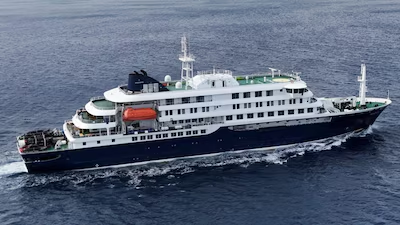
The hantavirus outbreak aboard the MV Hondius transformed what should have been a dream voyage into one of the most unsettling stories of the year — a slow-moving crisis that played out on the open ocean and gripped a world still scarred by the COVID-19 pandemic.
Bad News in the Lounge
It began with a grim announcement. On April 12, the ship’s captain gathered passengers in the lounge of the Hondius to tell them that one of their fellow travelers had died. He assured the group that the death appeared to be from natural causes and that, according to the ship’s doctor, the man posed no infection risk.
Less than two weeks earlier, the same passengers had raised a celebratory toast as the vessel left Argentina, bound for some of the most remote islands on Earth in search of rare birds and wildlife. Now they were consoling a grieving widow.
The deceased man and his wife, both 69 and from a quiet village in the Netherlands, had crossed South America together chasing rare bird sightings. Asked whether she wanted the trip cut short, the widow reportedly urged her fellow birders to continue, saying everyone was there for a reason and that her husband would have wanted the journey to go on. Within weeks, she too would be dead.
A Rare and Unpredictable Virus
Health officials later determined the cause was almost certainly the Andes species of hantavirus — a family of viruses carried by rodents that, in this particular strain, can spread between humans.
As of the most recent updates, the World Health Organization said at least ten cases, most of them confirmed, had been traced to the ship. Two of the three deaths were attributed to the virus, with the third strongly suspected. Dozens of people around the world were forced into quarantine, since the virus has an incubation period that can stretch as long as six weeks.
Public health authorities have stressed that the risk to the general public is low, given that transmission usually requires close, sustained contact. Even so, scientists who have studied the virus for decades caution that it can behave unpredictably and, under certain conditions, may spread without direct contact.
A Voyage Built for Wildlife Lovers
The Hondius, sailing under a Dutch flag, was built to navigate icy waters and reach far-flung corners of the planet. It drew nature enthusiasts hoping to spot dolphins, seals, whales, penguins and rare migratory birds. The trip, priced roughly between $8,000 and $27,000, set out from Ushuaia, Argentina, on April 1, carrying around 175 people from at least 23 countries.
Among the passengers were a Turkish birdwatcher posting online as the “bird detective,” an American travel influencer, and the Dutch couple whose journey would end in tragedy.
In the months before boarding, the couple had toured South America by camper, meticulously logging bird sightings — including a single remarkable day in which they recorded 77 species in just 13 hours. The husband documented nearly all of it on a popular birdwatching website.
Speculation Over the Source
How the virus reached the ship became the subject of intense speculation. Some pointed to a birdwatching spot near a landfill in Ushuaia, a theory that spread through internet memes and late-night television. Argentine officials initially suggested the man had visited the site but would not explain how they knew, and several guides said the couple had not been among their groups.
A local health official dismissed the landfill theory as a disinformation campaign aimed at damaging the area’s tourism reputation. Notably, the man — who recorded so many of his outings in detail — never logged a visit to the landfill.
The First Illness
In the early days, passengers suspected nothing. The American influencer cheerfully documented the ship’s dining rooms, cabins and coffee stations for his followers. The group attended biosecurity briefings before landing on fragile island ecosystems, disinfecting their boots and gear in what one passenger described as a thorough cleaning process.
Life aboard felt festive. Passengers shared buffet meals, dined on lamb for Easter, attended lectures, did laps around the deck, and joined a trivia night that revealed their average age was somewhere in the 60s.
But at some point after an early-April landing, the Dutch man fell ill. After several days receiving intensive care in the ship’s sick bay, he died on April 11 — the final chapter of a journey he had recorded in thousands of bird sightings.
The Outbreak Spreads
In the days that followed, the ship continued its itinerary, stopping at remote islands where passengers mingled with tiny local communities — visiting schools, churches and pubs, and even sharing meals and drinks with residents.
Then the widow began to fall ill. Despite calm seas, she clung to railings and leaned on fellow passengers she affectionately called her protective angels. After disembarking at one island to fly home with her husband’s remains, she grew sicker on the plane, was tended to by flight crew without protective equipment, and was ultimately taken to a clinic where she died. Testing later confirmed she had the hantavirus.
The cases multiplied. Another passenger was medically evacuated and confirmed infected. By late April, others aboard had become ill — including the ship’s doctor who had treated the Dutch couple. In early May, a German woman who had spent time with the couple died on the ship, and testing later confirmed both she and the doctor had the virus.
A Global Alarm
On May 3, the cruise company acknowledged a serious medical situation aboard and requested official testing. Under WHO regulations, that request triggered international protocols — and an anxious world took notice. When the ship reached Cape Verde, passengers were not allowed off.
A WHO representative admitted that early on, there were fears it could be something resembling a new pandemic. Specialists boarded to treat the sick and distribute protective equipment, and several more people were medically evacuated.
Cape Verde argued it was too small to manage the crisis. The WHO turned to Spain, which agreed to let the ship head to the Canary Islands — a decision the Spanish prime minister framed as an act of solidarity during a global health emergency.
Resistance and a Strange Standoff
Local leaders in the Canary Islands fought the decision. In one striking moment, a regional leader sent Spain’s health minister an AI-generated claim that rats are strong swimmers capable of surviving long periods in water — implying the rodents could reach shore and bring the virus with them. The minister responded with a technical report explaining that rats were unlikely to be aboard, and that the rodents linked to hantavirus are not good swimmers anyway.
Even as civil defense aircraft circled the vessel, some passengers carried on birdwatching, now wearing masks, photographing seabirds gliding past the ship.
The Journey’s End
When the Hondius finally reached the Canary Islands, workers in white hazmat suits met the ship. The last passengers disembarked on a Monday evening, headed for chartered flights and, in many cases, weeks of quarantine. Around the world, health experts scrambled to trace and test anyone who might have been exposed — including travelers who had shared flights with infected passengers.
Shortly after 7 p.m., the Hondius sounded its horn four times and turned back toward the open sea, beginning its long voyage home to the Netherlands to be disinfected.
What had started with celebratory toasts and the promise of wildlife in its purest form ended in protective gear, isolation and grief — a vivid reminder of how quickly the natural world can turn from wonder to danger.
Note: This article describes a serious illness and loss of life. Hantavirus details and case numbers reflect reporting available at the time and may be updated as investigations continue.
Author