Trump $250 Bill Proposal Sparks Partisan Clash in Congress
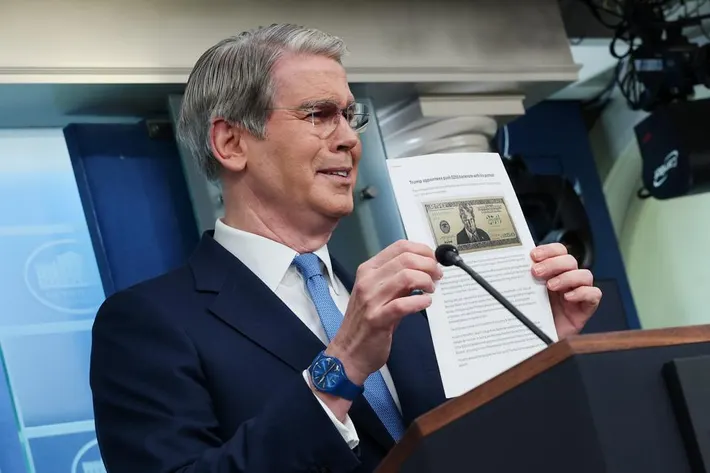
The White House is championing a controversial plan to introduce a Trump $250 bill, a banknote that would feature President Donald Trump’s portrait in celebration of the nation’s upcoming 250th anniversary. Treasury Secretary Scott Bessent confirmed the push, which would require Congress to overturn a longstanding federal law barring any living person from appearing on U.S. currency.
The proposal has already ignited a sharp political divide, with the administration framing it as a patriotic tribute and Democrats vowing to block it.
The Treasury Secretary Makes the Case
Speaking at a White House news conference, Bessent explained that the proposed bill would honor the country’s 250th anniversary of independence. He revealed that the Treasury has already begun preparing for the possibility of issuing the new currency.
Bessent laid out the legal landscape clearly. He noted that he currently operates under two mandates regarding U.S. currency: that no living person may appear on it, and that the currency must carry the phrase “In God we trust.” Legislation now before both the House and the Senate aims to change the first of those requirements, opening the door for Trump to appear on the $250 bill.
Prototypes Already in the Works
Reporting from the Washington Post added a notable wrinkle to the story. According to the Post, two of Trump’s political appointees at the Treasury had urged staff to begin preparing prototypes of a $250 bill bearing Trump’s image. This prompted concerns that simply creating such designs could run afoul of existing federal law.
Bessent sought to address those worries directly, insisting that the Treasury would stick to the law and that the ultimate decision rested with Capitol Hill.
Adding an unexpected detail, the artist behind the prototypes was identified as a Briton named Iain Alexander. According to the Post, Alexander has described himself online as a royal portrait artist, sculptor, and former Olympic squad swimmer.
Defending the Idea Amid Economic Strain
When a reporter pressed Bessent on whether placing Trump’s face on a $250 bill was appropriate at a time when many Americans struggle to afford everyday essentials, the secretary defended the concept. He argued there was nothing untoward about featuring the leader who served as president during the 250th anniversary on a banknote.
A Steep Path Through Congress
The legislation faces an uphill battle. While it would need only a simple majority in the Republican-controlled House of Representatives, its prospects in the Senate appear far dimmer.
The numbers tell the story:
- The bill would require 60 votes to advance in the Senate.
- Republicans currently hold just 53 seats there.
- That gap makes passage unlikely without significant Democratic support, which appears nonexistent.
Hakeem Jeffries, the top House Democrat, wasted no time in rejecting the idea. He declared a firm “hard no” on a Trump $250 bill and told the president to “get over yourself.” Jeffries argued that the upcoming July 4th anniversary should celebrate the American journey rather than serve, in his words, a wannabe king.
The History Behind the Law
The restriction the White House hopes to overturn has deep historical roots. Congress voted in 1866 to prohibit the image of any living person from appearing on currency notes, bonds, or securities.
According to the Bureau of Engraving and Printing, the law emerged soon after the country’s currency superintendent, who had been caught up in a sex scandal, appeared on the five-cent note. The episode prompted lawmakers to establish a rule that has endured for well over a century.
Bessent Touches on the Economy
The news conference extended beyond the currency debate. Responding to questions about the U.S.-Israel conflict with Iran, Bessent predicted that gas and oil prices would come down very quickly once the fighting ends.
He also offered an optimistic take on the Federal Reserve under its new chair, Kevin Warsh. Following their first meeting that morning, Bessent expressed confidence that Warsh would do the right thing to balance inflation and growth. He summed up the shift by declaring it a new day at the Fed, noting that the country now has what he called a Warsh Fed.
What Comes Next
The Trump $250 bill proposal now sits in the hands of Congress, where its fate appears uncertain at best. The plan has crystallized a familiar partisan divide, with supporters casting it as a fitting commemoration of a historic milestone and critics dismissing it as self-aggrandizement.
Given the Senate math and the firm opposition from Democratic leadership, the legislation faces long odds of becoming law. Still, the proposal has guaranteed a lively debate about how the nation should mark its 250th birthday and who, if anyone, deserves a place on its currency. As the anniversary approaches, the clash over Trump’s portrait offers a vivid snapshot of the broader political tensions shaping the moment.
Author