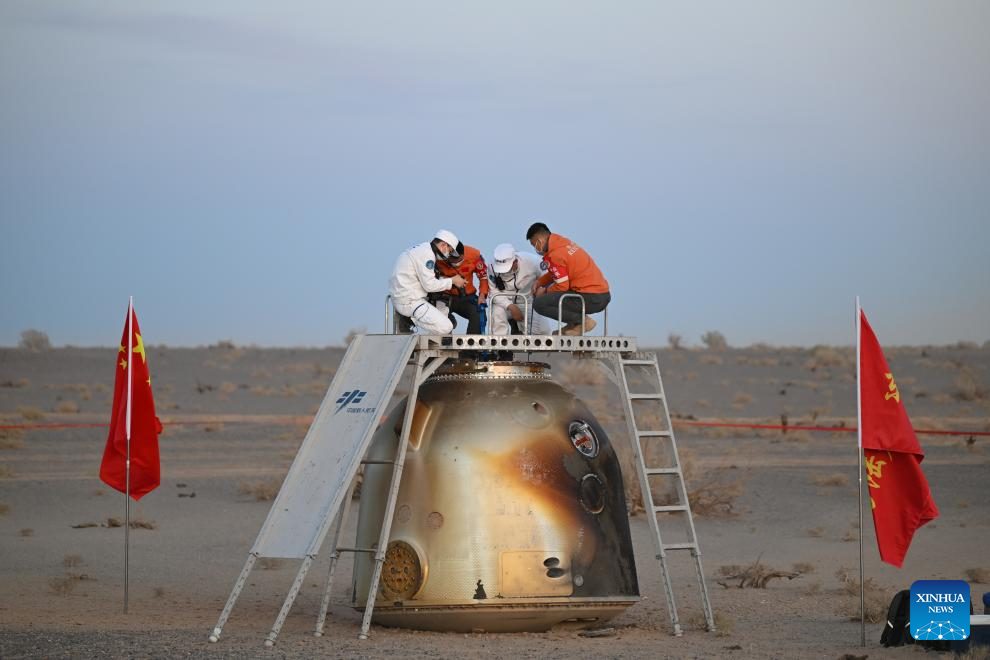
The Shenzhou 21 return has brought one of China’s most eventful and record-breaking crewed missions to a dramatic close. After spending an extraordinary 210 days in orbit, three Chinese astronauts touched down safely on Earth, capping a journey defined by scientific achievement and an unexpected brush with danger that left the crew temporarily stranded in space.
A Safe Landing After a Record Stay
The Shenzhou 21 trio returned home on 29 May from China’s Tiangong space station, landing safely at the Dongfeng Landing Site in Inner Mongolia. The touchdown occurred at 8:11 a.m. EDT, which corresponded to 8:11 p.m. China Standard Time.
The crew’s 210 days aloft set a new record for a Chinese crewed mission, comfortably exceeding the roughly 180-day, six-month stays that are typical for Tiangong missions. Yet perhaps the most remarkable detail is that the astronauts came home in a completely different spacecraft than the one that had carried them into orbit, a twist born from a genuinely alarming orbital event.
The Crew Behind the Mission
The three astronauts who made up the Shenzhou 21 crew were mission commander Zhang Lu, Wu Fei, and Zhang Hongzhang. They launched to Tiangong on 31 October of last year with the goal of relieving the Shenzhou 20 crew already aboard the station.
For each crew member, the mission carried personal significance. It marked Zhang Lu’s second spaceflight, following his earlier journey aboard Shenzhou 15 in 2022 and 2023. For both Zhang Hongzhang and Wu Fei, it was a first trip to space. At just 32 years old, Wu Fei earned the distinction of becoming the youngest Chinese astronaut ever to fly.
Reflecting on the experience shortly after landing, Wu offered a heartfelt observation, suggesting that the mission had taught him the most beautiful form of youth lies in answering the call of one’s country.
A Scary Twist in Orbit
The mission’s most dramatic chapter unfolded shortly after the Shenzhou 21 crew arrived. The Shenzhou 20 astronauts had been scheduled to return to Earth on 5 November. However, pre-departure inspections revealed a troubling problem: a crack in the window of their capsule, believed to have been caused by a space debris strike.
Chinese space officials concluded that bringing astronauts home in the damaged Shenzhou 20 vehicle would be too risky. The solution they devised was both clever and consequential.
Here is how the unusual sequence played out:
- On 14 November, the Shenzhou 20 crew returned to Earth aboard the Shenzhou 21 vessel, the very spacecraft that had just delivered the new crew.
- This left the newly arrived Shenzhou 21 astronauts effectively stranded on Tiangong, without their own ride home.
- To resolve the situation, China fast-tracked the launch of Shenzhou 22, sending it to Tiangong uncrewed on 24 November.
- That spacecraft, Shenzhou 22, ultimately became the vehicle that carried Zhang Lu, Wu Fei, and Zhang Hongzhang safely back to Earth.
The astronauts’ vulnerable, stranded condition fortunately did not last long, thanks to the rapid response from China’s space program.
As for the damaged Shenzhou 20 capsule, it eventually returned to Earth on 21 January without any astronauts aboard. Notably, the spacecraft survived the journey intact, offering valuable data despite the scare it had caused.
A Productive Mission Beyond the Drama
While the spacecraft swap dominated headlines, the Shenzhou 21 crew accomplished a great deal during their extended stay. They conducted three spacewalks over the course of the mission, a significant feat given the demands of operating outside the station.
Their scientific work was equally substantial. The astronauts completed numerous experiments across a range of disciplines, including microgravity fundamental physics, space materials science, space life science, aerospace medicine, and space technology. This breadth of research underscores the growing maturity of China’s orbital laboratory and its ambitions in space-based science.
Passing the Torch
The Shenzhou 21 crew did not leave Tiangong unattended. They were relieved by the three astronauts of the Shenzhou 23 mission, which launched to the station on 24 May. This handover became necessary in part because Shenzhou 22 had been converted into an uncrewed flight following the Shenzhou 20 debris strike, reshuffling the program’s carefully planned rotation.
The incoming Shenzhou 23 crew consists of mission commander Zhu Yangzhu, Zhang Zhiyuan, and Lai Ka-ying, who holds the historic distinction of being the first astronaut from Hong Kong to reach space.
Another Record on the Horizon
The Shenzhou 23 mission carries its own milestone. One of its three crew members is set to spend a full year aboard Tiangong, which would mark yet another first for the Chinese space program. As of now, officials have not revealed which of the three astronauts will take on that extended stay and enter the record books.
Why This Mission Matters
The Shenzhou 21 return is more than just the conclusion of a single mission. It demonstrates both the risks of long-duration spaceflight and the resilience of China’s space infrastructure in responding to them. The space debris strike that damaged the Shenzhou 20 capsule served as a sobering reminder of the dangers posed by orbital junk, a growing concern for all spacefaring nations.
At the same time, China’s ability to rapidly launch a replacement spacecraft and safely retrieve its stranded crew speaks to the program’s increasing sophistication. From setting a new endurance record to flying its youngest astronaut ever and preparing for a year-long stay, China continues to push the boundaries of its human spaceflight ambitions.
As the Shenzhou 23 crew settles in aboard Tiangong, the successful and safe Shenzhou 21 return stands as a testament to careful planning, quick thinking, and the steady advance of China’s presence in orbit.
Author