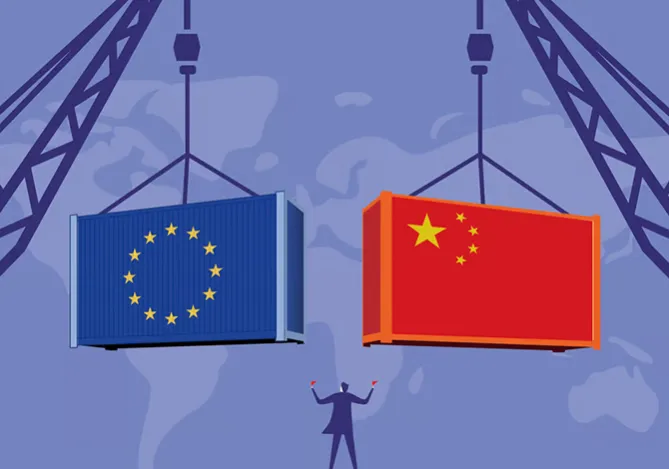
The looming Europe China trade war has moved from quiet anxiety to open alarm, as a flood of cheap goods threatens the continent’s manufacturing base. The mood among European leaders captures the urgency, perhaps best summed up by the top EU diplomat who compared breaking the continent’s dependence on China to undergoing chemotherapy: painful, but possibly necessary to cure the underlying disease.
A Shift in Tone Toward Beijing
That stark medical metaphor reflects the increasingly hardened stance Europe is adopting toward China, its second-largest goods trading partner after the United States. As Beijing pursues more aggressive trade policies and Chinese imports pour into Europe, leaders and companies across the bloc are growing deeply uneasy about their reliance on Chinese products.
The concern runs deep. With China steadily tightening its grip on global manufacturing, Europe increasingly views the situation as an existential threat to its own industries. One economic analyst described the prevailing mood in blunt terms, characterizing it as basically panic, accompanied by a sense of imminent danger and the feeling that European industry could collapse.
Anxiety Meets Hostility
The unease in Brussels is being met with open hostility in Beijing, where officials have warned that China will retaliate against any protective measures Europe might adopt. This sets the stage for a confrontation that is likely to intensify in the weeks ahead.
A series of high-level gatherings will test the relationship. World leaders are expected to address global economic imbalances at a Group of 7 meeting in Evian, France. Shortly after, China is anticipated to feature prominently on the agenda when the European Union’s 27 top leaders convene.
Setting the tone for these discussions, the EU’s executive arm held an early debate on China policy on Friday. In the statement that followed, officials acknowledged that the relationship would demand a more robust and coherent response moving forward.
The Search for a Path Forward
European officials have not abandoned hope of cooperation. Many still express a desire to work with China to address trade imbalances, which have grown more pronounced as Beijing has ramped up exports to fuel its own economic growth. At the same time, however, they are weighing more forceful trade and industrial measures to curb China’s expanding dominance in sensitive sectors.
The challenge is that pulling back from China could prove extraordinarily difficult. Several factors complicate any decisive action:
- Politicians and businesses fear retaliation from Beijing.
- Consumers have grown accustomed to affordable Chinese products.
- Europeans continue to buy cheaper Chinese goods, especially electric vehicles, which the EU has already tried and failed to keep from flooding the market.
As one Brussels-based analyst put it, Europe is not in a good place. She noted that leaders must answer to voters and navigate short-term political pressures, which makes countering the flow of Chinese goods especially hard, particularly if Beijing strikes back. In her assessment, Europe’s systems were simply not designed to handle a challenge of this scale.
Why the Imports Are Surging
Understanding the surge requires looking at China’s domestic situation. The Chinese government has long used subsidies and state programs to bolster its factories and companies. After a property crisis left policymakers searching for a new engine of growth, Beijing leaned heavily on industry. Meanwhile, as American tariffs made exporting to the United States more complicated, Chinese factories redirected their output toward markets like Europe.
The numbers tell the story dramatically. In the first quarter of this year, imports from China into Europe jumped sharply. An analysis of 2026 customs data found that China’s trade imbalance with the EU reached record levels early in the year, driven largely by an influx of electric vehicles.
Several forces converged to produce this spike. Chinese carmakers, facing slumping demand at home, pushed aggressively into Europe. At the same time, European consumers turned toward greener alternatives, a shift accelerated by the war in the Middle East, which drove up fuel prices. This came on top of a goods trade deficit in 2025 of roughly $418 billion, according to EU figures.
The consequences are falling hardest on European manufacturers and their workers, particularly in countries like Germany. Long a powerhouse in car and chemical production, Germany now finds itself struggling to compete.
Harsher Rhetoric and Bolder Ideas
As worries mount, Europe’s response has grown both louder and more ambitious. French President Emmanuel Macron, a longtime China critic, has urged the EU to create measures protecting strategic industries, modeled on those the United States already employs.
Even leaders typically seen as friendlier toward Beijing are shifting. Spain’s Prime Minister Pedro Sánchez, often regarded as one of Europe’s more China-friendly voices, recently argued that China needed to open up so that Europe would not be forced to close itself off.
Spain, at least initially, joined France, Italy, Lithuania, and the Netherlands in preparing a paper urging a more aggressive EU response, including new trade tools. While the document avoided naming China directly, it pointedly criticized trading partners with systemic and structural industrial overcapacity.
Economists observe that many European leaders still tread carefully out of fear of retaliation. Yet that caution may eventually give way as the fear of manufacturing losses grows, especially in industrial heartlands like Germany.
Concrete Steps Already Underway
Europe is not merely talking. The bloc has begun taking protective steps, most notably through the proposed Industrial Accelerator Act. This sweeping policy aims to rebuild Europe’s manufacturing base, and its design would effectively bar Chinese companies from benefiting from certain key subsidies, giving European-made electric vehicles a particular advantage.
Predictably, the plan has provoked outrage in Beijing, which has condemned it as protectionist and warned of retaliation.
China’s Aggressive Playbook
Ironically, China’s own hardening trade stance has helped fuel the European backlash. Last year, Beijing twice banned exports of rare-earth minerals and magnets in retaliation against American tariffs. Those bans struck Europe hard, since the continent relies on both materials for high-tech and green-energy production. The disruption exposed just how dependent European companies had become.
The pressure escalated further in April, when Beijing introduced rules granting officials sweeping powers. These included the authority to examine corporate records, interrogate employees, and even prevent executives from leaving China if they were suspected of helping move supply chains out of the country. According to the European Chamber of Commerce in China, this move could inflict an unprecedented level of damage on Europe’s economy.
Reading Beijing’s Confidence
Why is China pushing so hard? According to one expert on European-Chinese relations, Beijing senses a less unified front against its trade policies as Washington and Brussels spar with each other. With transatlantic tensions visible, China appears emboldened.
The expert summarized Beijing’s implicit message to Europe vividly: that Europe’s reliable American ally is no longer dependable, that even Washington is seeking stability with China, and therefore Europe should not test Beijing’s resolve.
What Lies Ahead
The trajectory points toward continued friction rather than easy resolution. Europe finds itself caught between a genuine dependence on Chinese goods and a mounting determination to protect its own industries. Each protective measure risks retaliation, and every act of retaliation hardens European resolve in turn.
As the G7 summit and the gathering of EU leaders approach, the coming weeks may prove decisive in shaping how this confrontation unfolds. Whether Europe can craft a coherent strategy that shields its manufacturers without triggering devastating retaliation remains the central question. For now, the Europe China trade war is edging ever closer, driven by a flood of imports, deep economic anxiety, and a relationship that grows more strained by the day.
Author