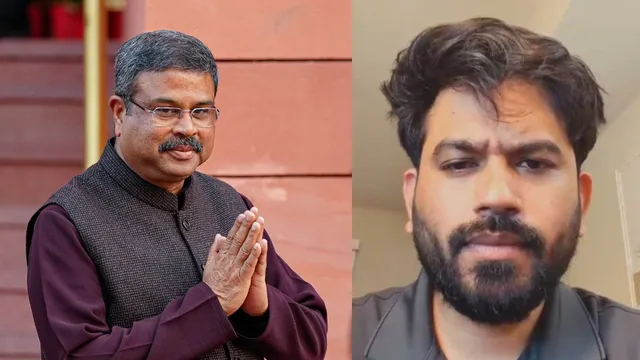
The CJP founder peaceful protest plan has stirred fresh political energy among students and young activists across India. Abhijeet Dipke, the founder of the Cockroach Janta Party (CJP), announced on Monday that he will return to India on June 6 to lead a peaceful demonstration demanding the resignation of Union Education Minister Dharmendra Pradhan over a series of examination-related failures.
The announcement, delivered through social media, has quickly drawn attention amid an already heated debate over the integrity of India’s major examinations.
The Call to Action
In a video shared on both Instagram and X, Dipke urged CJP supporters and students to rally alongside him in Delhi. His message struck a tone of constitutional resolve, framing the protest as a collective and lawful effort to hold the government accountable.
He argued that the moment had arrived for citizens to unite, follow the path laid out by the Constitution, and peacefully raise their voices in demand of Pradhan’s resignation. In his view, a unified voice would be impossible for those in power to ignore.
A Detailed Plan for June 6
Dipke laid out specific logistics for his return and the demonstration that is to follow. He said he would arrive in Delhi on Saturday morning, June 6, and invited his supporters to gather to greet him.
His outlined plan includes several clear steps:
- Arriving at the Delhi airport on the morning of June 6.
- Asking supporters to join him there.
- Proceeding together to the Parliament Street police station.
- Seeking official permission to hold a peaceful protest at Jantar Mantar.
By routing the protest through the proper channels, Dipke appeared keen to emphasize the lawful and democratic nature of his intended action.
Grievances Over Exam Controversies
At the heart of Dipke’s campaign lies deep frustration over recent examination disruptions. In his video, he alleged that the controversies surrounding various exams had left students anxious and uncertain about their futures, and he demanded that the government take responsibility.
He claimed that the turmoil had affected an enormous number of young people. According to Dipke, more than one crore students were impacted, including those appearing for major examinations such as NEET, CBSE, CUET, and SSC GD. For these students, he suggested, the disruptions translated into real worry about what lies ahead.
A Movement Gaining Momentum
The CJP itself is a relatively new phenomenon. Described as a youth-driven social media movement founded by Dipke, it has reportedly gained considerable traction since its launch just last month, attracting the support of various public figures.
Dipke also pointed to broader signs of mobilization beyond his own efforts. He claimed that an online petition calling for the Education Minister’s resignation had gathered eight lakh signatures, and noted that protests over education-related issues were already taking place in states including Uttar Pradesh, Rajasthan, and Maharashtra.
A Pointed Question of Accountability
For Dipke, the issue extends beyond any single exam. He framed the minister’s potential failure to resign as a referendum on the very idea of accountability in India.
He warned that if the education minister did not step down even after what he called a massive blunder, it would signal that accountability no longer existed in the country. That argument positions his protest as part of a larger struggle over governance and responsibility, rather than a narrow grievance.
Facing the Fear of Arrest
Notably, Dipke acknowledged the personal risks involved in his return. He revealed that his family and friends fear he could be arrested upon arriving in India, a concern that adds a layer of tension to his planned homecoming.
Even so, he expressed hope that the authorities would respect democratic norms and permit a peaceful demonstration. He said he still believed the country remained a democracy and that permission to protest peacefully would be granted.
Invoking India’s Icons
Throughout his appeal, Dipke drew on the legacy of some of India’s most revered historical figures. He described himself as a great admirer of Mahatma Gandhi, B.R. Ambedkar, Bhagat Singh, and Jawaharlal Nehru, positioning his movement within a tradition of principled, constitutional resistance.
He declared that he believed in the Constitution above all else and challenged the climate of fear surrounding dissent, asking how long people would continue to live in fear. In a characteristic flourish tied to his party’s name, he called on all peaceful and Constitution-abiding “cockroaches” to come together to safeguard the future of millions of students.
The Backdrop: NEET and CBSE Turmoil
Dipke’s campaign unfolds against a backdrop of significant controversy in India’s education system. The cancellation and subsequent rescheduling of NEET-UG 2026, prompted by alleged paper leaks, along with a dispute over the CBSE’s re-evaluation process, have placed Education Minister Pradhan under intense scrutiny.
These issues have not been confined to activist circles. The Congress party and other opposition groups have also called for Pradhan’s immediate resignation, citing the alleged lapses and amplifying the political pressure on the government.
What Lies Ahead
As June 6 approaches, attention will turn to whether Dipke’s return proceeds peacefully and whether the authorities grant permission for the planned protest at Jantar Mantar. His campaign has tapped into genuine anxiety among students and their families, channeling it into a broader demand for accountability.
The CJP founder peaceful protest represents a test not only of Dipke’s growing movement but also of how the government chooses to respond to mounting public frustration over examination failures. Whether it leads to meaningful change or becomes another flashpoint in an ongoing debate, the coming days are likely to keep the spotlight firmly on India’s education system and those responsible for it.
Author