SpaceX Starship V3 Test Flight Achieves Major Goals Ahead of Historic IPO
The SpaceX Starship V3 test flight delivered a powerful boost to Elon Musk’s space ambitions on Friday, as the company successfully executed a largely smooth mission just weeks before its highly anticipated public listing. The launch from Starbase, Texas saw Starship deploy mock satellites and perform a controlled splashdown in the Indian Ocean, marking a critical step forward for what could become the most valuable IPO in history.
A Critical Test Before SpaceX Goes Public
Friday’s launch was more than just a routine demonstration. It was the official debut of the upgraded Starship V3, a vehicle that has been developed at a cost of more than $15 billion. With SpaceX’s IPO expected next month at a record-breaking valuation of $1.75 trillion, the success of this flight was essential to reassure investors that the company is on track with its long-term goals.
Musk’s vision for Starship goes far beyond rocket testing. The vehicle is central to expanding the Starlink satellite network, supporting upcoming NASA moon missions, and one day enabling deep-space exploration. Investors are watching closely to see whether SpaceX can transform these grand ideas into commercial reality.
A Towering Rocket With Ambitious Goals
Friday’s launch was SpaceX’s 12th test flight of a Starship prototype since 2023 and the very first involving the new V3 model. Both the Starship upper stage and the Super Heavy booster received major upgrades, and the launch took place from a newly built pad specifically designed for the larger vehicle.
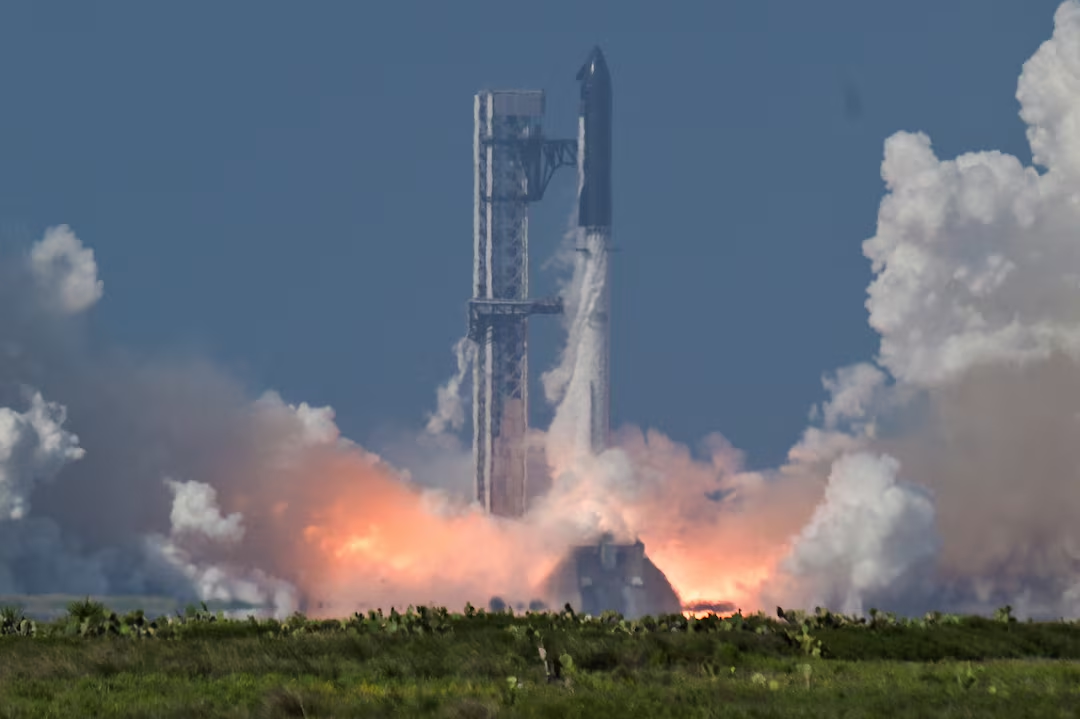
Standing over 40 stories tall, Starship blasted off at around 5:30 p.m. Central Time, lighting up the sky with the thunderous roar of 33 Raptor engines. The fiery liftoff was streamed live on SpaceX’s webcast, with billowing clouds of vapor and exhaust filling the launch site as the rocket climbed away from Earth.
Successful Separation Despite Minor Issues
Minutes after liftoff, the two stages of the rocket separated cleanly, allowing the upper Starship vehicle to continue toward its cruise phase. One of its six engines failed during ascent, but the spacecraft pushed forward without major issues. It successfully deployed its simulated satellite payload, soared through the upper atmosphere, and eventually executed a fiery re-entry before splashing down into the Indian Ocean.
The entire mission lasted just over an hour and was widely seen as a strong demonstration of progress. Although the Super Heavy booster failed to complete its planned boost-back burn after separation and landed in the Gulf of Mexico as expected, the overall flight surpassed most expectations.
Musk Celebrates the Achievement
Elon Musk took to his X platform shortly after the launch, congratulating his team on what he called an “epic first Starship V3 launch & landing.” His enthusiasm reflected just how important this flight was, both for SpaceX’s engineering progress and for shaping the public narrative ahead of the IPO.
Kathleen Curlee, a research analyst at Georgetown University’s Center for Security and Emerging Technology, also praised the mission. She described it as “another meaningful step forward” in SpaceX’s strategy to build the launch capacity needed for its growing ambitions in space. She acknowledged that the flight had some anomalies but said it had clearly met several key objectives.
Mock Satellites and Real Experiments
During its suborbital cruise, Starship successfully released 20 mock Starlink satellites, deploying them one by one as a demonstration of its future commercial role. Additionally, the rocket carried two actual modified satellites that scanned its heat shield during re-entry and transmitted important data back to mission control. This information will be highly valuable for refining the vehicle for future missions.
Due to the loss of an engine early on, controllers chose not to attempt a planned in-space engine re-ignition. However, Starship still completed a return-landing burn at the very end of its flight, executing several maneuvers designed to test the spacecraft under extreme stress. It survived these challenges with its structure intact during the controlled descent.
A Dramatic Final Moment
The test concluded around 65 minutes after liftoff when the Starship vehicle blazed through the atmosphere and landed nose-up in the Indian Ocean. After settling on the water, it tipped over and exploded in a dramatic fireball. SpaceX had already announced before launch that no recovery would be attempted for either the booster or the upper stage. Still, the explosion was met with loud cheers from SpaceX employees watching the live webcast, who saw the dramatic ending as a fitting conclusion to a successful test.
Investors Watching Closely Before the IPO
This flight came at a particularly critical time. SpaceX’s upcoming IPO is expected to mark the first U.S. market debut valued above $1 trillion. If successful, it will instantly turn SpaceX into one of the most valuable publicly traded companies in history.
The future of SpaceX’s most profitable businesses, especially Starlink and its proposed orbital data centers, depends largely on Starship’s success. Investors are eager to see how Musk balances his appetite for risk-taking with his long-term plans for lunar and interplanetary travel.
A Different Kind of Engineering Culture
SpaceX has built its reputation on a uniquely bold engineering philosophy. Unlike many traditional aerospace companies, which often spend years perfecting designs in the lab, SpaceX pushes its rockets to the point of failure during flight testing. The team then learns from each failure and improves the design at high speed. This approach has allowed the company to advance faster than nearly any competitor in the industry.
The Race to the Moon and Beyond
Starship is also at the center of NASA’s Artemis program, which aims to return American astronauts to the lunar surface for the first time since 1972. SpaceX won the $3 billion-plus contract back in 2021 to deliver astronauts to the moon, with the first crewed landing planned for 2028.
This race to the moon has taken on global importance, as China is targeting its own crewed lunar mission by 2030. With Starship intended to support refueling missions in orbit, ship-to-ship docking, and long-duration travel, its capabilities will play a defining role in shaping the next era of human space exploration.
Mars Plans Pushed Back
Musk had previously announced ambitious plans for Starship’s first uncrewed mission to Mars by the end of 2026. That target now appears out of reach. However, the V3 vehicle is designed with deep-space ambitions firmly in mind. Improvements to the Raptor engines, increased maneuverability, and the introduction of mid-flight refueling mechanisms are all aimed at preparing Starship for missions far beyond Earth’s orbit.
What Comes Next for SpaceX
With this latest test flight behind it, SpaceX now turns its focus toward its upcoming IPO and the next series of Starship missions. Each successful flight strengthens the company’s case as the future leader of global space travel. While the road ahead is filled with technical and financial challenges, Friday’s test made one thing clear: Starship is moving closer to becoming the most important rocket of its era, and SpaceX is on the brink of one of the most extraordinary financial moments in modern business history.
Author