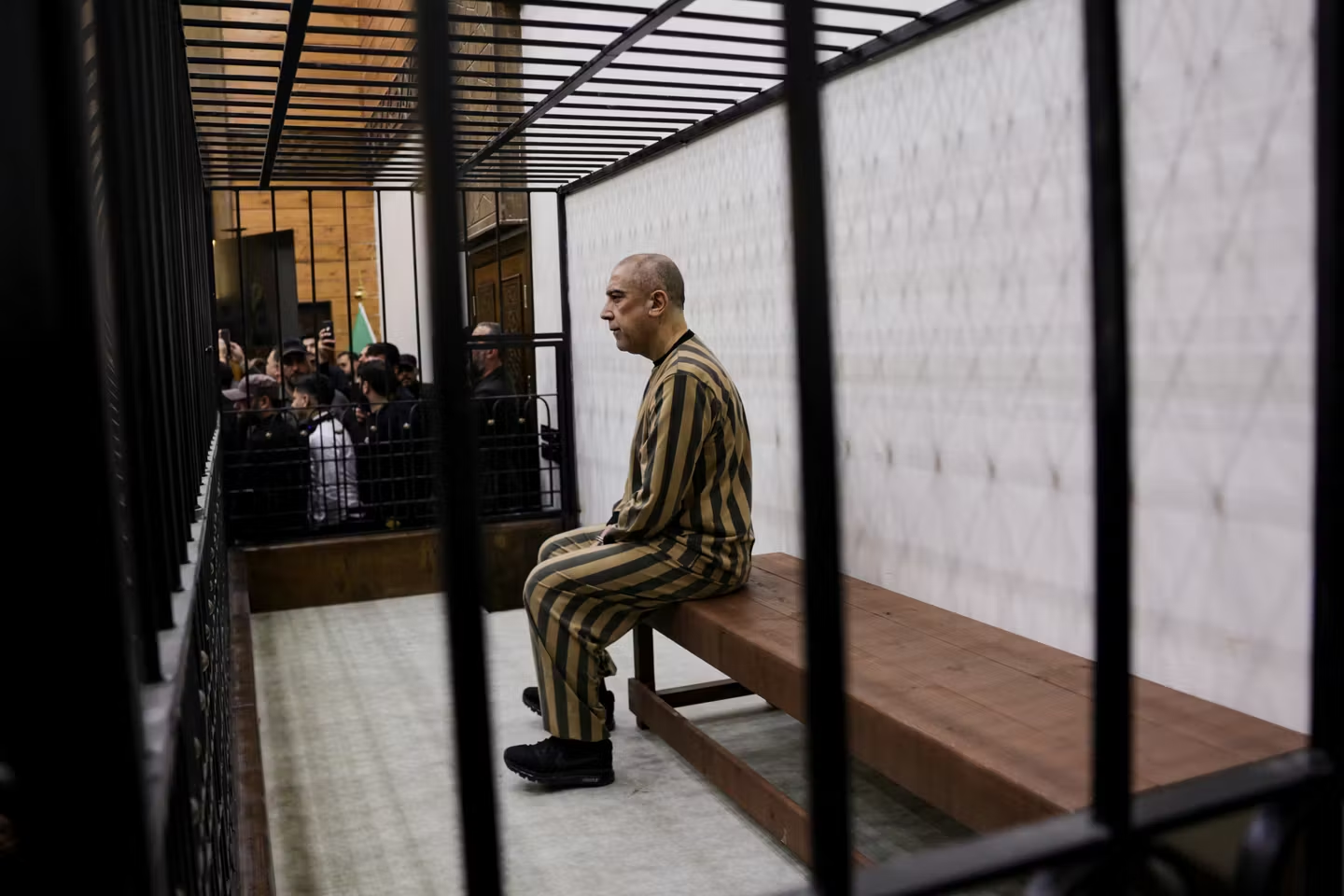
The Syrian officials torture trial that opened in Vienna on Monday marks another step in the long, halting pursuit of accountability for atrocities committed during Syria’s civil war. A former Syrian general and a one-time senior police officer now face justice in an Austrian courtroom, accused of torturing opponents of the now-deposed regime of Bashar al-Assad.
The case is notable not only for the gravity of the allegations but also for the tangled web of intelligence intrigue that surrounds how one of the defendants ended up in Europe.
The Defendants and the Charges
At the center of the trial are two men accused of grave abuses during the early years of Syria’s uprising. According to prosecutors, the pair are accused of having, on numerous occasions, ordered or failed to prevent the mistreatment of members of a protest movement.
The defendants are:
- Brigadier General Khaled al-Halabi, 63, a former brigadier general in the Syrian intelligence services, who has been in pre-trial detention since 2024.
- Lieutenant Colonel Musab Abu Rukbah, 54, a former head of the investigations office of the local criminal police.
The alleged crimes are said to have taken place in Raqa between April 2011 and March 2013, during a brutal crackdown on dissent.
A Pattern of Prosecutions Across Europe
This trial does not stand alone. Several similar cases tied to crimes committed during the Syrian civil war have been brought before courts in other countries, including Germany, France, and Sweden.
These prosecutions reflect a broader effort across Europe to ensure that those accused of wartime atrocities cannot simply find safe haven on the continent. Vienna’s case adds Austria to that growing list.
Not Guilty Pleas and a Hasty Escape
Halabi intends to contest the charges. His lawyer told reporters before the proceedings began that the former general would plead not guilty.
His history adds a dramatic dimension to the case. Halabi fled Raqa in 2013, slipping away just before the Islamic State group seized control of the city. Both he and Rukbah later applied for asylum in Austria in 2015 and have lived in the country ever since.
The Alleged Crackdown
Austrian prosecutors have laid out a stark account of what they say occurred. In their statement, they alleged that on the orders of the central government and the National Security Bureau of the Syrian Arab Republic, 21 individuals held in prisons were tortured and abused as part of the effort to suppress a civilian protest movement.
At the time of Halabi’s indictment, activists regarded him as the highest-ranking Syrian official accused of such abuses to be present in Europe, lending the trial particular symbolic weight.
Serious Charges and Potential Sentences
Both men face an array of serious accusations. Halabi is charged with torture, aggravated coercion, sexual coercion, and multiple counts of serious bodily harm, and could face up to 10 years in prison.
Rukbah, the former police officer, is accused of serious bodily harm, aggravated coercion, and sexual coercion, and likewise faces a potential sentence of up to 10 years.
Notably, the 10-year statute of limitations that would ordinarily apply was lifted in this case. Prosecutors explained that international obligations, including the United Nations Convention Against Torture and the Rome Statute of the International Criminal Court, required them to bring the charges forward.
Why Austria Has Jurisdiction
A natural question is why an Austrian court is hearing allegations about crimes committed in Syria. The answer lies in Austrian law, which provides for local courts to claim jurisdiction over certain offences committed abroad.
In this instance, the Vienna court has authority because the defendants reside in Austria. The trial is set to span 13 hearing days, running through to 30 June, with alleged victims now living in both Syria and Europe expected to testify.
Calls for Stronger Charges
Not everyone is fully satisfied with the scope of the prosecution. Anwar al-Bunni, a Syrian lawyer based in Germany who himself endured five years in Syrian prisons, welcomed the trial as important but expressed reservations.
He questioned why the general had not been charged with crimes against humanity, suggesting the indictment did not go far enough. His perspective, shaped by personal experience of the regime’s prisons, underscores the high expectations many survivors bring to such proceedings.
A Shadowy Path to Europe
Perhaps the most extraordinary element of the case concerns how Halabi reached Austria in the first place. The story involves intelligence agencies, secret agreements, and figures who are themselves now fugitives.
Senior Austrian officials suspected of having shielded the former brigadier general were acquitted in 2023. Prosecutors had accused them of helping him secure protection in the country, pointing to an agreement allegedly reached in May 2015 with Israel’s national intelligence agency, Mossad.
According to local media, Mossad is said to have brought the Syrian military officer to Austria from France, where he was at the time. The alleged arrangement, reportedly code-named “White Milk,” was said to have been overseen by Martin Weiss, then head of the Austrian intelligence service.
Fugitives and Lingering Questions
The intrigue does not end there. Weiss is now on the run in Dubai, wanted in connection with alleged links to another fugitive Austrian spy, Jan Marsalek, who is suspected of being protected by Moscow.
The evidence against Halabi reportedly came to Austrian attention in 2016, when the Commission for International Justice and Accountability, a group that gathers evidence on alleged war criminals, informed Vienna of his suspected crimes.
A lawyer representing 18 of the 21 alleged victims warned of a troubling possibility: that Austria risked becoming a place that sheltered perpetrators rather than holding them to account. That concern hangs over the proceedings as a reminder of how easily justice can be obstructed.
A Trial With Broader Significance
As the hearings unfold over the coming weeks, the Vienna trial carries meaning far beyond the fate of the two men in the dock. For survivors and human rights advocates, it represents a rare opportunity to see senior figures from the al-Assad era answer for alleged atrocities in a court of law.
The Syrian officials torture trial also tests the strength of international legal principles that allow national courts to pursue crimes committed elsewhere. Whether it ends in conviction or acquittal, the case sends a signal that those accused of such acts may find it increasingly difficult to escape scrutiny, even years later and thousands of miles from where the alleged crimes took place.
For the alleged victims preparing to testify, the trial offers something they have long been denied: a chance to be heard. As Vienna becomes the latest venue in Europe’s reckoning with Syria’s painful past, the world will be watching to see whether this proceeding delivers the accountability so many have sought.
Note that this article touches on torture and serious abuse. If reading about these topics is difficult for you, it may help to step away or reach out to someone you trust.
Author