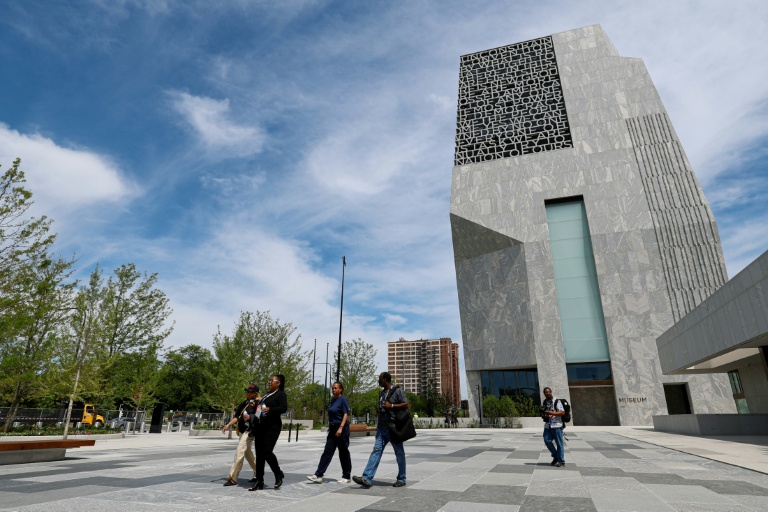
The Obama Presidential Center is finally ready to welcome the public, and a first look inside reveals an ambitious campus unlike any presidential library that came before it. At the very top sits the sunlit Sky Room, the place designed for visitors to stop and absorb everything they’ve just experienced. The panoramic views stretch across Chicago’s South and West Sides and out toward the deep blue of Lake Michigan. Yet the real purpose of the space is reflection, a quiet pause after climbing through floors of history and Barack Obama’s political legacy, memories still fresh for many.
Overhead, a striking artwork by Idris Khan creates the sensation of endless upward motion. Words drawn from Obama’s celebrated Selma, Alabama, speech are stamped and layered, rising as a band of blue toward a rim of light. In Selma and elsewhere, the former president often spoke of shaping the future together, and that theme lingers as the closing note of the journey: an open, unwritten road ahead.
A Decade in the Making
The long-awaited center opens to the public on June 19, deliberately timed to coincide with Juneteenth. More than ten years in the making, it carries a price tag of $850 million, a figure that kept climbing until it became, by a wide margin, the most expensive presidential library ever built.
That cost reflects its scope. This is not a single building but an entire 19.3-acre campus, conceived by architects Tod Williams and Billie Tsien. It reimagines the conventional idea of an archival library, offering instead:
- A museum tracing Obama’s political journey
- Space for community events and gatherings
- A fruit and vegetable garden
- An NBA regulation-sized basketball court
- A new branch of the Chicago Public Library
Ahead of the opening, Obama embarked on a lively promotional run, playing Wordle with Stephen Colbert, patching up a public spat with NBA star Anthony Edwards, and marking Star Wars Day alongside Mark Hamill in front of the center. That last appearance felt like a playful nod to one of the building’s nicknames, the “Death Star.” Its heavy granite form has also earned the label “Obamalisk,” used affectionately by some and mockingly by others.
A Building Made of Many Hands
Despite the colorful nicknames, Williams and Tsien rooted the museum’s shape in an image of four hands coming together, a symbol of the many hands that shape a place. Williams brushed aside the labels, saying he cares only about what the center is, what it does, and what it will become. Tsien framed their thinking in remarkably long terms, describing it as a “500-year building” where every choice aimed at something lasting and timeless.
When CNN toured the campus during its soft opening, the space was already buzzing. Community members arrived as the first guests, school groups came on field trips, and visitors lined up for exhibitions, riding escalators past Julie Mehretu’s vivid 83-foot vertical window. Tsien admitted the experience had been moving, describing how people walk in, look up, and feel a sense of ownership, as though the place is truly theirs.
Breaking With Tradition
The center departs from precedent in another significant way. Rather than being managed by the National Archives and Records Administration, it is run privately by the nonprofit Obama Foundation. The presidential archive, still overseen by the Archives, has become fully digital for the first time, a process that required scanning roughly 30 million pages. Portions of that archive are on display in the museum.
Not everyone has embraced the project or its expense. Residents have raised ongoing concerns about gentrification on the South Side, and the choice of location within the historic Jackson Park sparked legal challenges. An environmental group sued the City of Chicago over building a private project on public land, though the case was eventually dismissed. While the center added 3.7 acres to the park, construction also claimed hundreds of trees and the historic Women’s Garden from 1937, which was demolished and then reimagined for the new campus.
Obama Foundation CEO Valerie Jarrett emphasized the recreational spaces built from the outset, including an athletic field completed before the main plazas, along with gardens, green spaces, and even a sledding hill. She pointed to thousands of community meetings held to ensure the campus would blend into its surroundings and that nearby residents would feel a genuine stake in it.
Tracing the Obama Era
Inside, exhibitions explore the former president’s political legacy, the former first lady’s public initiatives, and the broader historical movements that shaped them both, from the Civil Rights era to women’s suffrage. Visitors encounter campaign keepsakes and memorabilia, including Shepard Fairey’s famous HOPE poster and children’s drawings. A video documenting the grassroots energy of the 2008 campaign counts down to that pivotal election night through footage of volunteers on the trail.
The museum also captures the Obamas’ influence on style and culture. On display are some of Michelle Obama’s most memorable looks, among them the greenish-gold ensemble Isabel Toledo designed for Inauguration Day in 2009 and the gown by Michelle Smith of Milly worn for Amy Sherald’s National Portrait Gallery painting. Notably absent is the president’s famously debated tan suit, which Jarrett said he gave away.
A full-scale replica of the Oval Office invites guests to sit at the desk. While Obama isn’t the first president to recreate the room, it stands out at a moment when the actual Oval Office has shifted dramatically in style, moving from understated to heavily gilded under the Trump presidency. Former White House interior designer Michael Smith was visibly emotional during an early glimpse of the replica in March.
Art on a Grand Scale
Across the campus, 30 artists have produced site-specific permanent works on a scale that would test even a major contemporary art museum. Curated by Virginia Shore, the collection places renowned and lesser-known artists in dialogue, many with deep ties to Chicago. The pieces include Mark Bradford’s vast tactile painting of the city, a nearly two-story beaded tapestry by Nick Cave and Marie Watt, and Martin Puryear’s sweeping outdoor sculpture honoring Martin Luther King Jr.
Other works reward quieter discovery, like Richard Hunt’s sculpture of a bird rising from a book in a courtyard near the library, or Rashid Johnson’s mosaic in the center’s Teaching Kitchen beside the produce garden. Artist Theaster Gates, a neighbor to the center through his Rebuild Foundation, contributed a frieze of archival images from Ebony and Jet magazines in the Forum building. He expressed hope that visitors would arrive with open hearts toward the future of democracy and the power of collective storytelling and belief.
Museum director Louise Bernard said the artists collectively tell a story about community, gathering, and art’s power to energize people. The works, she explained, lift up a sense of hope, speak to the power and place of Chicago, and explore memory, place, and the way color can transport those who experience it.
Author