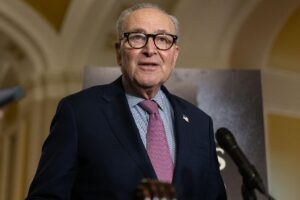
The story of Schumer Senate Democrats 2026 is shifting. After more than a year as a favorite target of frustrated Democrats, Senate Minority Leader Chuck Schumer is beginning to push back, arguing that his strategic bets are finally paying off as his party closes in on a real shot at retaking the Senate majority this November.
A Cautious Show of Confidence
With roughly five months until the midterms, Schumer is gently making his case. Speaking from his Capitol office, he was careful not to overstate things, acknowledging there was “no victory lap to take in June.”
Still, he walked through a series of moves he oversaw over the past year that he believes strengthened the party’s position. These included leading opposition to Republican safety-net cuts, picking shutdown fights over health care and immigration enforcement funding, and orchestrating national interventions in several Senate primaries.
His central message was that none of the recent progress came by chance. He argued that recruiting strong candidates, finding paths to victory, focusing on issues voters care about, and forcing Republicans to defend Trump’s agenda had all combined to put Democrats in a far better spot.
A Rocky Road to This Moment
Schumer’s renewed confidence follows a turbulent stretch. His decision to help advance a Republican government funding bill in March 2025 triggered a wave of calls from progressive groups and House Democrats for him to step aside as leader.
The criticism flared again when eight members of his caucus broke ranks to help reopen most of the government after a record-long shutdown in November. Polling has reflected the strain, showing declining favorability and approval for Schumer, even in his home state of New York, where voters have elected him to the Senate five times.
He has, however, held onto support among the Senate Democrats who chose him as leader, though some have grown noticeably cautious when asked about his future. Sen. Chris Murphy, part of a self-styled “fight club” pushing for a more aggressive party approach, sidestepped a direct question about whether Schumer would remain leader, saying only that Democrats were focused on winning a majority first.
Signs of Momentum
Recent weeks have offered Schumer some vindication. In the Iowa primary, his preferred candidate, state Rep. Josh Turek, prevailed even as progressives backed a more liberal contender. Polling now shows a tight race between Turek and Republican Rep. Ashley Hinson.
Schumer had already helped land high-profile recruits in several key states, drawing former Sen. Sherrod Brown into the Ohio race, former Rep. Mary Peltola in Alaska, and Gov. Roy Cooper in North Carolina. Texas has even entered the conversation, where state Rep. James Talarico faces scandal-plagued Attorney General Ken Paxton.
Sen. Tim Kaine said the tone around Schumer’s leadership has shifted since the March 2025 funding fight. He praised Schumer as a highly successful majority leader by nearly any measure, noting it took the whole caucus time to adjust to operating in the minority with a different set of tools. In Kaine’s view, Schumer eventually made that mental switch and sharpened the party’s pitch to the public.
The Maine Complication
Not every intervention has gone smoothly. In Maine, Schumer’s backing of Gov. Janet Mills over populist insurgent Graham Platner deepened grassroots frustration with his strategy. Mills ran what was widely seen as a lackluster campaign and suspended it weeks before the primary.
Yet the calculus shifted with a string of revelations about Platner, ranging from provocative online posts to a recent allegation that he was physically abusive toward a former girlfriend. Those disclosures suggested party leaders may have had sound reasons to favor a known quantity in their effort to unseat veteran Republican Sen. Susan Collins.
Asked about Platner, Schumer deflected, pivoting instead to a confident prediction that Democrats would beat Collins, win Maine, and reclaim the Senate.
The Battle for the Majority
Despite the optimism, flipping the Senate is far from guaranteed. Democrats will need to run the table across several Trump-won states, while Republicans entered the cycle with a structural edge, defending relatively few competitive seats.
Senate Majority Leader John Thune projected confidence that Republicans would hold and perhaps even expand their majority, pushing back against the prevailing narrative. Democrats, however, sense an opening. Kaine said that at the start of 2025 he would have put the odds of a Democratic takeover at 20 percent, but now places them at 45 percent and rising.
The party has long viewed its path back to power as running through four states: Maine, North Carolina, Ohio, and Alaska. Schumer believes new paths have opened as well, pointing to Iowa and Texas.
Trouble Spots Remain
Democrats also have to protect seats they already hold. In Georgia, incumbent Jon Ossoff is running a strong campaign. Michigan, by contrast, remains far more uncertain and highlights the challenges Schumer still faces.
Party operatives worry that progressive candidate Abdul el-Sayed could emerge from a messy three-way primary and complicate the party’s chances of keeping retiring Sen. Gary Peters’ seat. In what many read as an effort to narrow the field, Schumer voiced his preference for Rep. Haley Stevens, telling Punchbowl News she had the best chance to win.
That move drew fire. State Sen. Mallory McMorrow, the third leading candidate, seized the moment to attack Schumer, posting a video accusing the party of putting its thumb on the scale and insisting voters, not Schumer, should decide.
Pressed on whether Democrats would hold Michigan regardless of the nominee, Schumer declined to single out a candidate, saying only that the party would field a strong nominee who fit the state. He defended his recruitment approach with a pointed jab at his critics, saying he looks for great candidates rather than ones who simply fit the national Democratic profile.
Looking Ahead
For Schumer, the coming months will test whether his strategic gambles truly add up to a Democratic resurgence. The momentum is real, but so are the obstacles, from contested primaries to a favorable Republican map. As he made clear, he sees the party’s improved fortunes as the product of deliberate choices rather than luck, and now he is betting those choices will carry Democrats back into the majority.
Author