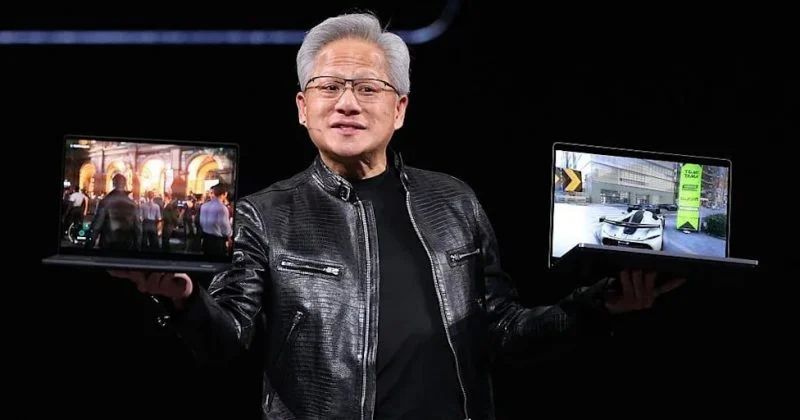
Nvidia Enters the PC Chip Market: Jensen Huang’s Bold Bid to Dominate Every Layer of AI
Nvidia’s move into the PC chip market marks one of the boldest strategic gambles of CEO Jensen Huang’s career, and Wall Street took notice immediately. As Nvidia revealed plans to design chips for personal computers, shares of rivals AMD, Intel, and Qualcomm slid on Monday, a sign that investors grasp just how disruptive this push could be. For Huang, the message was unmistakable: he wants Nvidia to win at every layer of artificial intelligence, not just the data center where it already reigns supreme.
Reinventing the PC
Speaking at Taiwan’s Computex conference on Monday, Huang declared that Nvidia, in partnership with Microsoft, intends to “reinvent the PC.” The vehicle for that ambition is a new system-on-chip, or SoC, designed specifically for personal computers.
The announcement sent a clear ripple through the industry. While shares of established CPU and mobile chipmakers fell, Nvidia’s own stock jumped more than 6%. With a market capitalization of around $5.4 trillion, the company is now the most valuable on the planet, sitting nearly $1 trillion ahead of its closest U.S. competitor.
Huang didn’t downplay the stakes. He compared the shift to the transformation of the basic mobile phone into the modern smartphone, arguing that agentic AI will soon run across every new computer.
Meet the RTX Spark
Nvidia is formally entering the market with a chip called RTX Spark, developed jointly with Taiwan’s MediaTek. Huang also referred to it as the N1X. The chip is set to debut later this year in a fresh wave of Windows PCs from major manufacturers, including:
- Microsoft
- Dell
- HP
- ASUS
- Lenovo
- MSI
Under the hood, the RTX Spark pairs Nvidia’s cutting-edge Blackwell GPU with a MediaTek CPU on a single chip. One standout feature is unified memory, which lets the CPU and GPU draw from the same pool of memory. That design removes a major bottleneck in AI processing and allows the chip to run larger, more capable models directly on the device.
The Push to the Edge
The deeper story here is Nvidia’s expansion beyond the data center toward what the industry calls “the edge,” where smaller devices like laptops and phones run sophisticated AI models on their own hardware rather than relying on the cloud.
Analysts read the move as a statement of total ambition. As IDC’s Tom Mainelli put it, Nvidia entering this space reflects Huang’s desire to own every piece of the AI stack in some form. Chip analyst Patrick Moorhead echoed that, noting that all AI computing, wherever it happens, is the real prize, and that Huang won’t be satisfied with just the data center and automotive markets.
Huang tied the technology to one of Silicon Valley’s hottest trends: AI agents. He suggested that background agents, which developers increasingly rely on to boost productivity, could run perfectly well on local machines, and far more cheaply than in the cloud. Holding up a small MSI computer built on Nvidia hardware, he marveled that such an agent could run around the clock with “no meter anxiety.”
A Tough Market to Crack
For all its momentum and financial firepower, Nvidia faces a genuinely difficult challenge. The PC chip market has long been dominated by the Intel-AMD duopoly. Qualcomm has rolled out its own Windows laptop SoCs over the past two years, and Apple, which holds roughly 9% of the PC market, has been making its own processors since 2020.
There’s also the question of scale. In the near term, the PC business is a relatively small piece of Nvidia’s empire. Consider the comparison:
- Nvidia’s networking business alone posted about $15 billion in sales in its most recent quarter, which one analyst estimated is at least 20 times the size of its prospective PC business.
- Total data center revenue topped $75 billion in the latest quarter.
- By contrast, Intel’s client computing group brought in $32.2 billion across all of 2025.
Analyst Ben Bajarin of Creative Strategies described the PC space as highly underpenetrated for Nvidia, framing the launch as the opening move in a long-term effort to gain share. Seaport Research Partners analyst Jay Goldberg was more skeptical, writing that he doesn’t expect meaningful revenue from Nvidia’s PC chips anytime soon, and he holds a sell rating on the stock.
A Second Chance for the AI PC
The launch also revives a concept that has so far underwhelmed. The “AI PC,” introduced by Microsoft and its partners in 2024, failed to ignite much of a revival, hampered by a shortage of compelling software and Microsoft’s struggles with its Copilot technology.
Still, the broader PC chip market is showing signs of life. IDC estimates 296 million PC chips shipped in 2025, the first increase in three years, though still below the pandemic-era peak of 361 million in 2021. Moorhead projects Nvidia could sell around 10 million PC chips over the next two years.
Some analysts believe Nvidia’s deep AI credentials could give the AI PC the credibility it has lacked. Because so much cloud-based AI already runs on Nvidia hardware, the company’s decision to bring that expertise to personal devices is, as Mainelli noted, genuinely intriguing even if Nvidia isn’t first to the idea.
Another Crack in the x86 Wall
Nvidia’s announcement also underscores the growing dominance of Arm architecture. For decades, CPUs have run on the x86 instruction sets pioneered by Intel in the 1970s and adopted by AMD years later.
Arm’s more power-efficient approach went mainstream when Apple chose it for the original iPhone in 2007. Amazon later brought Arm to the data center with its Graviton processor in 2018, and Google and Microsoft soon followed with their own custom Arm CPUs. Nvidia itself tried to acquire Arm for $40 billion in 2020, a deal regulators ultimately blocked, but one that previewed exactly the SoC ambitions on display now.
That migration has only accelerated. Apple ended its long reliance on Intel x86 chips and now uses its own Arm-based processors across its computers. Arm unveiled its first in-house CPU in March, attracting early customers like Meta, OpenAI, Cloudflare, and SAP, while AMD is reportedly developing an Arm-based PC chip of its own. Huang has predicted the overall CPU market will swell into a $200 billion industry as AI shifts from simple chatbots toward task-oriented agentic applications.
Taking Aim at the MacBook
Nvidia’s RTX Spark chips will likely appear first in premium machines, with more affordable options arriving later. Paired with AI features from companies like Adobe and Microsoft, Nvidia-powered laptops could become the first Windows devices in years to seriously challenge Apple’s MacBooks in the high-end category.
As Moorhead summed it up, this represents the closest the Windows ecosystem has come to truly taking on the MacBook Pro.
The Bottom Line
Nvidia’s entry into the PC chip market may not move its financial needle right away, but the strategic intent is crystal clear. By extending its AI dominance from the cloud all the way down to individual devices, Jensen Huang is betting that the future of computing will be defined by AI running everywhere, and he wants Nvidia at the center of it at every level. Whether the company can break a decades-old duopoly remains to be seen, but few would bet against the world’s most valuable company when it sets its sights on a new frontier.
Author