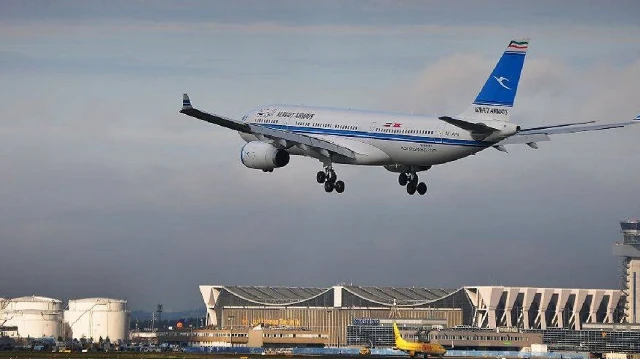
The Iranian attack on Kuwait airport has thrown Gulf aviation into chaos, forcing the country to suspend all commercial flights after drones and missiles slammed into one of the region’s busiest travel hubs. The strike, which damaged the main passenger terminal and left several people injured, marks a dangerous new escalation in the widening conflict between Iran and the United States.
What Happened at Kuwait International Airport
In the early hours of Wednesday, Kuwait International Airport came under direct attack. According to an Iranian drone and missile attack struck Kuwait’s international airport early on Wednesday, causing injuries and forcing authorities to divert flights, Kuwait’s state news agency reported. Onmanorama
Defense Ministry spokesperson Brig. Gen. Saud Abdulaziz Al-Otaibi confirmed that a number of hostile drones had targeted the airport’s passenger building, causing severe damage and injuring several individuals. Those wounded were taken to hospital, though officials have not yet disclosed the severity of their conditions.
The damage was concentrated on the airport’s T1 building, its main passenger terminal, which sustained extensive harm in the assault.
Flights Grounded Across the Region
The response was immediate and sweeping. Kuwait’s General Directorate of Civil Aviation suspended all commercial flights until further notice, while the national carrier, Kuwait Airways, halted its operations indefinitely.
The disruption rippled far beyond Kuwait’s borders. With the country’s airspace closed, incoming flights were diverted to alternative Gulf hubs, including:
- Doha
- Riyadh
- Dubai
Because the Gulf serves as a critical corridor linking Asia, Europe, and Africa, the closure affected not only Kuwait-bound traffic but also transit flights crossing between continents, amplifying the impact on global aviation schedules. Multiple international carriers were forced to halt services as a result.
A Hub Only Just Reopened
The timing of the strike makes it especially significant. Kuwait International Airport had only just reopened on June 1, after being closed since the start of the Iran war on February 28.
That brief return to normal operations was abruptly shattered, underscoring how fragile stability in the region has become. Kuwait has come under Iranian fire repeatedly since the war began in late February.
Part of a Wider US-Iran Escalation
The Iranian attack on Kuwait airport did not occur in isolation. It followed an overnight exchange of strikes between Iran and the United States, the latest flashpoint in a rapidly intensifying confrontation.
Late Tuesday, the US military said it had launched strikes on an Iranian military facility in retaliation for Iranian missiles fired at Kuwait and Bahrain. US Central Command reported that Iran had fired two missiles at Kuwait that fell short or broke apart en route, while US and Bahraini forces intercepted missiles aimed at Bahrain.
Bahrain’s defense ministry said its military had intercepted and destroyed three missiles along with a number of drones launched at the island nation. According to US Central Command, Iran fired ballistic missiles toward several regional neighbors, but all failed to hit their intended targets.
In response, US forces conducted strikes on Qeshm Island, targeting Iranian positions after the attempted attacks and defeating multiple Iranian ballistic missiles and drones.
Iran’s Stated Motive
Iran’s paramilitary Revolutionary Guard offered its own justification for the wave of attacks. The IRGC said it had targeted the headquarters of the US Navy’s 5th Fleet in Bahrain, as well as another country it did not name.
According to the Guard, the assault was retaliation for a US strike on the engine room of an oil tanker that had attempted to reach Iran in defiance of an American blockade. The attack also came after Iran reportedly stopped communicating with mediators about extending a ceasefire in its war with the US.
The Bigger Picture
The strike on Kuwait’s airport highlights how a conflict centered on Iran and the United States is increasingly drawing in Gulf Arab states and endangering civilian infrastructure.
The key developments now defining the crisis include:
- A direct hit on a major civilian airport, causing injuries and severe terminal damage
- A complete suspension of commercial flights in Kuwait, with regional knock-on effects
- An escalating tit-for-tat between US and Iranian forces involving missiles and drones
- Iranian attacks reaching multiple Gulf states, including Bahrain
What Comes Next
For now, Kuwait International Airport remains shuttered to commercial traffic, with no clear timeline for reopening. The diversion of flights to neighboring hubs offers a temporary fix, but the broader threat to Gulf aviation persists as long as the US-Iran conflict continues to escalate.
The attack serves as a stark reminder that in this widening war, civilian targets and essential infrastructure are no longer out of reach. Unless diplomacy regains traction, the skies over the Gulf, and the millions who depend on them, are likely to remain dangerously contested.
Author