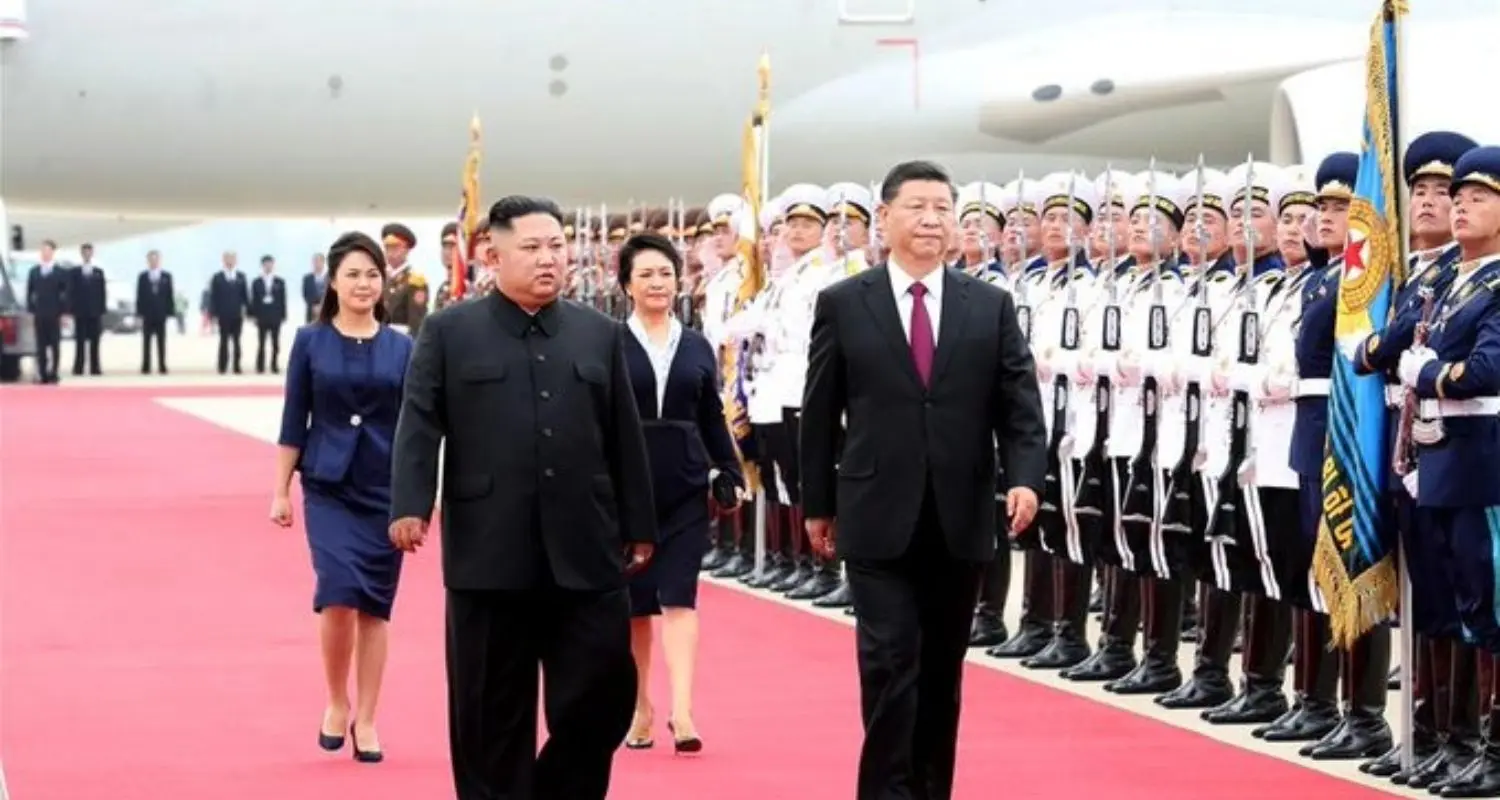
The Xi Jinping North Korea visit marks a significant diplomatic moment, as the Chinese president has landed in Pyongyang for his first trip to the country in seven years — arriving just days after North Korean leader Kim Jong Un reaffirmed his ambition for the “exponential” expansion of his nuclear arsenal.
A Highly Anticipated Meeting
Xi is expected to meet Kim on Tuesday. The summit comes at a delicate time, following years in which the North Korean leader has cultivated closer economic and military ties with Russia.
Many analysts believe China hopes to nudge North Korea toward dialogue with its neighbors — including on denuclearization — at a moment when Kim has grown increasingly bold about his nuclear ambitions.
Zhu Feng, an international relations expert at Nanjing University, summarized Beijing’s likely perspective: “From China’s perspective, [North Korea] should be engaging with neighbouring countries in talks on peace and denuclearisation.” He added that Pyongyang “should be seeking economic and social engagement with its neighbours to ensure it becomes less isolated and more oriented towards peace.”
The trip also follows a recent flurry of summits in Beijing, where Xi has hosted both U.S. President Donald Trump and Russia’s Vladimir Putin.
A History of Stalled Talks
The diplomatic backdrop is complex. During Trump’s first term, the U.S. and North Korea held successive rounds of denuclearization negotiations. Those talks ultimately collapsed at a high-profile summit between Trump and Kim — their third meeting — in Hanoi in 2019.
More recently, Kim has signaled openness to renewed talks with Washington, albeit with conditions. He has previously said he held “good personal memories” of Trump and that there was “no reason not to” talk, provided the U.S. “abandons its delusional obsession with denuclearisation.”
Shanghai-based scholar Shen Dingli interpreted Pyongyang’s posture this way: “North Korea wants to send a message to the US: ‘I am not your enemy.'”
Kim’s Hardening Nuclear Stance
Despite hints of diplomacy, Kim’s recent actions point toward an increasingly assertive nuclear posture. He last visited China in September, where he stood alongside Xi and Putin at Beijing’s lavish 80th anniversary celebrations marking the end of the Second World War.
In the lead-up to that visit, Kim inspected production lines and plans for North Korea’s Hwasong-20 intercontinental ballistic missile. Just last week, he toured a nuclear material facility and dismissed the very idea of denuclearization as “anachronistic.”
State media has amplified this message. The Korean Central News Agency quoted Kim describing an ambitious plan to strengthen the country’s nuclear forces “at an exponential rate.” His sister and key government spokesperson, Kim Yo Jong, reinforced the stance on Sunday, declaring that the country’s “status as a nuclear power is an absolute and inviolable boundary.”
Analysts caution, however, that Pyongyang charts its own course. As Ja Ian Chong of the National University of Singapore put it, “North Korea has its own mind. They don’t do things at anybody else’s bidding, including Beijing.”
The Russia Complication
A central theme running beneath the summit is North Korea’s deepening relationship with Russia. Pyongyang has skillfully played its giant neighbors against each other to its advantage, strengthening ties with Moscow and even sending troops to support Russia’s war against Ukraine.
This closer alignment with Russia has reportedly irritated China, which maintains a mutual defense treaty with Pyongyang and has historically served as its economic lifeline.
Experts see Xi’s visit as an effort to mend strained relations. “For Xi, going to Pyongyang and renewing ties with Kim helps to ensure that North Korea doesn’t get too close to Russia relative to China itself,” said Peter Ward of the Sejong Institute in Seoul. “He wants to keep North Korea close.”
China may also have economic incentives to offer. Park Won-gon, a professor at Ewha Womans University, noted that Beijing could provide benefits such as tourism — an area that has occupied a gray zone under UN sanctions on North Korea.
A Wider Regional Agenda
The leaders’ discussions may extend well beyond their bilateral relationship. Possible topics include:
- Taiwan: Beijing continues to view the island as part of Chinese territory and remains highly sensitive to any challenge to that position.
- Japan: China’s rhetoric toward Japanese Prime Minister Sanae Takaichi has sharpened considerably since she suggested last year that any conflict over Taiwan would be “existential” for her country — remarks that angered Beijing.
Lim Eul-chul, a professor at the Institute for Far Eastern Studies of Kyungnam University, suggested the agenda could be broad: “There is a possibility of close discussions regarding not only the US but also Japan’s military expansion.”
A Peninsula Increasingly Divided
Adding to the regional uncertainty, Pyongyang has dropped its longstanding commitment to future “reunification” with South Korea. Experts say this move effectively formalized the division of the Korean peninsula by defining the two sides as separate, adversarial states.
What to Watch
As Xi and Kim prepare to meet, the summit represents a balancing act on multiple fronts. For China, the goal appears to be reasserting its influence over a neighbor drifting toward Moscow, while encouraging a less confrontational North Korean posture. For Kim, the meeting offers leverage — a chance to extract economic and diplomatic benefits while holding firm on his nuclear ambitions. Whether Xi can pull Pyongyang back toward dialogue, or whether Kim continues to chart his own defiant path, will shape the security landscape of the region for years to come.
Author